QUESTION IMAGE
Question
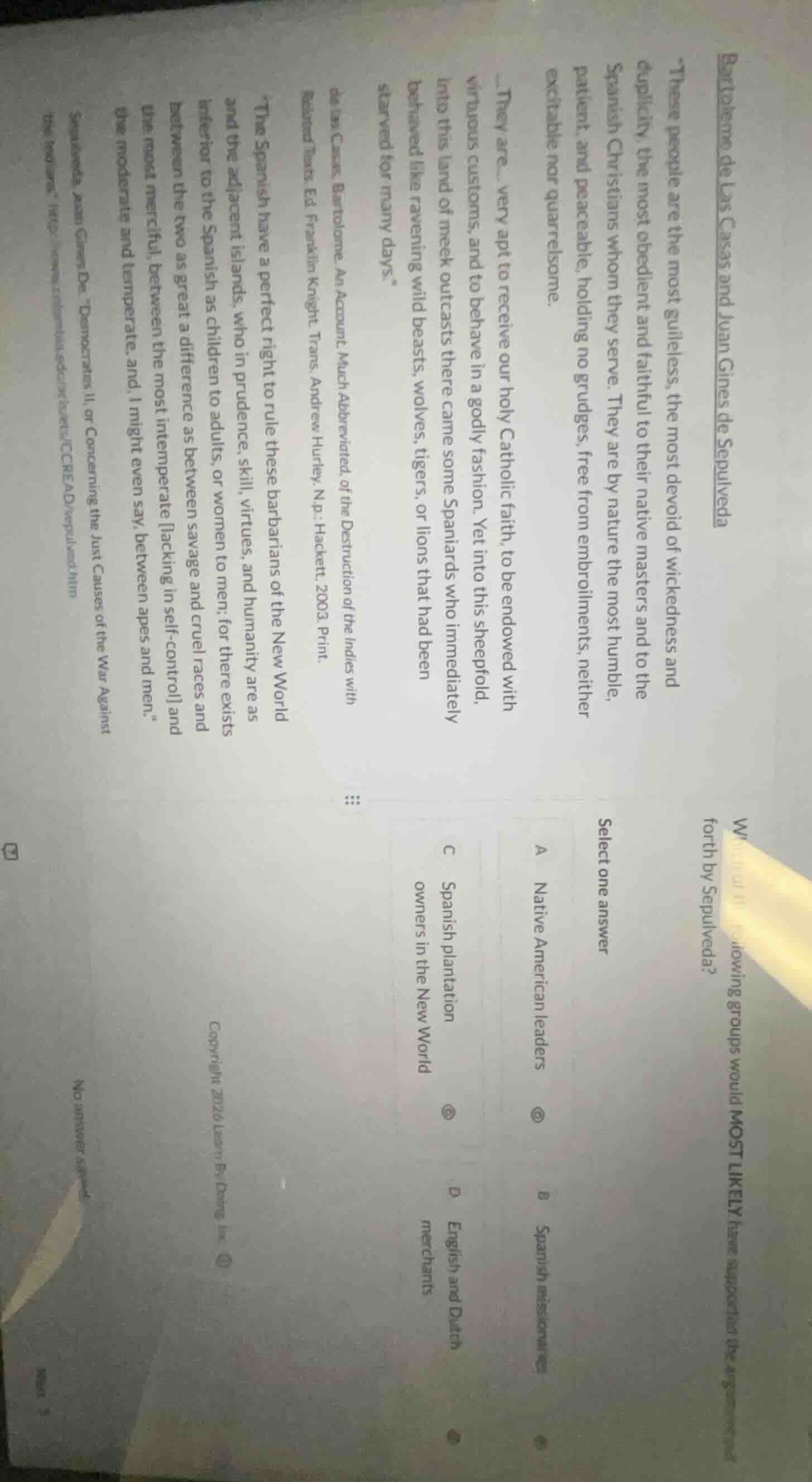
bartolomé de las casas and juan ginés de sepúlveda
these people are the most guileless, the most devoid of wickedness and duplicity, the most obedient and faithful to their native masters and to the spanish christians whom they serve. they are by nature the most humble, patient, and peaceable, holding no grudges, free from embroilments, neither excitable nor quarrelsome.
they are... very apt to receive our holy catholic faith, to be endowed with virtuous customs, and to behave in a godly fashion. yet into this land of meek outcasts there came some spaniards who immediately behaved like ravening wild beasts, wolves, tigers, or lions that had been starved for many days.
—bartolomé de las casas, an account, much abridged, of the destruction of the indies with related texts, ed. franklin knight, trans. andrew hurley, n.p.: hackett, 2003, print.
the spanish have a perfect right to rule these barbarians of the new world and the adjacent islands, who in prudence, skill, virtues, and humanity are as inferior to the spanish as children to adults, or women to men; for there exists between the two as great a difference as between savage and cruel races and the most merciful, between the most intemperate lacking in self - control and the moderate and temperate, and, i might even say, between apes and men.
—juan ginés de sepúlveda, “democrates i, or concerning the just causes of the war against the indians,” in...
which of the following groups would most likely have supported the argument put forth by sepúlveda?
select one answer
a native american leaders
b spanish missionaries
c spanish plantation owners in the new world
d english and dutch merchants
The text from Bartolomé de Las Casas describes the native people (likely Native Americans) as guileless, obedient, faithful, humble, patient, and peaceable, while the Spanish are portrayed negatively (behaving like wild beasts, starving for days). The question is about which group would most likely support the argument (from the text's tone, it's about the positive view of Native Americans). Option A is Native American leaders, which aligns with the positive depiction of the native people in the text. Spanish missionaries (B) might have mixed views, Spanish plantation owners (C) likely benefited from exploiting natives, and English/Dutch merchants (D) are not the focus here.

Snap & solve any problem in the app
Get step-by-step solutions on Sovi AI
Photo-based solutions with guided steps
Explore more problems and detailed explanations
A. Native American leaders