QUESTION IMAGE
Question
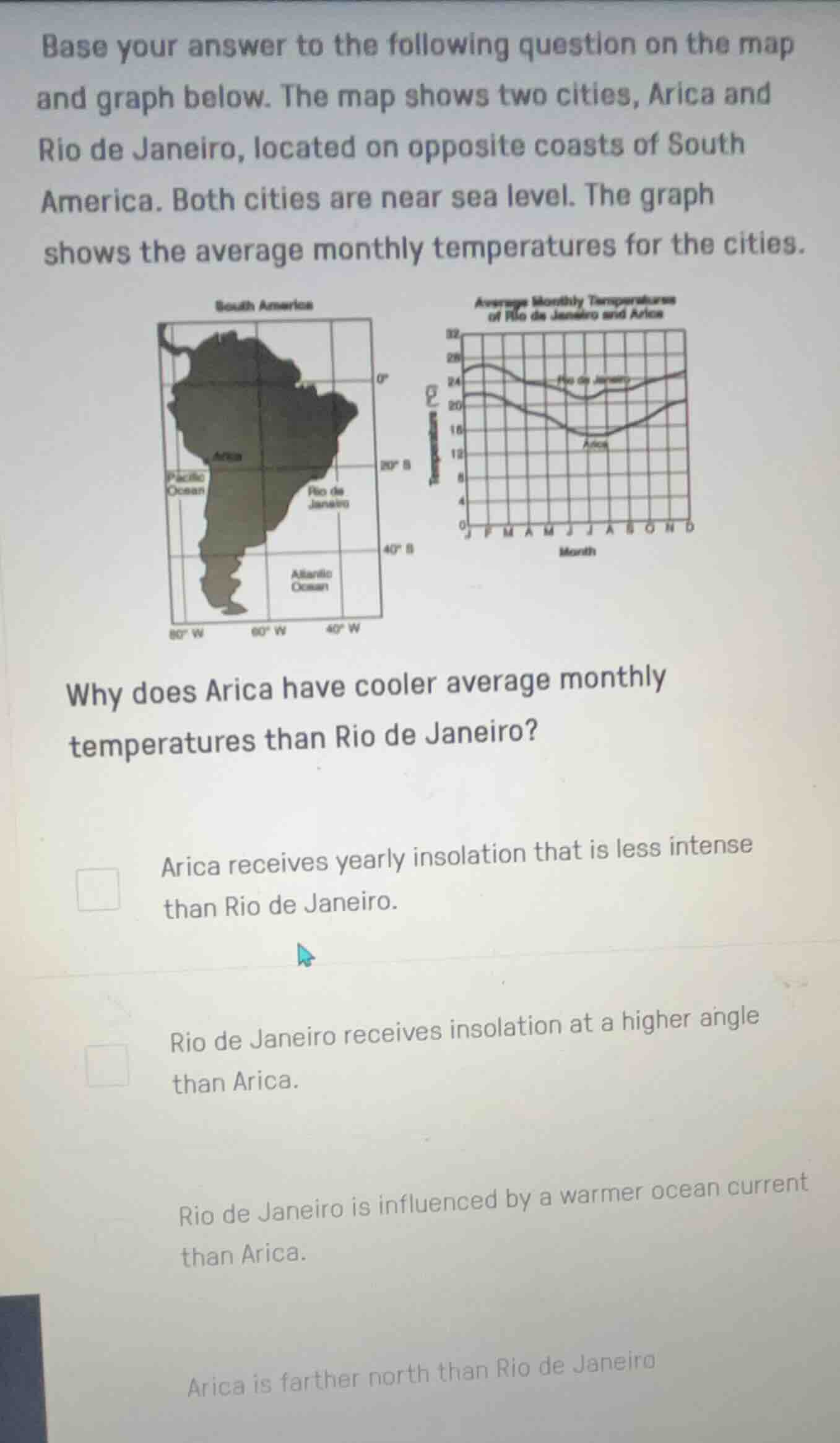
base your answer to the following question on the map and graph below. the map shows two cities, arica and rio de janeiro, located on opposite coasts of south america. both cities are near sea level. the graph shows the average monthly temperatures for the cities. map and graph are shown here why does arica have cooler average monthly temperatures than rio de janeiro? arica receives yearly insolation that is less intense than rio de janeiro. rio de janeiro receives insolation at a higher angle than arica. rio de janeiro is influenced by a warmer ocean current than arica. arica is farther north than rio de janeiro
- Analyze the first option: Insolation intensity depends on latitude. Arica and Rio de Janeiro's latitudes (Arica near 18°S, Rio near 23°S) – Arica is north of Rio, so insolation intensity: Arica’s insolation can be more intense (closer to equator - like 18°S vs 23°S), so this option is wrong.
- Analyze the second option: Insolation angle - higher latitude (Rio is at ~23°S, Arica ~18°S) means Rio is farther from equator, so insolation angle at Rio should be lower (since angle is more direct near equator). So Rio receiving insolation at higher angle is wrong.
- Analyze the third option: Ocean currents - Arica is on the Pacific, influenced by the Humboldt (cold) current. Rio is on the Atlantic, influenced by warm ocean currents (like Brazil Current). So Rio being influenced by a warmer ocean current than Arica explains Rio’s warmer temps (so Arica is cooler). This is correct.
- Analyze the fourth option: Arica is farther north (closer to equator) than Rio de Janeiro (Arica ~18°S, Rio ~23°S). Closer to equator would mean more intense insolation, but Arica is cooler, so this doesn't explain. So this option is wrong.

Snap & solve any problem in the app
Get step-by-step solutions on Sovi AI
Photo-based solutions with guided steps
Explore more problems and detailed explanations
The correct option is: Rio de Janeiro is influenced by a warmer ocean current than Arica.