QUESTION IMAGE
Question
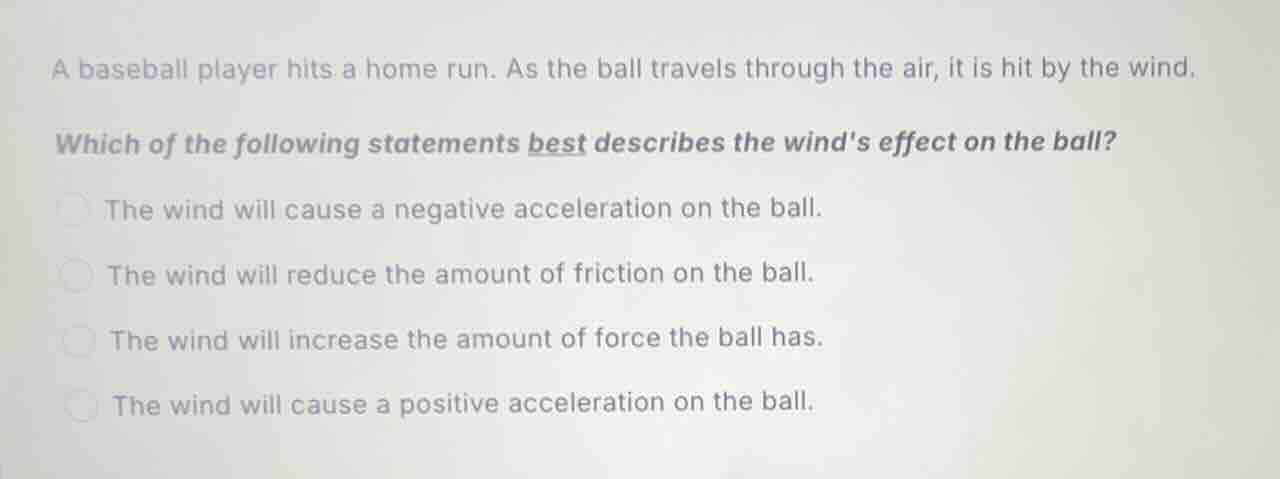
a baseball player hits a home run. as the ball travels through the air, it is hit by the wind. which of the following statements best describes the winds effect on the ball? the wind will cause a negative acceleration on the ball. the wind will reduce the amount of friction on the ball. the wind will increase the amount of force the ball has. the wind will cause a positive acceleration on the ball.
- Analyze Option 1: Negative acceleration implies a decrease in velocity. If the wind opposes the ball's motion (e.g., headwind), it slows the ball, causing negative acceleration. But we need to check other options too.
- Analyze Option 2: Wind is a fluid (air) movement. Friction on the ball (air resistance) depends on relative motion. Wind doesn't reduce friction; if wind is in the same direction as the ball, it might even change the relative speed, but generally, wind doesn't reduce friction. So this is incorrect.
- Analyze Option 3: Force is an external influence. The ball's own "force" (momentum/kinetic energy) is related to its mass and velocity. Wind can apply a force on the ball, but it doesn't "increase the amount of force the ball has" (the ball's internal force isn't increased; the wind applies an external force). This is a misinterpretation of force concepts. So incorrect.
- Analyze Option 4: Positive acceleration is an increase in velocity. If the wind is a tailwind (same direction as the ball), it can increase the ball's velocity, causing positive acceleration. But wait, the direction of the wind relative to the ball is not specified. However, let's re - evaluate Option 1. The term "negative acceleration" is about the direction of acceleration relative to velocity. If the wind is a headwind, it's negative acceleration; if tailwind, positive. But the question is about "best describes". Wait, no—wait, the key is: the wind can either help (tailwind, positive acceleration) or hinder (headwind, negative acceleration). But the options: let's think again. Wait, the first option says "negative acceleration"—but is that always true? No. The fourth option says "positive acceleration"—is that always true? No. Wait, maybe I made a mistake. Wait, no—wait, the wind exerts a force on the ball. The acceleration depends on the direction of the wind relative to the ball's motion. But let's check the options again.
Wait, the first option: "The wind will cause a negative acceleration on the ball." But if the wind is a tailwind (pushing the ball in the direction it's moving), acceleration is positive. The fourth option: "The wind will cause a positive acceleration on the ball." If it's a headwind, acceleration is negative. But the question is which "best describes"—but maybe the intended answer is that the wind can cause either, but wait, no—wait, maybe the options are misphrased? Wait, no, let's think about the physics.
Wait, the key is: the wind applies a force. The acceleration (a = F/m) direction depends on the force direction relative to velocity.
But let's re - examine the options:
- Option 1: "negative acceleration"—if the wind is opposite to the ball's motion (headwind), it slows down (negative acceleration). But if tailwind, positive. But maybe the question assumes a general case? No, that's not right.
Wait, maybe the error is in my initial analysis. Let's think about the other options:
Option 2: "reduce friction"—friction (air resistance) is due to the ball moving through air. Wind is air movement. The friction force is $F_f=\frac{1}{2}
ho v^2 C_d A$, where $v$ is the relative velocity between the ball and the air. If the wind is in the same direction as the ball, the relative velocity is $v_{ball}-v_{wind}$, so friction decreases? Wait, no—if the wind is moving with the ball (tailwind), the relative speed between the ball and the air is less, so air resistance (friction) is less. But the option says "reduce the amount of friction on the ball"—is that possible? But the question is about the wind's effect on the ball's mot…

Snap & solve any problem in the app
Get step-by-step solutions on Sovi AI
Photo-based solutions with guided steps
Explore more problems and detailed explanations
The wind will cause a positive acceleration on the ball.