QUESTION IMAGE
Question
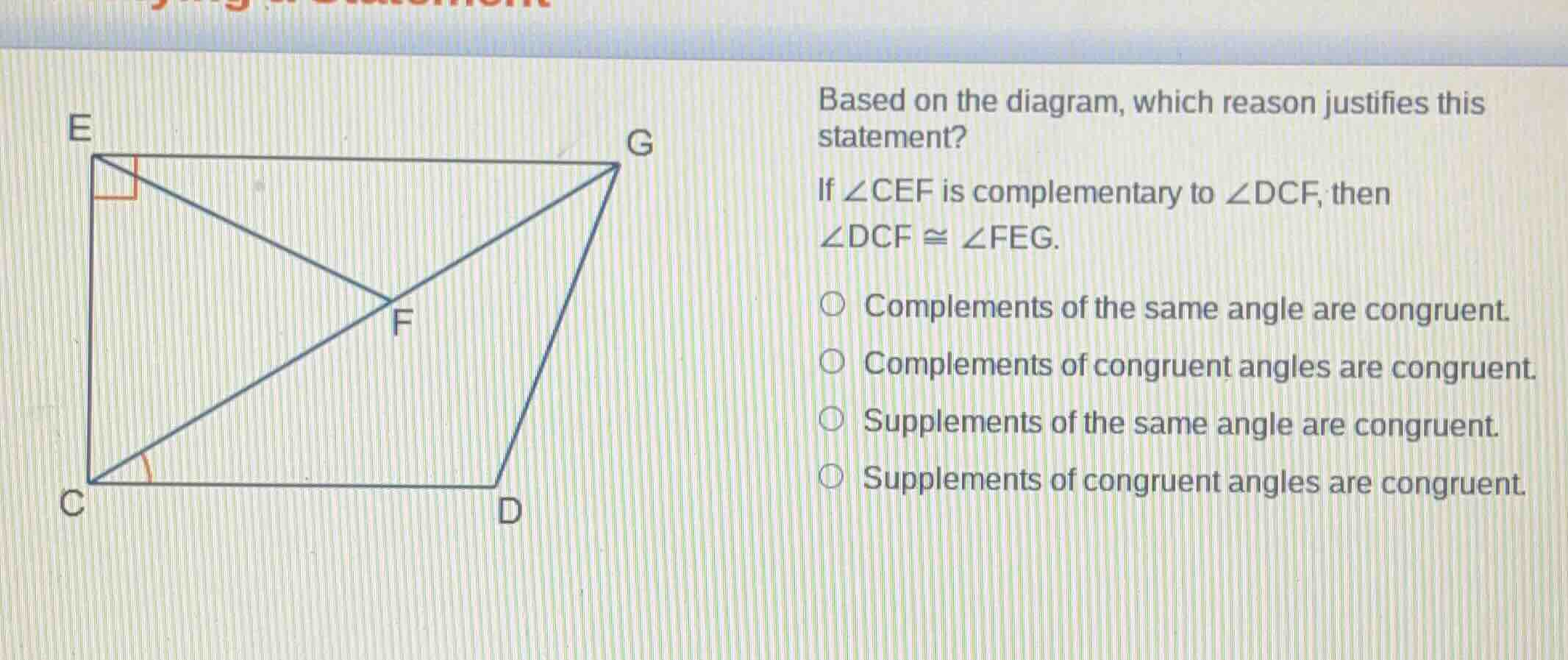
based on the diagram, which reason justifies this statement? if $\angle cef$ is complementary to $\angle dcf$, then $\angle dcf \cong \angle feg$. \bigcirc complements of the same angle are congruent. \bigcirc complements of congruent angles are congruent. \bigcirc supplements of the same angle are congruent. \bigcirc supplements of congruent angles are congruent.
Brief Explanations
- First, analyze the angle relationships: From the diagram, $\angle CEF$ and $\angle FEG$ are complementary (since $\angle CEG$ is a right angle, so $\angle CEF + \angle FEG = 90^\circ$).
- We are given that $\angle CEF$ is complementary to $\angle DCF$, meaning $\angle CEF + \angle DCF = 90^\circ$.
- Now, both $\angle DCF$ and $\angle FEG$ are complements of the same angle $\angle CEF$. The theorem "Complements of the same angle are congruent" states that if two angles are complements of the same angle, they are congruent. So this theorem justifies $\angle DCF \cong \angle FEG$.
- Eliminate other options: The question is about complementary angles (sum to $90^\circ$), so options about supplements (sum to $180^\circ$) are incorrect. Also, there's no mention of congruent angles being complemented, so the "complements of congruent angles" option is not applicable here.

Snap & solve any problem in the app
Get step-by-step solutions on Sovi AI
Photo-based solutions with guided steps
Explore more problems and detailed explanations
A. Complements of the same angle are congruent.