QUESTION IMAGE
Question
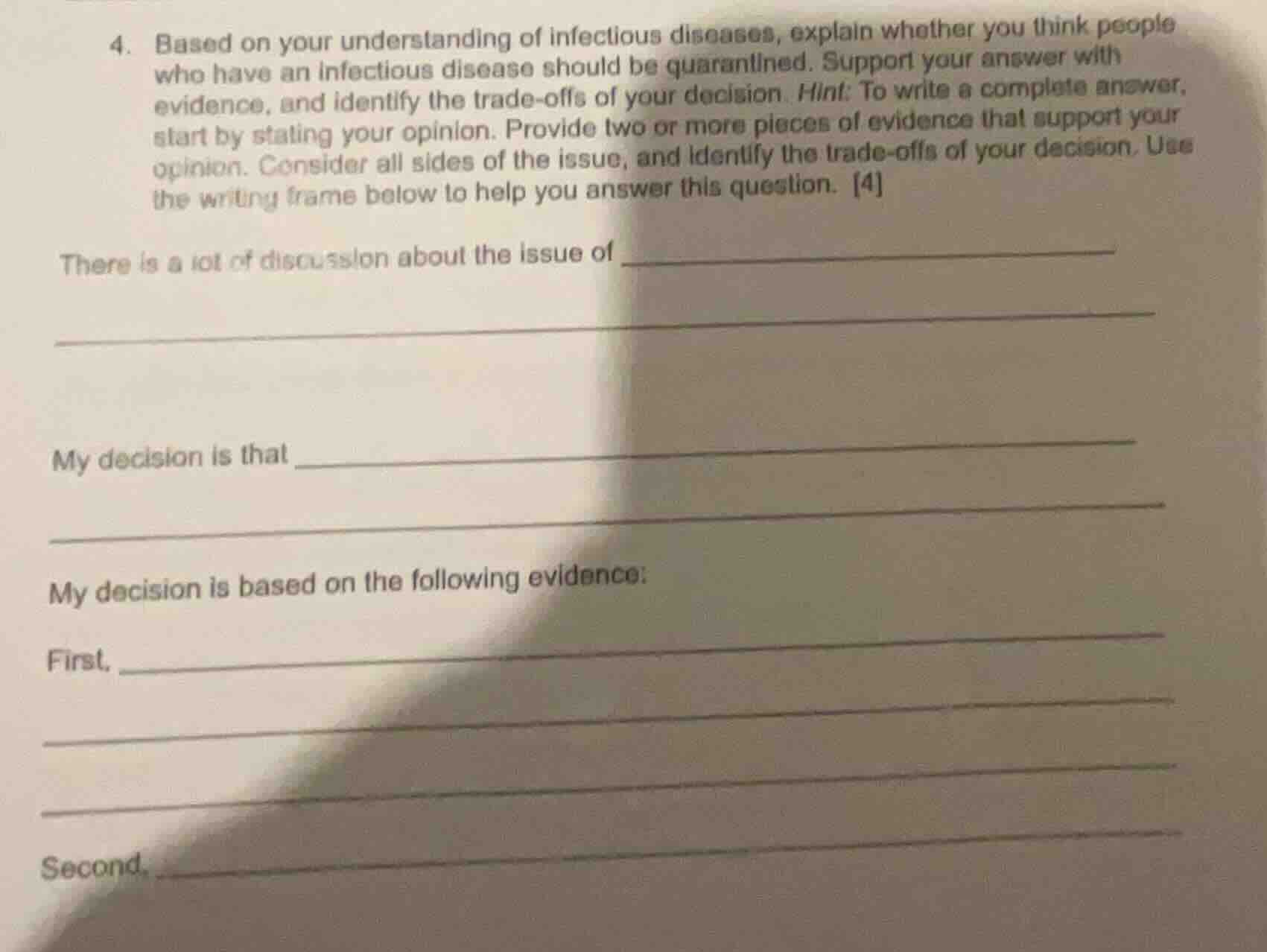
- based on your understanding of infectious diseases, explain whether you think people who have an infectious disease should be quarantined. support your answer with evidence, and identify the trade - offs of your decision. hint: to write a complete answer, start by stating your opinion. provide two or more pieces of evidence that support your opinion. consider all sides of the issue, and identify the trade - offs of your decision. use the writing frame below to help you answer this question. 4
there is a lot of discussion about the issue of
my decision is that
my decision is based on the following evidence:
first,
second,
To answer this, we analyze the issue of quarantining infectious disease patients. First, state the issue: whether infectious disease patients should be quarantined. Then, take a stance (e.g., they should be quarantined). Evidence 1: Quarantine reduces disease spread (e.g., COVID - 19 quarantines limited transmission). Evidence 2: It protects vulnerable populations (like the elderly or immunocompromised) from infection. Trade - offs: Patients may feel isolated, and there can be economic impacts on individuals (e.g., loss of income) and society (e.g., reduced workforce).

Snap & solve any problem in the app
Get step-by-step solutions on Sovi AI
Photo-based solutions with guided steps
Explore more problems and detailed explanations
There is a lot of discussion about the issue of whether people who have an infectious disease should be quarantined.
My decision is that people who have an infectious disease should be quarantined.
My decision is based on the following evidence:
First, quarantine is an effective way to limit the spread of the infectious disease. For example, during the COVID - 19 pandemic, quarantining infected individuals and their close contacts helped to slow down the rate of new infections in the community.
Second, quarantine protects vulnerable populations. People with weakened immune systems, the elderly, and young children are at a higher risk of developing severe symptoms or complications from infectious diseases. By quarantining infected individuals, we reduce the chances of these vulnerable groups being exposed to the disease.
The trade - offs of this decision are that quarantined individuals may experience feelings of isolation and loneliness. Also, there can be economic consequences, as quarantined people may not be able to work, leading to loss of income for themselves and potential disruptions to businesses and the overall economy.