QUESTION IMAGE
Question
m∠bec =
m∠abc = 62
Step1: Analyze triangle angle sum
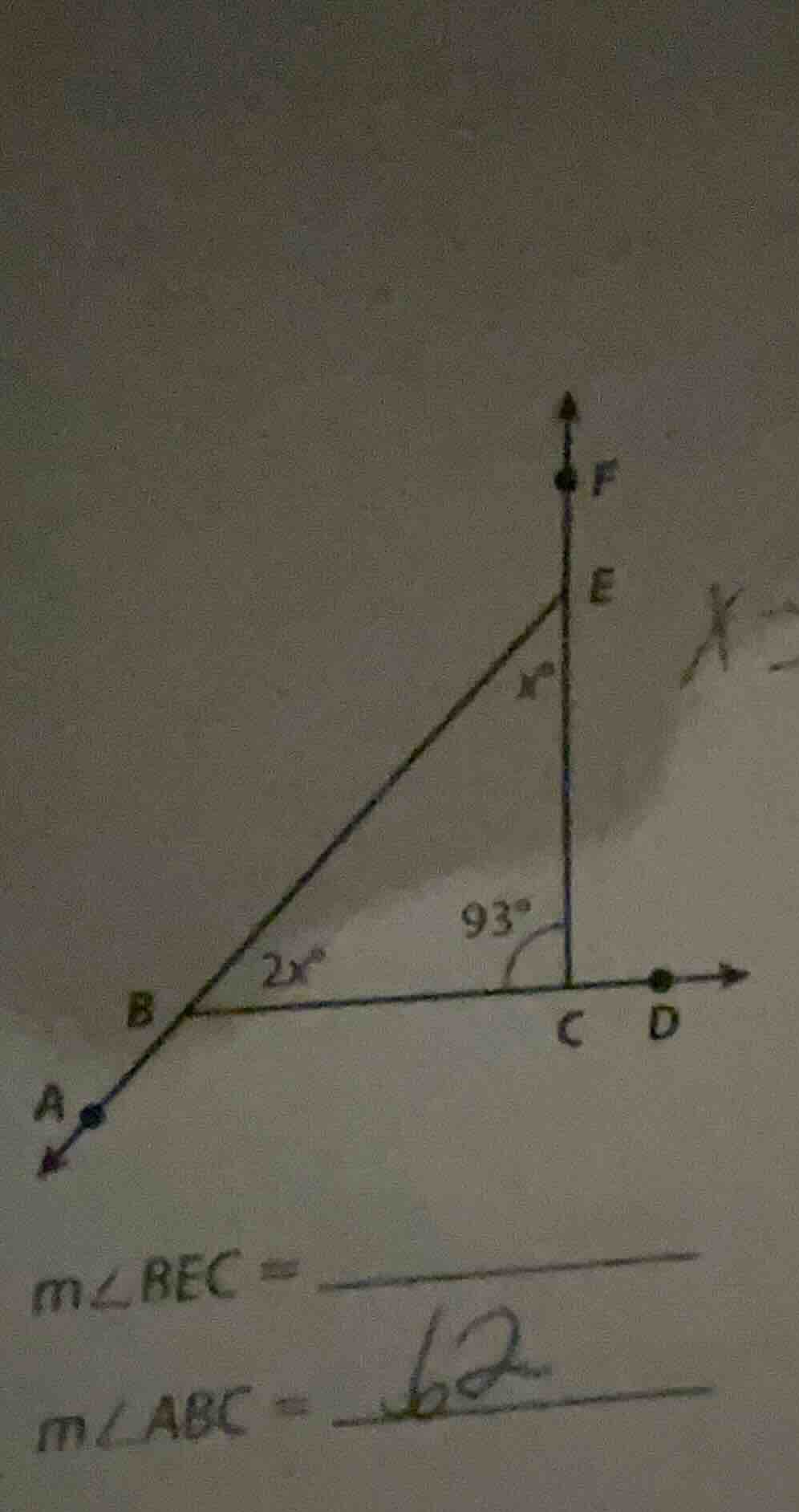
In triangle \(BCE\), the sum of angles is \(180^\circ\). We know one angle is \(93^\circ\), and the other two angles are \(x\) (at \(E\)) and \(2x\) (at \(B\)). Wait, actually, looking at the diagram, \(\angle ECD\) is a straight line? Wait, no, \(CD\) is horizontal, \(EC\) is vertical? Wait, maybe it's a triangle with angles: at \(C\), the angle adjacent to \(93^\circ\) is \(180 - 93 = 87^\circ\)? Wait, no, maybe I misread. Wait, the angle at \(C\) between \(BC\) and \(EC\) is \(93^\circ\)? Wait, no, the diagram shows \(BC\) horizontal, \(EC\) vertical? Wait, maybe it's a triangle where the angles are \(x\), \(2x\), and the angle at \(C\) is \(180 - 93 = 87^\circ\)? Wait, no, let's correct.
Wait, actually, the sum of angles in a triangle is \(180^\circ\). So in triangle \(BCE\), angles are \(2x\) (at \(B\)), \(x\) (at \(E\)), and the angle at \(C\) is \(180 - 93 = 87^\circ\)? Wait, no, the angle at \(C\) is given as \(93^\circ\)? Wait, the diagram has \(\angle BCD\) as a straight line? Wait, maybe \(CD\) is a straight line, so \(\angle ECD\) is \(90^\circ\)? No, the diagram shows \(\angle ECD\) as \(93^\circ\)? Wait, maybe the angle at \(C\) in triangle \(BCE\) is \(180 - 93 = 87^\circ\)? No, let's start over.
Wait, the problem is to find \(x\) such that in triangle \(BCE\), the sum of angles is \(180^\circ\). So angles are \(2x\) (at \(B\)), \(x\) (at \(E\)), and the angle at \(C\) is \(180 - 93 = 87^\circ\)? Wait, no, the angle at \(C\) is \(93^\circ\)? Wait, the diagram shows \(\angle ECD = 93^\circ\), so the angle at \(C\) in triangle \(BCE\) is \(180 - 93 = 87^\circ\)? No, that's not right. Wait, maybe \(EC\) is vertical, \(BC\) is horizontal, so \(\angle ECB\) is \(93^\circ\), and the other two angles are \(x\) and \(2x\). Then sum of angles in triangle: \(x + 2x + 93 = 180\).
Step2: Solve for \(x\)
So \(3x + 93 = 180\)
Subtract 93 from both sides: \(3x = 180 - 93 = 87\)
Then \(x = 87 / 3 = 29\)
Wait, but then \(m\angle BEC = x = 29^\circ\), and \(m\angle ABC = 2x = 58^\circ\)? Wait, no, maybe I made a mistake. Wait, the angle at \(C\) is \(180 - 93 = 87^\circ\)? No, the diagram shows \(\angle ECD = 93^\circ\), so \(\angle ECB = 180 - 93 = 87^\circ\). Then sum of angles in triangle: \(x + 2x + 87 = 180\)
So \(3x = 180 - 87 = 93\)
Then \(x = 93 / 3 = 31\). Wait, that makes more sense. Wait, let's check:
If \(x = 31\), then \(2x = 62\), and \(x + 2x + 87 = 31 + 62 + 87 = 180\). Yes, that works. Wait, so the angle at \(C\) is \(87^\circ\) (since \(\angle ECD = 93^\circ\), so \(\angle ECB = 180 - 93 = 87^\circ\)). Then sum of angles in triangle: \(x + 2x + 87 = 180\)
So \(3x = 93\), \(x = 31\). Then \(m\angle BEC = x = 31^\circ\), \(m\angle ABC = 2x = 62^\circ\).
Wait, the original diagram has some writing: \(m\angle BEC = \_\_\_\), \(m\angle ABC = 62\). So maybe \(x = 31\), \(2x = 62\).
So let's do the calculation:
Sum of angles in triangle: \(2x + x + (180 - 93) = 180\)
Simplify: \(3x + 87 = 180\)
Subtract 87: \(3x = 93\)
Divide by 3: \(x = 31\)
Then \(m\angle BEC = x = 31^\circ\), \(m\angle ABC = 2x = 62^\circ\).
Step1: Set up angle sum equation
In \(\triangle BCE\), sum of angles is \(180^\circ\). Angles: \(\angle EBC = 2x^\circ\), \(\angle BEC = x^\circ\), \(\angle ECB = 180^\circ - 93^\circ = 87^\circ\) (since \(\angle ECD = 93^\circ\) and \(BCD\) is a straight line).
So equation: \(2x + x + 87 = 180\)
Step2: Solve for \(x\)
Combine like terms: \(3x + 87 = 180\)
Subtract 87: \(3x = 180 - 87 = 93\)
Divide by 3: \(x = \frac{93}{3} = 31\)
Step3: Find \(m\an…

Snap & solve any problem in the app
Get step-by-step solutions on Sovi AI
Photo-based solutions with guided steps
Explore more problems and detailed explanations
\(m\angle BEC = 31^\circ\), \(m\angle ABC = 62^\circ\)