QUESTION IMAGE
Question
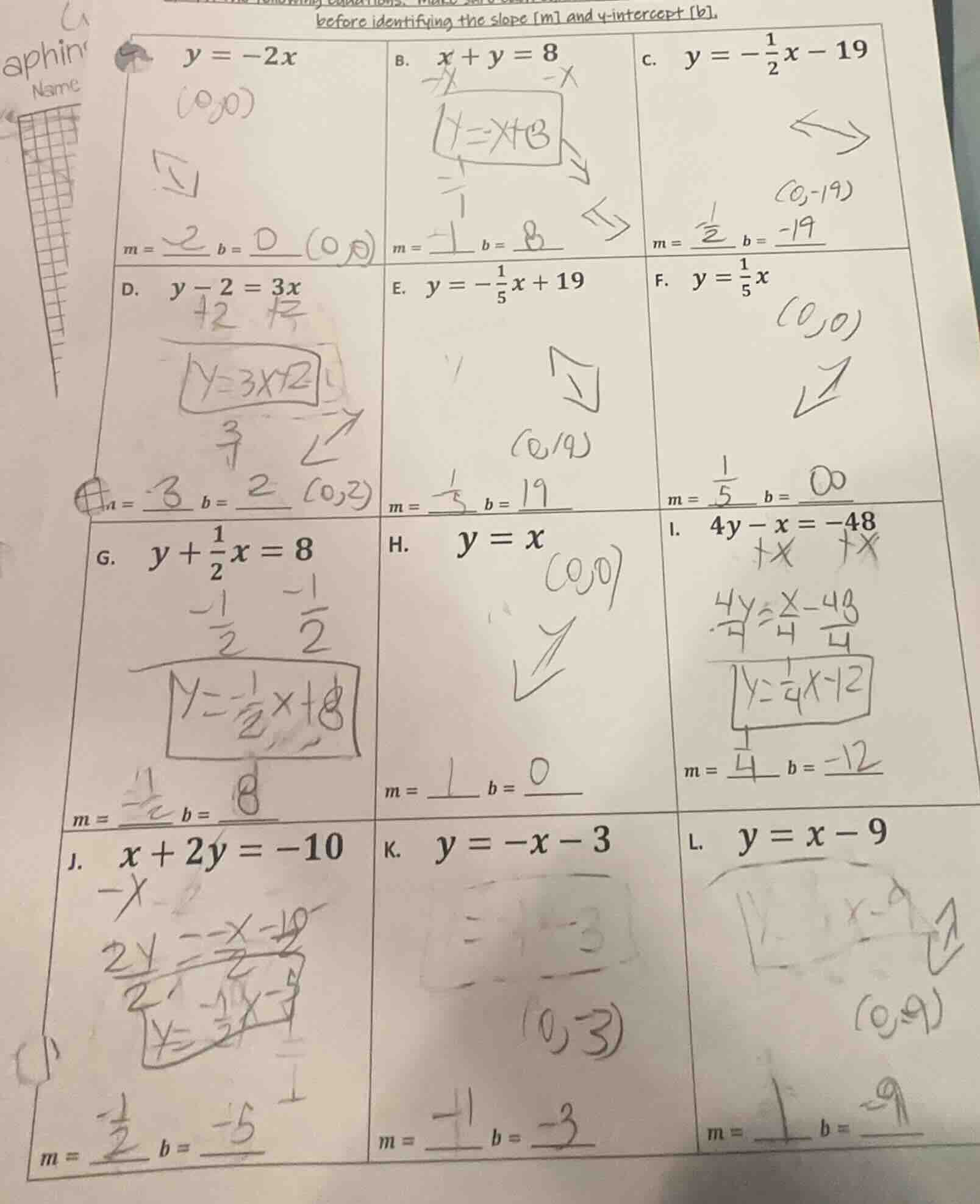
before identifying the slope m and y-intercept b.
a. $y = -2x$
$m = \underline{\quad}$ $b = \underline{\quad}$
b. $x + y = 8$
$m = \underline{\quad}$ $b = \underline{\quad}$
c. $y = -\frac{1}{2}x - 19$
$m = \underline{\quad}$ $b = \underline{\quad}$
d. $y - 2 = 3x$
$m = \underline{\quad}$ $b = \underline{\quad}$
e. $y = -\frac{1}{5}x + 19$
$m = \underline{\quad}$ $b = \underline{\quad}$
f. $y = \frac{1}{5}x$
$m = \underline{\quad}$ $b = \underline{\quad}$
g. $y + \frac{1}{2}x = 8$
$m = \underline{\quad}$ $b = \underline{\quad}$
h. $y = x$
$m = \underline{\quad}$ $b = \underline{\quad}$
i. $4y - x = -48$
$m = \underline{\quad}$ $b = \underline{\quad}$
j. $x + 2y = -10$
$m = \underline{\quad}$ $b = \underline{\quad}$
k. $y = -x - 3$
$m = \underline{\quad}$ $b = \underline{\quad}$
l. $y = x - 9$
$m = \underline{\quad}$ $b = \underline{\quad}$
To solve for the slope \( m \) and \( y \)-intercept \( b \) of each linear equation, we use the slope-intercept form \( y = mx + b \), where \( m \) is the slope and \( b \) is the \( y \)-intercept. We rewrite each equation in this form if necessary.
Part A: \( y = -2x \)
The equation is already in slope-intercept form.
- Step 1: Identify \( m \) and \( b \) from \( y = mx + b \).
Here, \( m = -2 \) (coefficient of \( x \)) and \( b = 0 \) (constant term, since there is no additional constant).
Part B: \( x + y = 8 \)
Rewrite in slope-intercept form:
- Step 1: Solve for \( y \): \( y = -x + 8 \).
- Step 2: Identify \( m \) and \( b \).
Here, \( m = -1 \) (coefficient of \( x \)) and \( b = 8 \) (constant term).
Part C: \( y = -\frac{1}{2}x - 19 \)
The equation is already in slope-intercept form.
- Step 1: Identify \( m \) and \( b \).
Here, \( m = -\frac{1}{2} \) (coefficient of \( x \)) and \( b = -19 \) (constant term).
Part D: \( y - 2 = 3x \)
Rewrite in slope-intercept form:
- Step 1: Solve for \( y \): \( y = 3x + 2 \).
- Step 2: Identify \( m \) and \( b \).
Here, \( m = 3 \) (coefficient of \( x \)) and \( b = 2 \) (constant term).
Part E: \( y = -\frac{1}{5}x + 19 \)
The equation is already in slope-intercept form.
- Step 1: Identify \( m \) and \( b \).
Here, \( m = -\frac{1}{5} \) (coefficient of \( x \)) and \( b = 19 \) (constant term).
Part F: \( y = \frac{1}{5}x \)
The equation is already in slope-intercept form.
- Step 1: Identify \( m \) and \( b \).
Here, \( m = \frac{1}{5} \) (coefficient of \( x \)) and \( b = 0 \) (constant term, since there is no additional constant).
Part G: \( y + \frac{1}{2}x = 8 \)
Rewrite in slope-intercept form:
- Step 1: Solve for \( y \): \( y = -\frac{1}{2}x + 8 \).
- Step 2: Identify \( m \) and \( b \).
Here, \( m = -\frac{1}{2} \) (coefficient of \( x \)) and \( b = 8 \) (constant term).
Part H: \( y = x \)
The equation is already in slope-intercept form (can be written as \( y = 1x + 0 \)).
- Step 1: Identify \( m \) and \( b \).
Here, \( m = 1 \) (coefficient of \( x \)) and \( b = 0 \) (constant term).
Part I: \( 4y - x = -48 \)
Rewrite in slope-intercept form:
- Step 1: Solve for \( y \):
\( 4y = x - 48 \)
\( y = \frac{1}{4}x - 12 \).
- Step 2: Identify \( m \) and \( b \).
Here, \( m = \frac{1}{4} \) (coefficient of \( x \)) and \( b = -12 \) (constant term).
Part J: \( x + 2y = -10 \)
Rewrite in slope-intercept form:
- Step 1: Solve for \( y \):
\( 2y = -x - 10 \)
\( y = -\frac{1}{2}x - 5 \).
- Step 2: Identify \( m \) and \( b \).
Here, \( m = -\frac{1}{2} \) (coefficient of \( x \)) and \( b = -5 \) (constant term).
Part K: \( y = -x - 3 \)
The equation is already in slope-intercept form.
- Step 1: Identify \( m \) and \( b \).
Here, \( m = -1 \) (coefficient of \( x \)) and \( b = -3 \) (constant term).
Part L: \( y = x - 9 \)
The equation is already in slope-intercept form (can be written as \( y = 1x - 9 \)).
- Step 1: Identify \( m \) and \( b \).
Here, \( m = 1 \) (coefficient of \( x \)) and \( b = -9 \) (constant term).
Final Answers (Summarized):
| Equation | \( m \) | \( b \) |
|---|---|---|
| \( x + y = 8 \) | \( -1 \) | \( 8 \) |
| \( y = -\frac{1}{2}x - 19 \) | \( -\frac{1}{2} \) | \( -19 \) |
| \( y - 2 = 3x \) | \( 3 \) | \( 2 \) |
| \( y = -\frac{1}{5}x + 19 \) | \( -\frac{1}{5} \) | \( 19 \) |
| \( y = \frac{1}{5}x \) | \( \frac{1}{5} \) | \( 0 \) |
| \( y + \fr…

Snap & solve any problem in the app
Get step-by-step solutions on Sovi AI
Photo-based solutions with guided steps
Explore more problems and detailed explanations
To solve for the slope \( m \) and \( y \)-intercept \( b \) of each linear equation, we use the slope-intercept form \( y = mx + b \), where \( m \) is the slope and \( b \) is the \( y \)-intercept. We rewrite each equation in this form if necessary.
Part A: \( y = -2x \)
The equation is already in slope-intercept form.
- Step 1: Identify \( m \) and \( b \) from \( y = mx + b \).
Here, \( m = -2 \) (coefficient of \( x \)) and \( b = 0 \) (constant term, since there is no additional constant).
Part B: \( x + y = 8 \)
Rewrite in slope-intercept form:
- Step 1: Solve for \( y \): \( y = -x + 8 \).
- Step 2: Identify \( m \) and \( b \).
Here, \( m = -1 \) (coefficient of \( x \)) and \( b = 8 \) (constant term).
Part C: \( y = -\frac{1}{2}x - 19 \)
The equation is already in slope-intercept form.
- Step 1: Identify \( m \) and \( b \).
Here, \( m = -\frac{1}{2} \) (coefficient of \( x \)) and \( b = -19 \) (constant term).
Part D: \( y - 2 = 3x \)
Rewrite in slope-intercept form:
- Step 1: Solve for \( y \): \( y = 3x + 2 \).
- Step 2: Identify \( m \) and \( b \).
Here, \( m = 3 \) (coefficient of \( x \)) and \( b = 2 \) (constant term).
Part E: \( y = -\frac{1}{5}x + 19 \)
The equation is already in slope-intercept form.
- Step 1: Identify \( m \) and \( b \).
Here, \( m = -\frac{1}{5} \) (coefficient of \( x \)) and \( b = 19 \) (constant term).
Part F: \( y = \frac{1}{5}x \)
The equation is already in slope-intercept form.
- Step 1: Identify \( m \) and \( b \).
Here, \( m = \frac{1}{5} \) (coefficient of \( x \)) and \( b = 0 \) (constant term, since there is no additional constant).
Part G: \( y + \frac{1}{2}x = 8 \)
Rewrite in slope-intercept form:
- Step 1: Solve for \( y \): \( y = -\frac{1}{2}x + 8 \).
- Step 2: Identify \( m \) and \( b \).
Here, \( m = -\frac{1}{2} \) (coefficient of \( x \)) and \( b = 8 \) (constant term).
Part H: \( y = x \)
The equation is already in slope-intercept form (can be written as \( y = 1x + 0 \)).
- Step 1: Identify \( m \) and \( b \).
Here, \( m = 1 \) (coefficient of \( x \)) and \( b = 0 \) (constant term).
Part I: \( 4y - x = -48 \)
Rewrite in slope-intercept form:
- Step 1: Solve for \( y \):
\( 4y = x - 48 \)
\( y = \frac{1}{4}x - 12 \).
- Step 2: Identify \( m \) and \( b \).
Here, \( m = \frac{1}{4} \) (coefficient of \( x \)) and \( b = -12 \) (constant term).
Part J: \( x + 2y = -10 \)
Rewrite in slope-intercept form:
- Step 1: Solve for \( y \):
\( 2y = -x - 10 \)
\( y = -\frac{1}{2}x - 5 \).
- Step 2: Identify \( m \) and \( b \).
Here, \( m = -\frac{1}{2} \) (coefficient of \( x \)) and \( b = -5 \) (constant term).
Part K: \( y = -x - 3 \)
The equation is already in slope-intercept form.
- Step 1: Identify \( m \) and \( b \).
Here, \( m = -1 \) (coefficient of \( x \)) and \( b = -3 \) (constant term).
Part L: \( y = x - 9 \)
The equation is already in slope-intercept form (can be written as \( y = 1x - 9 \)).
- Step 1: Identify \( m \) and \( b \).
Here, \( m = 1 \) (coefficient of \( x \)) and \( b = -9 \) (constant term).
Final Answers (Summarized):
| Equation | \( m \) | \( b \) |
|---|---|---|
| \( x + y = 8 \) | \( -1 \) | \( 8 \) |
| \( y = -\frac{1}{2}x - 19 \) | \( -\frac{1}{2} \) | \( -19 \) |
| \( y - 2 = 3x \) | \( 3 \) | \( 2 \) |
| \( y = -\frac{1}{5}x + 19 \) | \( -\frac{1}{5} \) | \( 19 \) |
| \( y = \frac{1}{5}x \) | \( \frac{1}{5} \) | \( 0 \) |
| \( y + \frac{1}{2}x = 8 \) | \( -\frac{1}{2} \) | \( 8 \) |
| \( y = x \) | \( 1 \) | \( 0 \) |
| \( 4y - x = -48 \) | \( \frac{1}{4} \) | \( -12 \) |
| \( x + 2y = -10 \) | \( -\frac{1}{2} \) | \( -5 \) |
| \( y = -x - 3 \) | \( -1 \) | \( -3 \) |
| \( y = x - 9 \) | \( 1 \) | \( -9 \) |
(If you need individual answers for each part, use the table or the step-by-step results above.)