QUESTION IMAGE
Question
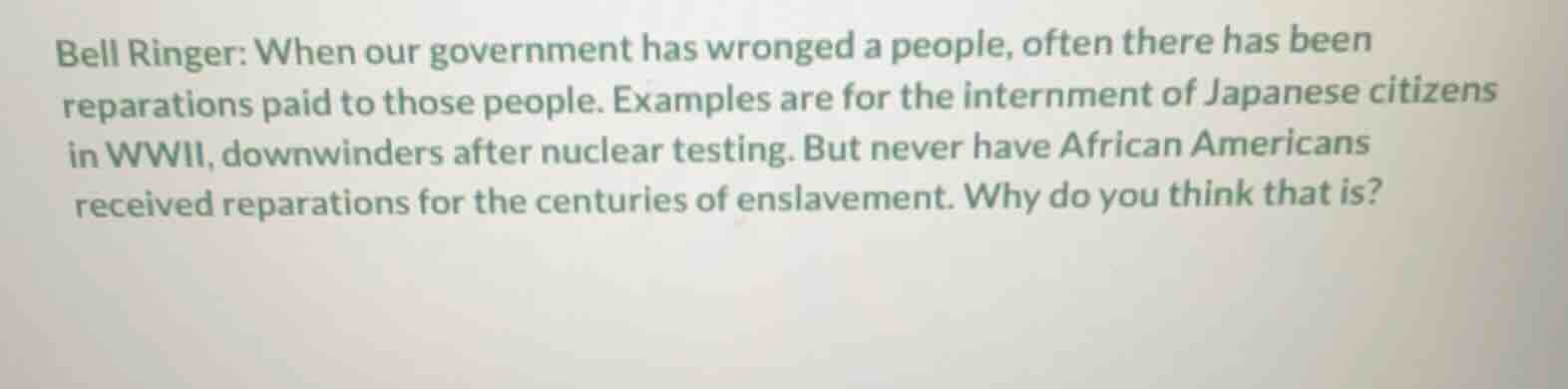
bell ringer: when our government has wronged a people, often there has been reparations paid to those people. examples are for the internment of japanese citizens in wwii, downwinders after nuclear testing. but never have african americans received reparations for the centuries of enslavement. why do you think that is?
There are several interconnected reasons, rooted in historical, political, and social factors:
- Legacy of systemic racism: Enslavement was legally sanctioned for centuries, and post-emancipation policies (like redlining, voter suppression) continued to disenfranchise African Americans, creating structural barriers to advocating for reparations.
- Diffuse responsibility and timeline: Unlike the WWII Japanese internment or nuclear testing downwinders (with clear, recent government actions and identifiable decision-makers), enslavement spanned centuries, involved multiple actors, and has been framed by some as a "historical relic" rather than a harm with ongoing intergenerational impacts.
- Political opposition: There has been sustained political pushback, often centered on claims of individual non-responsibility by current citizens, or debates over the logistics and scope of reparations, which has prevented meaningful legislative action.
- Lack of mainstream consensus: Public discourse has often minimized the long-term economic, social, and psychological harms of enslavement and its aftermath, reducing broad public support for reparations.

Snap & solve any problem in the app
Get step-by-step solutions on Sovi AI
Photo-based solutions with guided steps
Explore more problems and detailed explanations
African Americans have not received reparations for enslavement due to a combination of factors: the enduring legacy of systemic racism that has suppressed their advocacy, the diffuse, centuries-long timeline of enslavement that has been used to avoid clear governmental accountability, sustained political opposition to the concept of reparations, and a lack of widespread mainstream consensus on the ongoing intergenerational harms caused by enslavement and its post-emancipation aftermath.