QUESTION IMAGE
Question
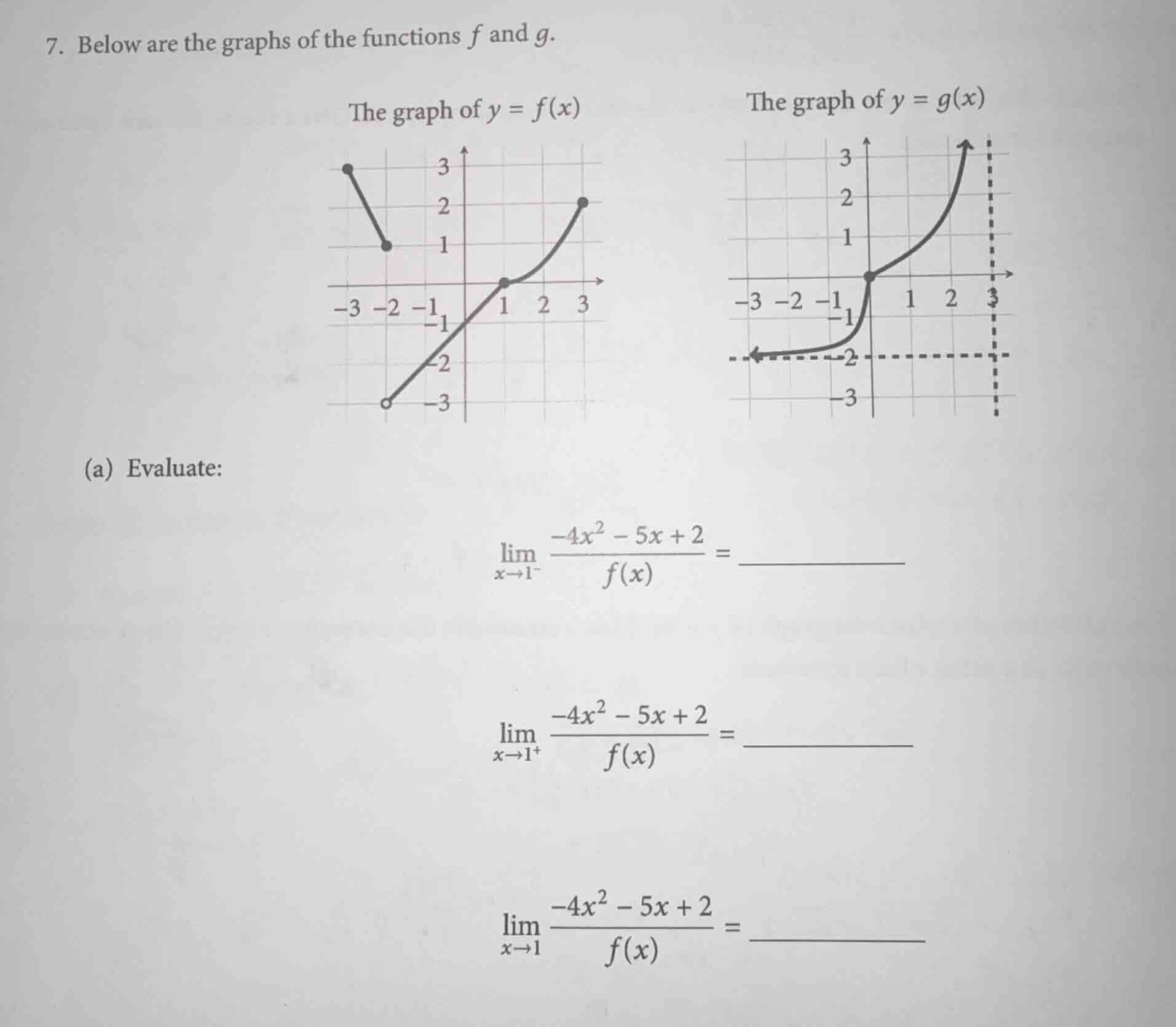
- below are the graphs of the functions f and g.
the graph of y = f(x) the graph of y = g(x)
(a) evaluate:
\\(\lim_{x \to 1^-} \frac{-4x^2 - 5x + 2}{f(x)} = \underline{\quad\quad}\\)
\\(\lim_{x \to 1^+} \frac{-4x^2 - 5x + 2}{f(x)} = \underline{\quad\quad}\\)
\\(\lim_{x \to 1} \frac{-4x^2 - 5x + 2}{f(x)} = \underline{\quad\quad}\\)
Step1: Evaluate numerator limit at $x\to1$
First, calculate $\lim_{x\to1} (-4x^2 -5x +2)$:
$$\lim_{x\to1} (-4x^2 -5x +2) = -4(1)^2 -5(1) +2 = -4-5+2 = -7$$
This limit is the same for $x\to1^-$ and $x\to1^+$.
Step2: Find $\lim_{x\to1^-} f(x)$
From the graph of $f(x)$, as $x$ approaches 1 from the left, $f(x)$ approaches 0, and $f(x)<0$ here:
$$\lim_{x\to1^-} f(x) = 0^-$$
Step3: Compute left-hand overall limit
$$\lim_{x\to1^-} \frac{-4x^2 -5x +2}{f(x)} = \frac{-7}{0^-} = +\infty$$
Step4: Find $\lim_{x\to1^+} f(x)$
From the graph of $f(x)$, as $x$ approaches 1 from the right, $f(x)$ approaches 0, and $f(x)>0$ here:
$$\lim_{x\to1^+} f(x) = 0^+$$
Step5: Compute right-hand overall limit
$$\lim_{x\to1^+} \frac{-4x^2 -5x +2}{f(x)} = \frac{-7}{0^+} = -\infty$$
Step6: Check overall limit at $x\to1$
Since $\lim_{x\to1^-} \frac{-4x^2 -5x +2}{f(x)}
eq \lim_{x\to1^+} \frac{-4x^2 -5x +2}{f(x)}$, the two-sided limit does not exist.

Snap & solve any problem in the app
Get step-by-step solutions on Sovi AI
Photo-based solutions with guided steps
Explore more problems and detailed explanations
$\lim_{x\to1^-} \frac{-4x^2 -5x +2}{f(x)} = +\infty$
$\lim_{x\to1^+} \frac{-4x^2 -5x +2}{f(x)} = -\infty$
$\lim_{x\to1} \frac{-4x^2 -5x +2}{f(x)}$ does not exist