QUESTION IMAGE
Question
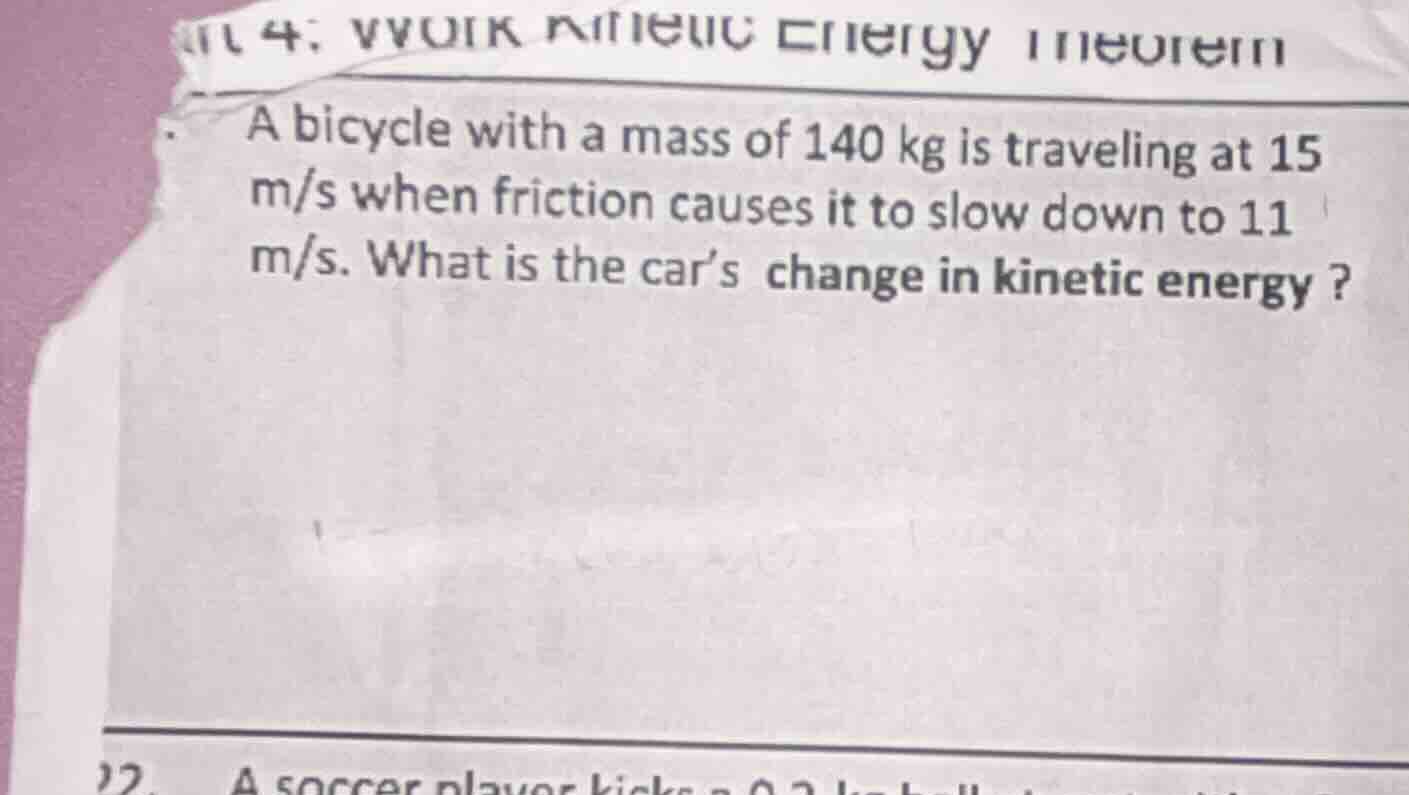
a bicycle with a mass of 140 kg is traveling at 15 m/s when friction causes it to slow down to 11 m/s. what is the car’s change in kinetic energy ?
Step1: Recall the kinetic energy formula
The formula for kinetic energy is $KE = \frac{1}{2}mv^2$, where $m$ is the mass and $v$ is the velocity. The change in kinetic energy $\Delta KE$ is the final kinetic energy $KE_f$ minus the initial kinetic energy $KE_i$, so $\Delta KE=KE_f - KE_i=\frac{1}{2}mv_f^2-\frac{1}{2}mv_i^2$.
Step2: Identify the given values
The mass $m = 140\space kg$, the initial velocity $v_i=15\space m/s$, and the final velocity $v_f = 11\space m/s$.
Step3: Calculate the initial kinetic energy
Substitute $m = 140$ and $v_i = 15$ into the kinetic energy formula:
$KE_i=\frac{1}{2}\times140\times(15)^2=\frac{1}{2}\times140\times225 = 70\times225=15750\space J$
Step4: Calculate the final kinetic energy
Substitute $m = 140$ and $v_f = 11$ into the kinetic energy formula:
$KE_f=\frac{1}{2}\times140\times(11)^2=\frac{1}{2}\times140\times121 = 70\times121 = 8470\space J$
Step5: Calculate the change in kinetic energy
$\Delta KE=KE_f - KE_i=8470 - 15750=- 7280\space J$ (The negative sign indicates a decrease in kinetic energy)

Snap & solve any problem in the app
Get step-by-step solutions on Sovi AI
Photo-based solutions with guided steps
Explore more problems and detailed explanations
The change in kinetic energy is $- 7280\space J$ (or a decrease of $7280\space J$)