QUESTION IMAGE
Question
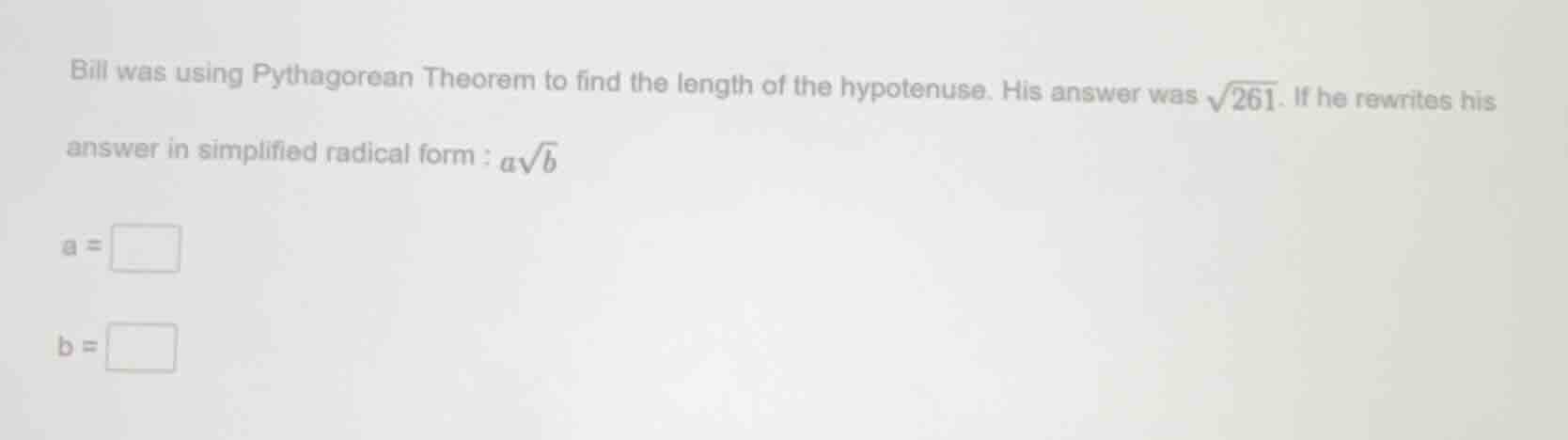
bill was using pythagorean theorem to find the length of the hypotenuse. his answer was \\(\sqrt{261}\\). if he rewrites his answer in simplified radical form : \\(a\sqrt{b}\\)\\(a = \square\\)\\(b = \square\\)
Step1: Factorize 261
First, we factorize 261. We find the largest perfect square factor of 261.
We know that \(261 = 9\times29\), where 9 is a perfect square (\(3^2 = 9\)) and 29 is a prime number.
Step2: Simplify the radical
Using the property of square roots \(\sqrt{xy}=\sqrt{x}\times\sqrt{y}\) (for \(x\geq0,y\geq0\)), we can rewrite \(\sqrt{261}\) as:
\(\sqrt{261}=\sqrt{9\times29}=\sqrt{9}\times\sqrt{29}\)
Since \(\sqrt{9} = 3\), we have \(\sqrt{261}=3\sqrt{29}\)
Comparing with the form \(a\sqrt{b}\), we get \(a = 3\) and \(b=29\)

Snap & solve any problem in the app
Get step-by-step solutions on Sovi AI
Photo-based solutions with guided steps
Explore more problems and detailed explanations
For \(a\): 3
For \(b\): 29