QUESTION IMAGE
Question
the black death
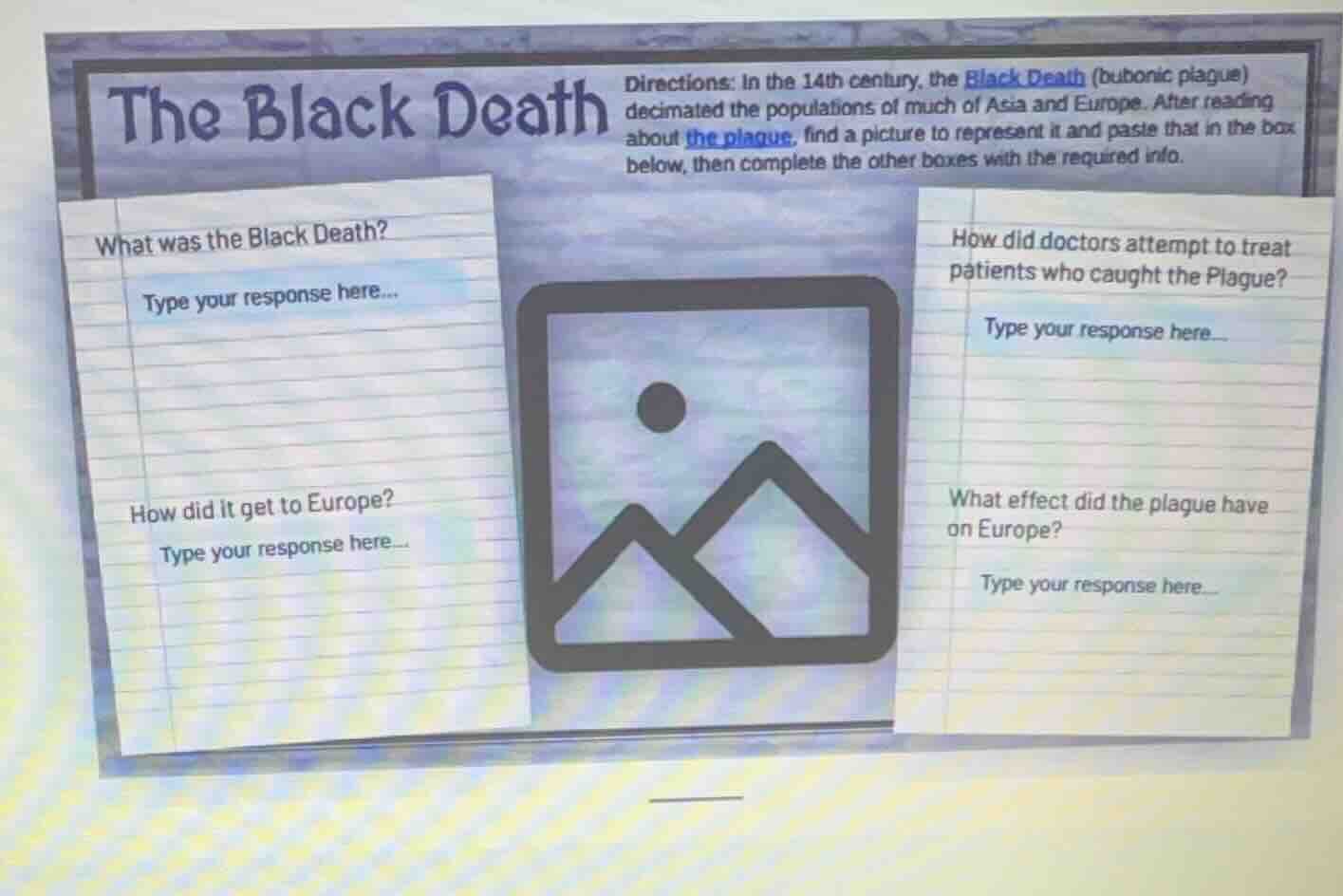
directions: in the 14th century, the black death (bubonic plague) decimated the populations of much of asia and europe. after reading about the plague, find a picture to represent it and paste that in the box below, then complete the other boxes with the required info.
what was the black death?
type your response here...
how did it get to europe?
type your response here...
how did doctors attempt to treat patients who caught the plague?
type your response here...
what effect did the plague have on europe?
type your response here...
- What was the Black Death?: It was a deadly bubonic plague pandemic caused by the bacterium Yersinia pestis, spread primarily by fleas on rodents. It caused painful swollen lymph nodes (buboes), fever, and high mortality.
- How did it get to Europe?: It spread from Central Asia via trade routes (like the Silk Road) to the Crimea, then reached Sicily in 1347 via infected Genoese merchant ships, and quickly spread across the continent.
- How did doctors attempt to treat patients who caught the Plague?: Treatments were unscientific, including bloodletting, applying herbal poultices to buboes, using aromatic substances (like flowers or incense) to "purify" air, and consuming potions of herbs or minerals. Some also used leeches or lanced buboes.
- What effect did the plague have on Europe?: It killed 30-60% of Europe's population, leading to labor shortages that increased peasant wages and weakened feudal systems. It also sparked religious fervor (including flagellants), economic disruption, and shifts in medical and cultural thought.
- Image note: A suitable image would be a depiction of 14th-century plague doctors (with their distinctive beaked masks), buboes on a patient, or a scene of medieval street burial/quarantine.

Snap & solve any problem in the app
Get step-by-step solutions on Sovi AI
Photo-based solutions with guided steps
Explore more problems and detailed explanations
- What was the Black Death?
The Black Death was a devastating 14th-century bubonic plague pandemic caused by Yersinia pestis, marked by swollen lymph nodes, fever, and extremely high mortality rates across Asia and Europe.
- How did it get to Europe?
It spread from Central Asia along trade routes, reached the Crimea by 1346, then arrived in Sicily in 1347 via infected Genoese merchant ships, and rapidly spread across European kingdoms.
- How did doctors attempt to treat patients who caught the Plague?
Doctors used unproven methods: bloodletting, lancing and draining buboes, herbal poultices, aromatic air "purification" (like incense), and mineral/herbal potions. Some wore beaked masks filled with herbs.
- What effect did the plague have on Europe?
It killed 30-60% of Europe's population, creating labor shortages that raised peasant wages, broke down feudal systems, triggered religious extremism (e.g., flagellants), disrupted economies, and shifted medical and cultural perspectives.
- Suggested image: A historical illustration of a 14th-century plague doctor in a beaked mask, or a depiction of medieval plague-related social disruption (e.g., mass burials).