QUESTION IMAGE
Question
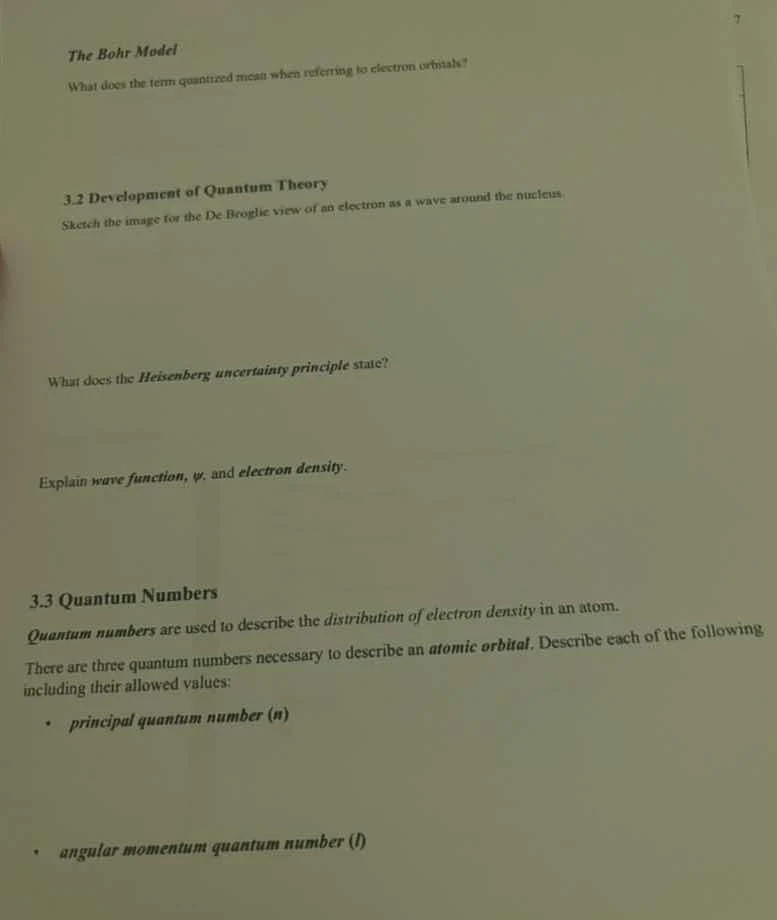
the bohr model
what does the term quantized mean when referring to electron orbitals?
3.2 development of quantum theory
sketch the image for the de broglie view of an electron as a wave around the nucleus.
what does the heisenberg uncertainty principle state?
explain wave function, $\psi$, and electron density.
3.3 quantum numbers
quantum numbers are used to describe the distribution of electron density in an atom.
there are three quantum numbers necessary to describe an atomic orbital. describe each of the following including their allowed values:
- principal quantum number ($n$)
- angular momentum quantum number ($l$)
Brief Explanations
- Quantized electron orbitals: Electrons can only occupy specific, discrete energy levels (orbitals) around the nucleus, not any arbitrary energy state.
- De Broglie electron wave sketch: A circular (or spherical, for 3D) standing wave centered on a small nucleus, where the wave's circumference equals a whole number multiple of the electron's wavelength.
- Heisenberg uncertainty principle: It is impossible to simultaneously measure the exact position and exact momentum (or velocity) of a subatomic particle like an electron with complete precision; the more accurately one is measured, the less accurate the measurement of the other becomes.
- Wave function ($\psi$) and electron density:
- $\psi$: A mathematical function that describes the quantum state of an electron, containing information about its wave-like behavior in an atom. It has no direct physical meaning on its own.
- Electron density: Equal to $|\psi|^2$, it represents the probability of finding an electron in a specific region of space around the nucleus.
- Principal quantum number ($n$):
- Describes the main energy level (shell) of an electron and the average distance of the electron from the nucleus.
- Allowed values: Positive integers ($n = 1, 2, 3, ...$)
- Angular momentum quantum number ($l$):
- Describes the shape of the atomic orbital (subshell) an electron occupies.
- Allowed values: Integers from $0$ to $n-1$ (where $n$ is the principal quantum number; e.g., if $n=2$, $l=0,1$)

Snap & solve any problem in the app
Get step-by-step solutions on Sovi AI
Photo-based solutions with guided steps
Explore more problems and detailed explanations
- For "quantized" electron orbitals: Electrons can only occupy discrete, specific energy levels (fixed orbitals) around the nucleus, not any intermediate energy state.
- For De Broglie view sketch: A standing wave (circular in 2D, spherical standing wave in 3D) wrapped around a central nucleus, where the wave's length fits perfectly (whole number of wavelengths) along the path around the nucleus.
- For Heisenberg uncertainty principle: It is impossible to precisely and simultaneously measure both the exact position and exact momentum (velocity) of a subatomic particle such as an electron; greater precision in one measurement leads to greater uncertainty in the other.
- For wave function and electron density:
- Wave function ($\psi$): A mathematical function describing an electron's quantum state, encoding its wave behavior in an atom (no direct physical interpretation).
- Electron density: Defined as $|\psi|^2$, it is the probability of locating an electron in a given region of space around an atomic nucleus.
- For principal quantum number ($n$):
- Defines the main electron energy shell and average distance from the nucleus.
- Allowed values: $n = 1, 2, 3, ...$ (positive integers)
- For angular momentum quantum number ($l$):
- Defines the shape of the atomic orbital (subshell).
- Allowed values: $l = 0, 1, 2, ..., n-1$ (integers from 0 to $n-1$, where $n$ is the principal quantum number)