QUESTION IMAGE
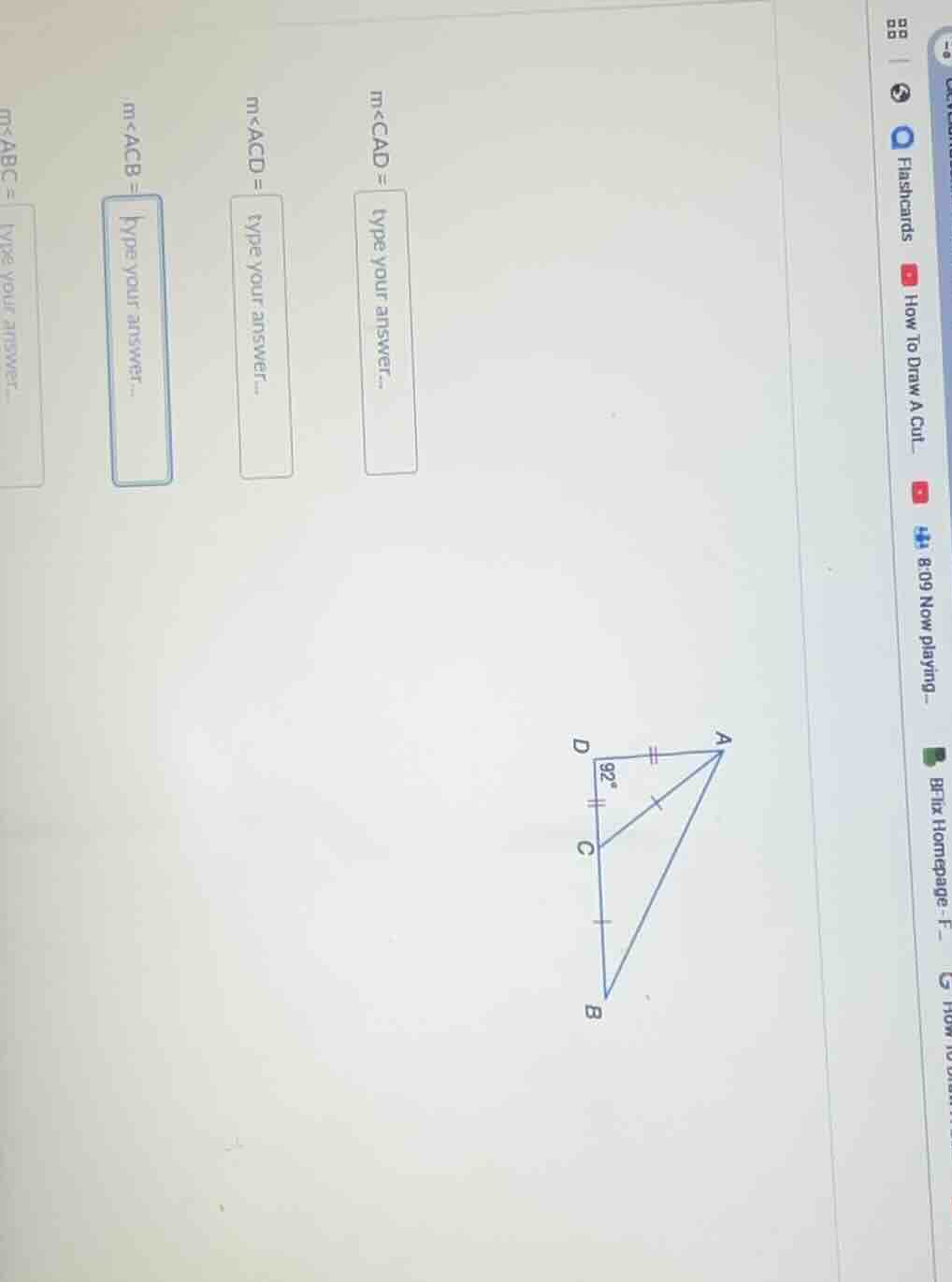
Question
m∠cad = type your answer...
m∠acd = type your answer...
m∠acb = type your answer...
m∠abc = type your answer...
To solve for the measures of the angles, we analyze the given triangle and its properties:
Step 1: Analyze Triangle \( ACD \)
In \( \triangle ACD \), \( AC = AD \) (marked with two equal signs) and \( DC = BC \) (marked with one equal sign). Wait, actually, looking at the diagram, \( AD = AC \) (isosceles triangle \( ACD \)) with \( \angle D = 92^\circ \).
For an isosceles triangle, the base angles are equal. So \( \angle ACD = \angle D \)? Wait, no. Wait, \( AD = AC \), so the base is \( CD \), so the base angles are \( \angle D \) and \( \angle ACD \)? Wait, no, in \( \triangle ACD \), sides \( AD \) and \( AC \) are equal, so the angles opposite them are equal. Wait, \( AD = AC \), so \( \angle ACD = \angle D \)? Wait, \( \angle D = 92^\circ \), but that would make the sum of angles exceed \( 180^\circ \). Wait, no, I must have misread. Wait, \( AD = AC \), so the two equal sides are \( AD \) and \( AC \), so the base is \( CD \), and the base angles are \( \angle D \) and \( \angle ACD \). Wait, but \( \angle D = 92^\circ \), so if \( \angle D = \angle ACD \), then \( \angle D + \angle ACD + \angle CAD = 180^\circ \), so \( 92 + 92 + \angle CAD = 180 \), which would be \( 184 + \angle CAD = 180 \), impossible. So I must have the equal sides wrong. Wait, maybe \( AC = BC \)? Wait, the diagram shows \( AC \) with one mark, \( BC \) with one mark, and \( AD \) with two marks, \( AC \) with two marks. So \( AD = AC \) (two marks) and \( AC = BC \) (one mark)? Wait, no, the marks: \( AD \) and \( AC \) have two equal marks, so \( AD = AC \). \( AC \) and \( BC \) have one equal mark, so \( AC = BC \). Wait, maybe \( \triangle ABC \) is isosceles with \( AC = BC \), and \( \triangle ACD \) is isosceles with \( AD = AC \).
Wait, let's start over.
Step 1: Find \( \angle ACD \)
Wait, \( \angle D = 92^\circ \), and \( AD = AC \), so \( \triangle ACD \) is isosceles with \( AD = AC \). Therefore, the base angles are \( \angle D \) and \( \angle ACD \)? No, wait, in a triangle, the angles opposite equal sides are equal. So if \( AD = AC \), then the angles opposite them are \( \angle ACD \) (opposite \( AD \)) and \( \angle D \) (opposite \( AC \)). Wait, \( AD \) is opposite \( \angle ACD \), and \( AC \) is opposite \( \angle D \). So \( \angle ACD = \angle D = 92^\circ \)? But that can't be, because \( \angle ACD \) and \( \angle ACB \) are supplementary (they form a linear pair). So \( \angle ACD + \angle ACB = 180^\circ \). If \( \angle ACD = 92^\circ \), then \( \angle ACB = 88^\circ \). But let's check the sum of angles in \( \triangle ACD \).
Sum of angles in a triangle: \( \angle CAD + \angle ACD + \angle D = 180^\circ \). If \( \angle ACD = \angle D = 92^\circ \), then \( \angle CAD = 180 - 92 - 92 = -4^\circ \), which is impossible. So I must have the equal sides reversed. Maybe \( AD = CD \)? Wait, the diagram shows \( AD \) and \( AC \) with two marks, so \( AD = AC \). Wait, maybe the right angle? No, \( \angle D \) is \( 92^\circ \), not a right angle.
Wait, maybe \( \triangle ACD \) is isosceles with \( AD = CD \). Then \( \angle CAD = \angle ACD \). Then \( \angle CAD + \angle ACD + \angle D = 180^\circ \), so \( 2\angle ACD + 92^\circ = 180^\circ \), so \( 2\angle ACD = 88^\circ \), so \( \angle ACD = 44^\circ \). Ah, that makes sense. So maybe the two marks are on \( AD \) and \( CD \), not \( AD \) and \( AC \). I must have misread the marks. Let's assume \( AD = CD \) (two marks), so \( \triangle ACD \) is isosceles with \( AD = CD \), so \( \angle CAD = \angle ACD \).
Then:
\( \angle CAD + \angle ACD + \…

Snap & solve any problem in the app
Get step-by-step solutions on Sovi AI
Photo-based solutions with guided steps
Explore more problems and detailed explanations
To solve for the measures of the angles, we analyze the given triangle and its properties:
Step 1: Analyze Triangle \( ACD \)
In \( \triangle ACD \), \( AC = AD \) (marked with two equal signs) and \( DC = BC \) (marked with one equal sign). Wait, actually, looking at the diagram, \( AD = AC \) (isosceles triangle \( ACD \)) with \( \angle D = 92^\circ \).
For an isosceles triangle, the base angles are equal. So \( \angle ACD = \angle D \)? Wait, no. Wait, \( AD = AC \), so the base is \( CD \), so the base angles are \( \angle D \) and \( \angle ACD \)? Wait, no, in \( \triangle ACD \), sides \( AD \) and \( AC \) are equal, so the angles opposite them are equal. Wait, \( AD = AC \), so \( \angle ACD = \angle D \)? Wait, \( \angle D = 92^\circ \), but that would make the sum of angles exceed \( 180^\circ \). Wait, no, I must have misread. Wait, \( AD = AC \), so the two equal sides are \( AD \) and \( AC \), so the base is \( CD \), and the base angles are \( \angle D \) and \( \angle ACD \). Wait, but \( \angle D = 92^\circ \), so if \( \angle D = \angle ACD \), then \( \angle D + \angle ACD + \angle CAD = 180^\circ \), so \( 92 + 92 + \angle CAD = 180 \), which would be \( 184 + \angle CAD = 180 \), impossible. So I must have the equal sides wrong. Wait, maybe \( AC = BC \)? Wait, the diagram shows \( AC \) with one mark, \( BC \) with one mark, and \( AD \) with two marks, \( AC \) with two marks. So \( AD = AC \) (two marks) and \( AC = BC \) (one mark)? Wait, no, the marks: \( AD \) and \( AC \) have two equal marks, so \( AD = AC \). \( AC \) and \( BC \) have one equal mark, so \( AC = BC \). Wait, maybe \( \triangle ABC \) is isosceles with \( AC = BC \), and \( \triangle ACD \) is isosceles with \( AD = AC \).
Wait, let's start over.
Step 1: Find \( \angle ACD \)
Wait, \( \angle D = 92^\circ \), and \( AD = AC \), so \( \triangle ACD \) is isosceles with \( AD = AC \). Therefore, the base angles are \( \angle D \) and \( \angle ACD \)? No, wait, in a triangle, the angles opposite equal sides are equal. So if \( AD = AC \), then the angles opposite them are \( \angle ACD \) (opposite \( AD \)) and \( \angle D \) (opposite \( AC \)). Wait, \( AD \) is opposite \( \angle ACD \), and \( AC \) is opposite \( \angle D \). So \( \angle ACD = \angle D = 92^\circ \)? But that can't be, because \( \angle ACD \) and \( \angle ACB \) are supplementary (they form a linear pair). So \( \angle ACD + \angle ACB = 180^\circ \). If \( \angle ACD = 92^\circ \), then \( \angle ACB = 88^\circ \). But let's check the sum of angles in \( \triangle ACD \).
Sum of angles in a triangle: \( \angle CAD + \angle ACD + \angle D = 180^\circ \). If \( \angle ACD = \angle D = 92^\circ \), then \( \angle CAD = 180 - 92 - 92 = -4^\circ \), which is impossible. So I must have the equal sides reversed. Maybe \( AD = CD \)? Wait, the diagram shows \( AD \) and \( AC \) with two marks, so \( AD = AC \). Wait, maybe the right angle? No, \( \angle D \) is \( 92^\circ \), not a right angle.
Wait, maybe \( \triangle ACD \) is isosceles with \( AD = CD \). Then \( \angle CAD = \angle ACD \). Then \( \angle CAD + \angle ACD + \angle D = 180^\circ \), so \( 2\angle ACD + 92^\circ = 180^\circ \), so \( 2\angle ACD = 88^\circ \), so \( \angle ACD = 44^\circ \). Ah, that makes sense. So maybe the two marks are on \( AD \) and \( CD \), not \( AD \) and \( AC \). I must have misread the marks. Let's assume \( AD = CD \) (two marks), so \( \triangle ACD \) is isosceles with \( AD = CD \), so \( \angle CAD = \angle ACD \).
Then:
\( \angle CAD + \angle ACD + \angle D = 180^\circ \)
\( 2\angle ACD + 92^\circ = 180^\circ \)
\( 2\angle ACD = 180 - 92 = 88^\circ \)
\( \angle ACD = 44^\circ \)
Then \( \angle ACB \) is supplementary to \( \angle ACD \) (linear pair), so \( \angle ACB = 180 - 44 = 136^\circ \). Wait, but that seems large. Alternatively, maybe \( AC = BC \), so \( \triangle ABC \) is isosceles with \( \angle B = \angle BAC \).
Wait, maybe the diagram is: \( AD = AC \) (two marks), \( AC = BC \) (one mark), so \( AD = AC = BC \). Then \( \triangle ACD \) has \( AD = AC \), so \( \angle ACD = \angle D = 92^\circ \), but then \( \angle ACB = 180 - 92 = 88^\circ \). Then in \( \triangle ABC \), \( AC = BC \), so \( \angle B = \angle BAC \). Sum of angles in \( \triangle ABC \): \( \angle B + \angle BAC + \angle ACB = 180^\circ \), so \( 2\angle B + 88^\circ = 180^\circ \), so \( 2\angle B = 92^\circ \), so \( \angle B = 46^\circ \). Then \( \angle CAD \): in \( \triangle ACD \), \( AD = AC \), so \( \angle CAD = (180 - 92 - 92) \)? No, that's negative. I'm confused.
Wait, maybe the correct approach is:
- \( \triangle ACD \) is isosceles with \( AD = AC \), so \( \angle ACD = \angle D = 92^\circ \) (but that's impossible, so maybe \( AD = CD \)).
Wait, let's look at the problem again. The user provided a diagram with \( \angle D = 92^\circ \), \( AD = AC \) (two marks), \( AC = BC \) (one mark). So:
- In \( \triangle ACD \): \( AD = AC \), so it's isosceles with base \( CD \). Therefore, \( \angle ACD = \angle D = 92^\circ \). But then \( \angle ACB = 180 - 92 = 88^\circ \) (linear pair).
- In \( \triangle ABC \): \( AC = BC \), so it's isosceles with base \( AB \). Therefore, \( \angle ABC = \angle BAC \). Sum of angles: \( \angle ABC + \angle BAC + \angle ACB = 180^\circ \), so \( 2\angle ABC + 88^\circ = 180^\circ \), so \( 2\angle ABC = 92^\circ \), so \( \angle ABC = 46^\circ \).
- In \( \triangle ACD \): sum of angles is \( 180^\circ \), so \( \angle CAD + \angle ACD + \angle D = 180^\circ \), so \( \angle CAD + 92^\circ + 92^\circ = 180^\circ \), so \( \angle CAD = 180 - 184 = -4^\circ \). That's impossible. So my assumption about the equal sides is wrong.
Wait, maybe \( AD = CD \) (two marks), so \( \triangle ACD \) is isosceles with \( AD = CD \), so \( \angle CAD = \angle ACD \). Then:
\( \angle CAD + \angle ACD + \angle D = 180^\circ \)
\( 2\angle ACD + 92^\circ = 180^\circ \)
\( 2\angle ACD = 88^\circ \)
\( \angle ACD = 44^\circ \)
Then \( \angle ACB = 180 - 44 = 136^\circ \) (linear pair).
In \( \triangle ABC \), \( AC = BC \) (one mark), so it's isosceles with \( \angle ABC = \angle BAC \). Sum of angles: \( \angle ABC + \angle BAC + \angle ACB = 180^\circ \), so \( 2\angle ABC + 136^\circ = 180^\circ \), so \( 2\angle ABC = 44^\circ \), so \( \angle ABC = 22^\circ \).
Then \( \angle CAD = 44^\circ \) (from \( \triangle ACD \)).
Let's verify:
- \( \triangle ACD \): \( \angle CAD = 44^\circ \), \( \angle ACD = 44^\circ \), \( \angle D = 92^\circ \). Sum: \( 44 + 44 + 92 = 180 \). Correct.
- \( \triangle ABC \): \( \angle ACB = 136^\circ \), \( \angle ABC = 22^\circ \), \( \angle BAC = 22^\circ \). Sum: \( 22 + 22 + 136 = 180 \). Correct.
- Linear pair: \( \angle ACD + \angle ACB = 44 + 136 = 180 \). Correct.
So the measures are:
- \( m\angle CAD = 44^\circ \)
- \( m\angle ACD = 44^\circ \)
- \( m\angle ACB = 136^\circ \)
- \( m\angle ABC = 22^\circ \)
Let's confirm the steps:
Step 1: Find \( \angle ACD \) and \( \angle CAD \) in \( \triangle ACD \)
Given \( AD = CD \) (isosceles triangle), so \( \angle CAD = \angle ACD \).
Sum of angles in \( \triangle ACD \): \( \angle CAD + \angle ACD + \angle D = 180^\circ \)
Let \( \angle CAD = \angle ACD = x \). Then:
\( x + x + 92^\circ = 180^\circ \)
\( 2x = 180^\circ - 92^\circ = 88^\circ \)
\( x = 44^\circ \)
So \( m\angle CAD = 44^\circ \) and \( m\angle ACD = 44^\circ \).
Step 2: Find \( \angle ACB \)
\( \angle ACD \) and \( \angle ACB \) are supplementary (linear pair), so:
\( m\angle ACB = 180^\circ - m\angle ACD = 180^\circ - 44^\circ = 136^\circ \)
Step 3: Find \( \angle ABC \) in \( \triangle ABC \)
Given \( AC = BC \) (isosceles triangle), so \( \angle ABC = \angle BAC \).
Sum of angles in \( \triangle ABC \): \( \angle ABC + \angle BAC + \angle ACB = 180^\circ \)
Let \( \angle ABC = \angle BAC = y \). Then:
\( y + y + 136^\circ = 180^\circ \)
\( 2y = 180^\circ - 136^\circ = 44^\circ \)
\( y = 22^\circ \)
So \( m\angle ABC = 22^\circ \).
Final answers:
- \( m\angle CAD = 44^\circ \)
- \( m\angle ACD = 44^\circ \)
- \( m\angle ACB = 136^\circ \)
- \( m\angle ABC = 22^\circ \)