QUESTION IMAGE
Question
4.7 with calcchat® and calcview®
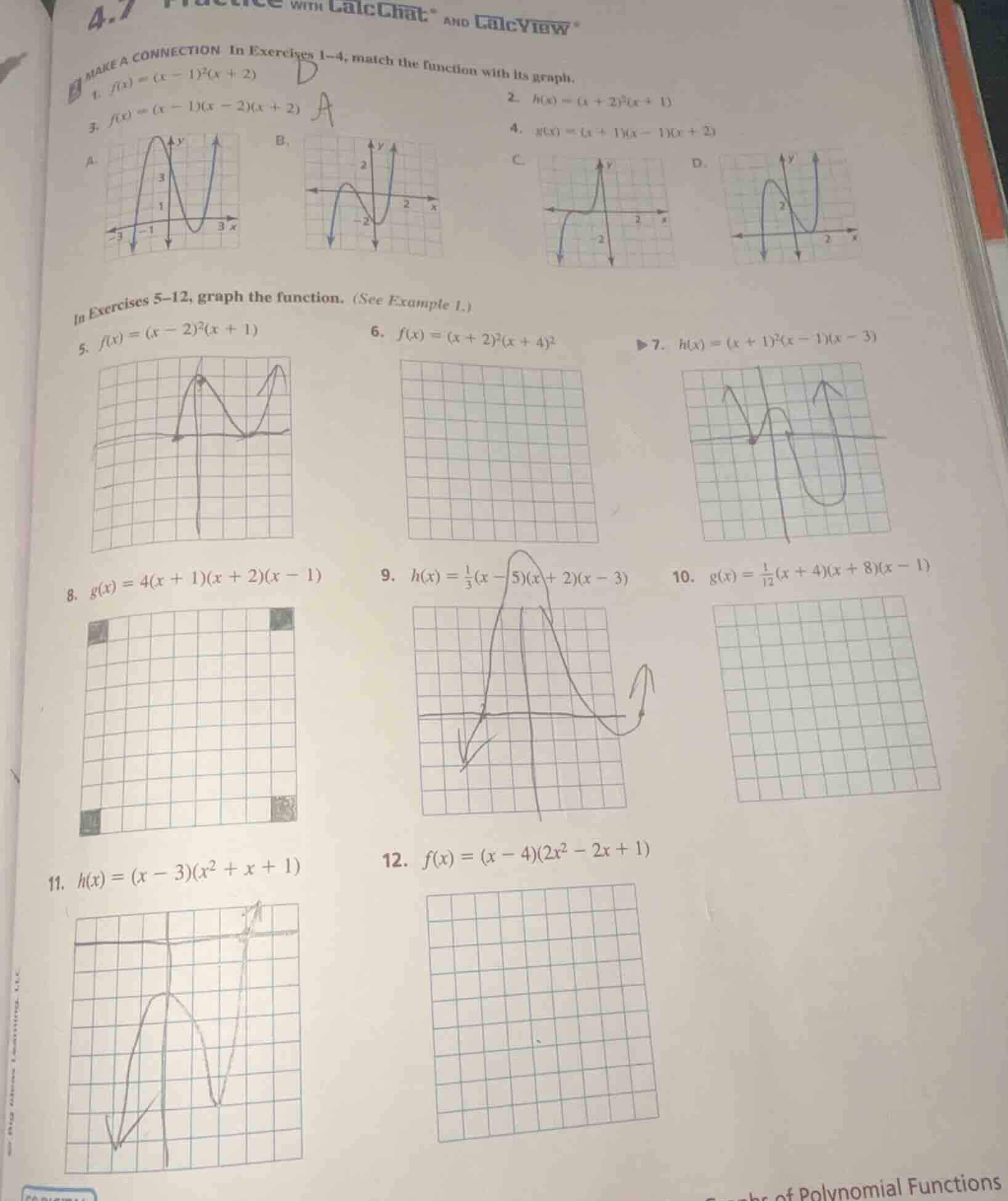
make a connection in exercises 1–4, match the function with its graph.
- ( j(x) = (x - 1)^2(x + 2) )
- ( h(x) = (x + 2)^2(x + 1) )
- ( f(x) = (x - 1)(x - 2)(x + 2) )
- ( g(x) = (x + 1)(x - 1)(x + 2) )
a. graph b. graph c. graph d. graph
in exercises 5–12, graph the function. (see example 1.)
- ( f(x) = (x - 2)^2(x + 1) )
- ( f(x) = (x + 2)^2(x + 4)^2 )
- ( h(x) = (x + 1)^2(x - 1)(x - 3) )
graphs for 5 - 7
- ( g(x) = 4(x + 1)(x + 2)(x - 1) )
- ( h(x) = \frac{1}{3}(x - 5)(x + 2)(x - 3) )
- ( g(x) = \frac{1}{12}(x + 4)(x + 8)(x - 1) )
graphs for 8 - 10
- ( h(x) = (x - 3)(x^2 + x + 1) )
- ( f(x) = (x - 4)(2x^2 - 2x + 1) )
graphs for 11 - 12
polynomial functions
Step1: Match Exercise 1: Find roots
Roots of $f(x)=(x-1)^2(x+2)$: $x=1$ (double root, graph touches x-axis), $x=-2$ (single root, graph crosses x-axis). Leading coefficient positive, degree 3: as $x\to+\infty$, $f(x)\to+\infty$; as $x\to-\infty$, $f(x)\to-\infty$. Matches Graph A.
Step2: Match Exercise 2: Find roots
Roots of $h(x)=(x+2)^2(x+1)$: $x=-2$ (double root, touches x-axis), $x=-1$ (single root, crosses x-axis). Leading coefficient positive, degree 3: as $x\to+\infty$, $h(x)\to+\infty$; as $x\to-\infty$, $h(x)\to-\infty$. Matches Graph B.
Step3: Match Exercise 3: Find roots
Roots of $f(x)=(x-1)(x-2)(x+2)$: $x=1,2,-2$ (all single roots, cross x-axis). Leading coefficient positive, degree 3: as $x\to+\infty$, $f(x)\to+\infty$; as $x\to-\infty$, $f(x)\to-\infty$. Matches Graph D.
Step4: Match Exercise 4: Find roots
Roots of $g(x)=(x+1)(x-1)(x+2)$: $x=-1,1,-2$ (all single roots, cross x-axis). Leading coefficient positive, degree 3: as $x\to+\infty$, $g(x)\to+\infty$; as $x\to-\infty$, $g(x)\to-\infty$. Matches Graph C.
Step5: Graph Exercise 5: Key features
Roots: $x=2$ (double root, touches x-axis), $x=-1$ (single root, crosses x-axis). y-intercept: $f(0)=(0-2)^2(0+1)=4$. Leading coefficient positive, degree 3: ends go $x\to+\infty, f(x)\to+\infty$; $x\to-\infty, f(x)\to-\infty$. Plot points: $(-1,0), (0,4), (2,0)$, sketch curve touching at $x=2$, crossing at $x=-1$.
Step6: Graph Exercise 6: Key features
Roots: $x=-2, -4$ (both double roots, touch x-axis). y-intercept: $f(0)=(0+2)^2(0+4)^2=64$. Leading coefficient positive, degree 4: as $x\to\pm\infty$, $f(x)\to+\infty$. Plot points: $(-4,0), (-2,0), (0,64)$, sketch curve touching x-axis at both roots, opening upwards.
Step7: Graph Exercise 7: Key features
Roots: $x=-1$ (double root, touches x-axis), $x=1,3$ (single roots, cross x-axis). y-intercept: $h(0)=(0+1)^2(0-1)(0-3)=3$. Leading coefficient positive, degree 4: as $x\to\pm\infty$, $h(x)\to+\infty$. Plot points: $(-1,0), (1,0), (3,0), (0,3)$, sketch curve touching at $x=-1$, crossing at $x=1,3$.
Step8: Graph Exercise 8: Key features
Roots: $x=-1,-2,1$ (all single roots, cross x-axis). y-intercept: $g(0)=4(0+1)(0+2)(0-1)=-8$. Leading coefficient positive, degree 3: as $x\to+\infty$, $g(x)\to+\infty$; as $x\to-\infty$, $g(x)\to-\infty$. Plot points: $(-2,0), (-1,0), (1,0), (0,-8)$, sketch curve crossing x-axis at all roots.
Step9: Graph Exercise 9: Key features
Roots: $x=5,-2,3$ (all single roots, cross x-axis). y-intercept: $h(0)=\frac{1}{3}(0-5)(0+2)(0-3)=10$. Leading coefficient positive, degree 3: as $x\to+\infty$, $h(x)\to+\infty$; as $x\to-\infty$, $h(x)\to-\infty$. Plot points: $(-2,0), (3,0), (5,0), (0,10)$, sketch curve crossing x-axis at all roots.
Step10: Graph Exercise 10: Key features
Roots: $x=-4,-8,1$ (all single roots, cross x-axis). y-intercept: $g(0)=\frac{1}{12}(0+4)(0+8)(0-1)=-\frac{8}{3}\approx-2.67$. Leading coefficient positive, degree 3: as $x\to+\infty$, $g(x)\to+\infty$; as $x\to-\infty$, $g(x)\to-\infty$. Plot points: $(-8,0), (-4,0), (1,0), (0,-\frac{8}{3})$, sketch curve crossing x-axis at all roots.
Step11: Graph Exercise 11: Key features
Roots: $x=3$ (single root, crosses x-axis); $x^2+x+1=0$ has no real roots. y-intercept: $h(0)=(0-3)(0+0+1)=-3$. Leading coefficient positive, degree 3: as $x\to+\infty$, $h(x)\to+\infty$; as $x\to-\infty$, $h(x)\to-\infty$. Plot points: $(3,0), (0,-3)$, sketch curve crossing at $x=3$, curving upwards for large $x$, downwards for small $x$.
Step12: Graph Exercise 12: Key features
Rewrite $2x^2-2x+1$: discriminant $(-…

Snap & solve any problem in the app
Get step-by-step solutions on Sovi AI
Photo-based solutions with guided steps
Explore more problems and detailed explanations
Matching Exercises 1-4:
- $f(x)=(x-1)^2(x+2)$: Graph A
- $h(x)=(x+2)^2(x+1)$: Graph B
- $f(x)=(x-1)(x-2)(x+2)$: Graph D
- $g(x)=(x+1)(x-1)(x+2)$: Graph C
Graphing Exercises 5-12 (Summary of Key Graph Features):
- $f(x)=(x-2)^2(x+1)$: Touches x-axis at $x=2$, crosses at $x=-1$, y-intercept $(0,4)$, ends up/down.
- $f(x)=(x+2)^2(x+4)^2$: Touches x-axis at $x=-2,-4$, y-intercept $(0,64)$, ends up/up.
- $h(x)=(x+1)^2(x-1)(x-3)$: Touches x-axis at $x=-1$, crosses at $x=1,3$, y-intercept $(0,3)$, ends up/up.
- $g(x)=4(x+1)(x+2)(x-1)$: Crosses x-axis at $x=-2,-1,1$, y-intercept $(0,-8)$, ends up/down.
- $h(x)=\frac{1}{3}(x-5)(x+2)(x-3)$: Crosses x-axis at $x=-2,3,5$, y-intercept $(0,10)$, ends up/down.
- $g(x)=\frac{1}{12}(x+4)(x+8)(x-1)$: Crosses x-axis at $x=-8,-4,1$, y-intercept $(0,-\frac{8}{3})$, ends up/down.
- $h(x)=(x-3)(x^2+x+1)$: Crosses x-axis at $x=3$, y-intercept $(0,-3)$, ends up/down, no other real roots.
- $f(x)=(x-4)(2x^2-2x+1)$: Crosses x-axis at $x=4$, y-intercept $(0,-4)$, ends up/down, no other real roots.