QUESTION IMAGE
Question
- calories burned
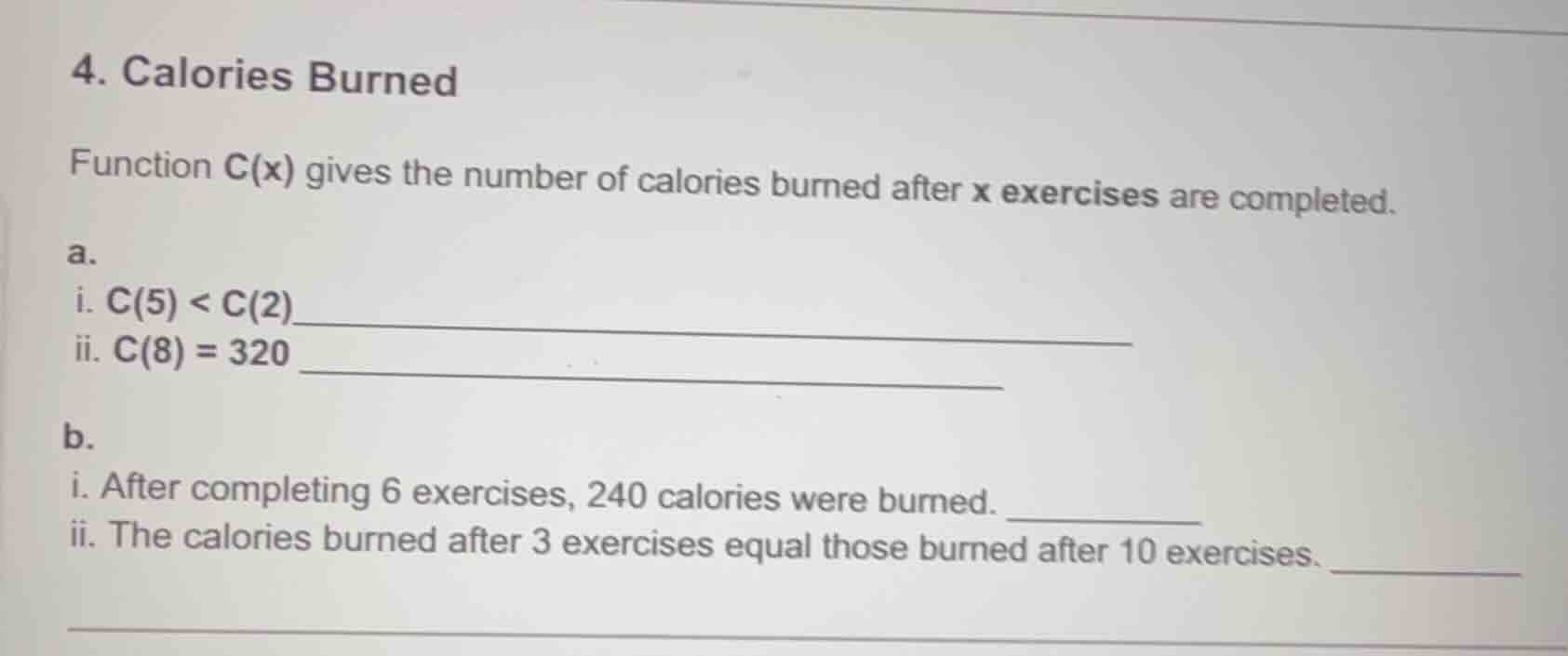
function c(x) gives the number of calories burned after x exercises are completed.
a.
i. c(5) < c(2)
ii. c(8) = 320
b.
i. after completing 6 exercises, 240 calories were burned.
ii. the calories burned after 3 exercises equal those burned after 10 exercises.
To solve this, we interpret the function \( C(x) \) which represents calories burned after \( x \) exercises. Let's analyze each part:
Part a
i. \( C(5) < C(2) \)
- Explanation: \( C(5) \) is calories burned after 5 exercises, \( C(2) \) after 2. This inequality means fewer calories are burned after 5 exercises than 2. In most exercise contexts, more exercises (higher \( x \)) should burn more calories (so \( C(x) \) is usually increasing). Thus, this is false (unlikely in real - world exercise calorie - burning, as more exercise generally burns more calories). But just interpreting the notation: \( C(5) \) (calories at \( x = 5 \)) is less than \( C(2) \) (calories at \( x = 2 \)).
ii. \( C(8)=320 \)
- Explanation: This means that when \( x = 8 \) (after 8 exercises), the number of calories burned is 320. It's a statement of the function's value at \( x = 8 \).
Part b
i. After completing 6 exercises, 240 calories were burned.
- Explanation: In function notation, when \( x = 6 \) (6 exercises), \( C(6) \) (calories burned) is 240. So this translates to \( C(6)=240 \).
ii. The calories burned after 3 exercises equal those burned after 10 exercises.
- Explanation: If calories at \( x = 3 \) (3 exercises) equal calories at \( x = 10 \) (10 exercises), in function notation, this is \( C(3)=C(10) \).
Final Answers (Interpretations)
a. i. \( C(5) \) (calories at 5 exercises) \( < C(2) \) (calories at 2 exercises) (unlikely in real - world, but as a function statement, it's an inequality of function values at \( x = 5 \) and \( x = 2 \))
a. ii. \( C(8) \) (calories at 8 exercises) \( = 320 \)
b. i. \( C(6)=240 \)
b. ii. \( C(3)=C(10) \)
If we were to answer in terms of truth (assuming \( C(x) \) is an increasing function, as more exercise should burn more calories):
a. i. False (because typically \( C(x) \) is increasing, so \( C(5)>C(2) \))
a. ii. Just a function value statement (could be true depending on the exercise type and intensity)
b. i. True (if the function is defined such that \( C(6) = 240 \))
b. ii. False (typically \( C(x) \) is increasing, so \( C(3)<C(10) \))
But if we are just interpreting the notation:
a. i. \( C(5) < C(2) \) (interpretation: Calories burned after 5 exercises are less than after 2 exercises)
a. ii. \( C(8) = 320 \) (interpretation: After 8 exercises, 320 calories are burned)
b. i. \( C(6)=240 \) (interpretation: The function value at \( x = 6 \) is 240)
b. ii. \( C(3)=C(10) \) (interpretation: Calories burned at \( x = 3 \) and \( x = 10 \) are equal)
If you want to know if these are "true" or "false" in a real - world exercise context (assuming \( C(x) \) is non - decreasing, which is reasonable for exercise):
a. i. False
a. ii. Could be True (depends on the exercise)
b. i. True (if the data supports it)
b. ii. False
Since the question doesn't specify if we need to evaluate truth or just interpret, here are the interpretations:
a. i. \( C(5) \) (calories at \( x = 5 \)) is less than \( C(2) \) (calories at \( x = 2 \))
a. ii. \( C(8) \) (calories at \( x = 8 \)) is 320
b. i. \( C(6)=240 \)
b. ii. \( C(3)=C(10) \)

Snap & solve any problem in the app
Get step-by-step solutions on Sovi AI
Photo-based solutions with guided steps
Explore more problems and detailed explanations
To solve this, we interpret the function \( C(x) \) which represents calories burned after \( x \) exercises. Let's analyze each part:
Part a
i. \( C(5) < C(2) \)
- Explanation: \( C(5) \) is calories burned after 5 exercises, \( C(2) \) after 2. This inequality means fewer calories are burned after 5 exercises than 2. In most exercise contexts, more exercises (higher \( x \)) should burn more calories (so \( C(x) \) is usually increasing). Thus, this is false (unlikely in real - world exercise calorie - burning, as more exercise generally burns more calories). But just interpreting the notation: \( C(5) \) (calories at \( x = 5 \)) is less than \( C(2) \) (calories at \( x = 2 \)).
ii. \( C(8)=320 \)
- Explanation: This means that when \( x = 8 \) (after 8 exercises), the number of calories burned is 320. It's a statement of the function's value at \( x = 8 \).
Part b
i. After completing 6 exercises, 240 calories were burned.
- Explanation: In function notation, when \( x = 6 \) (6 exercises), \( C(6) \) (calories burned) is 240. So this translates to \( C(6)=240 \).
ii. The calories burned after 3 exercises equal those burned after 10 exercises.
- Explanation: If calories at \( x = 3 \) (3 exercises) equal calories at \( x = 10 \) (10 exercises), in function notation, this is \( C(3)=C(10) \).
Final Answers (Interpretations)
a. i. \( C(5) \) (calories at 5 exercises) \( < C(2) \) (calories at 2 exercises) (unlikely in real - world, but as a function statement, it's an inequality of function values at \( x = 5 \) and \( x = 2 \))
a. ii. \( C(8) \) (calories at 8 exercises) \( = 320 \)
b. i. \( C(6)=240 \)
b. ii. \( C(3)=C(10) \)
If we were to answer in terms of truth (assuming \( C(x) \) is an increasing function, as more exercise should burn more calories):
a. i. False (because typically \( C(x) \) is increasing, so \( C(5)>C(2) \))
a. ii. Just a function value statement (could be true depending on the exercise type and intensity)
b. i. True (if the function is defined such that \( C(6) = 240 \))
b. ii. False (typically \( C(x) \) is increasing, so \( C(3)<C(10) \))
But if we are just interpreting the notation:
a. i. \( C(5) < C(2) \) (interpretation: Calories burned after 5 exercises are less than after 2 exercises)
a. ii. \( C(8) = 320 \) (interpretation: After 8 exercises, 320 calories are burned)
b. i. \( C(6)=240 \) (interpretation: The function value at \( x = 6 \) is 240)
b. ii. \( C(3)=C(10) \) (interpretation: Calories burned at \( x = 3 \) and \( x = 10 \) are equal)
If you want to know if these are "true" or "false" in a real - world exercise context (assuming \( C(x) \) is non - decreasing, which is reasonable for exercise):
a. i. False
a. ii. Could be True (depends on the exercise)
b. i. True (if the data supports it)
b. ii. False
Since the question doesn't specify if we need to evaluate truth or just interpret, here are the interpretations:
a. i. \( C(5) \) (calories at \( x = 5 \)) is less than \( C(2) \) (calories at \( x = 2 \))
a. ii. \( C(8) \) (calories at \( x = 8 \)) is 320
b. i. \( C(6)=240 \)
b. ii. \( C(3)=C(10) \)