QUESTION IMAGE
Question
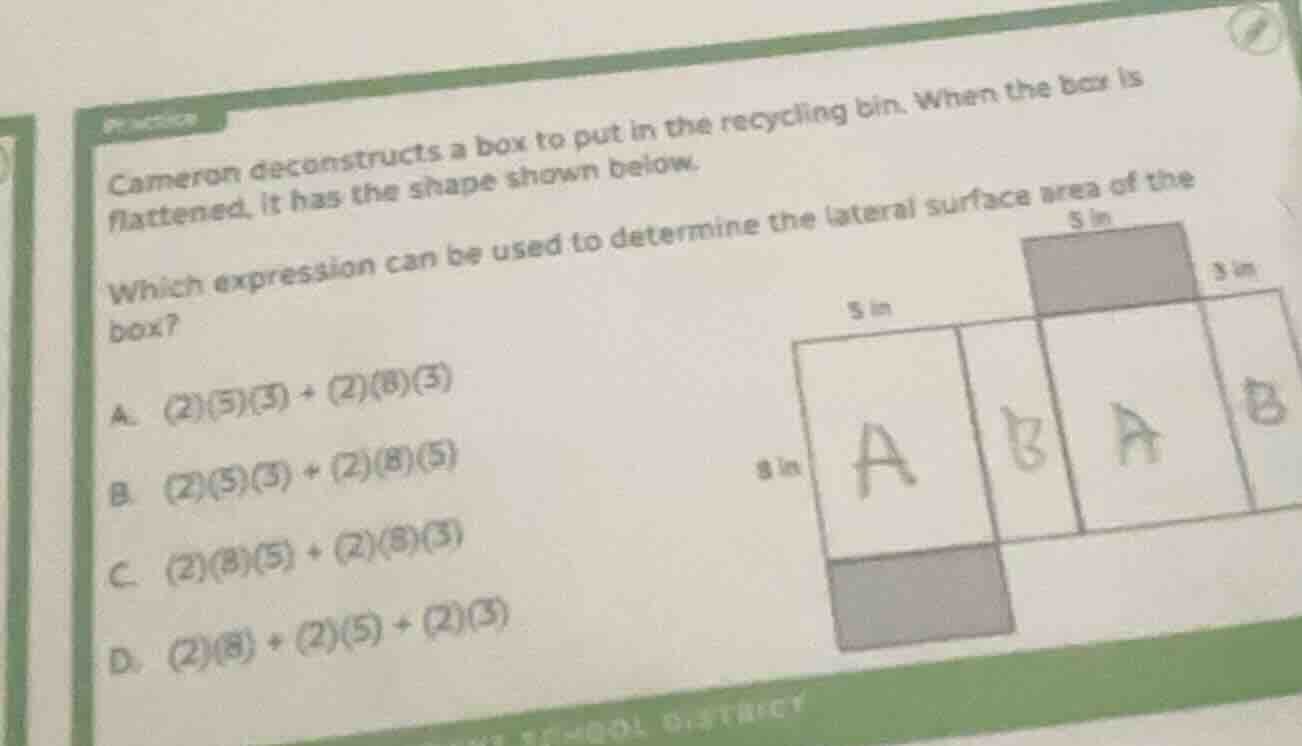
cameron deconstructs a box to put in the recycling bin. when the box is flattened, it has the shape shown below. which expression can be used to determine the lateral surface area of the box? a. (2)(5)(3) + (2)(8)(3) b. (2)(5)(5) + (2)(8)(5) c. (2)(8)(5) + (2)(8)(3) d. (2)(8) + (2)(5) + (2)(3)
Step1: Recall lateral surface area formula for a rectangular prism
The lateral surface area (LSA) of a rectangular prism is given by \( LSA = 2h(l + w) \), where \( l \) is length, \( w \) is width, and \( h \) is height. Alternatively, it can be calculated as the sum of the areas of the four lateral faces: \( 2(lh + wh) \).
From the net, we can identify the dimensions: length \( l = 8 \) in, width \( w = 5 \) in, height \( h = 3 \) in.
Step2: Calculate the area of each pair of lateral faces
- The area of the two faces with dimensions \( l \) and \( h \): \( 2 \times l \times h = 2\times8\times3 \) (but wait, no—wait, actually, the lateral faces: the pairs are (length × height) and (width × height). Wait, let's re-express.
Wait, the lateral surface area is the area of the four sides excluding the top and bottom. So for a rectangular prism with length \( l \), width \( w \), height \( h \), the lateral surface area is \( 2(lh + wh) \).
From the net, the length \( l = 8 \) in, width \( w = 5 \) in, height \( h = 3 \) in.
So, \( 2(lh + wh) = 2(8\times3 + 5\times3) = 2\times3\times(8 + 5) \)? Wait, no, let's expand \( 2(lh + wh) = 2lh + 2wh \).
Substituting \( l = 8 \), \( w = 5 \), \( h = 3 \):
\( 2(8\times3) + 2(5\times3) = (2\times8\times3) + (2\times5\times3) \), which is the same as \( (2)(5)(3) + (2)(8)(3) \), which matches option A.
Wait, let's check the options:
Option A: \( (2)(5)(3) + (2)(8)(3) \) – this is \( 2\times5\times3 + 2\times8\times3 \), which is \( 2(5\times3 + 8\times3) \), the lateral surface area.
Option B: \( (2)(5)(5) + (2)(8)(5) \) – incorrect, since height is 3, not 5.
Option C: \( (2)(8)(5) + (2)(8)(3) \) – incorrect, as it uses 8×5 which is not a lateral face (that would be a top/bottom face).
Option D: \( (2)(8) + (2)(5) + (2)(3) \) – this is the perimeter of the base times height? No, that's not the formula. The perimeter of the base is \( 2(l + w) \), so lateral surface area is perimeter × height, which is \( 2(l + w)h = 2lh + 2wh \), which is the same as option A. Wait, but option D is \( 2\times8 + 2\times5 + 2\times3 = 2(8 + 5 + 3) \), which is the perimeter of the net's outer edges, not the lateral surface area. So option D is incorrect.
So the correct expression is \( (2)(5)(3) + (2)(8)(3) \), which is option A.

Snap & solve any problem in the app
Get step-by-step solutions on Sovi AI
Photo-based solutions with guided steps
Explore more problems and detailed explanations
A. \((2)(5)(3) + (2)(8)(3)\)