QUESTION IMAGE
Question
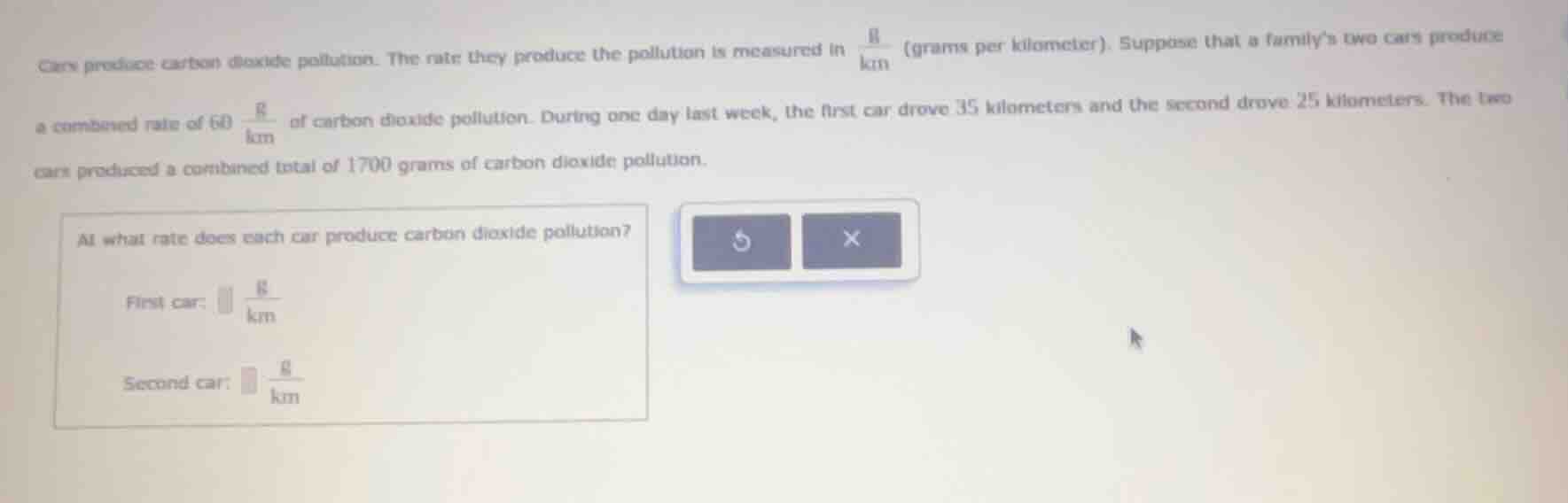
cars produce carbon dioxide pollution. the rate they produce the pollution is measured in \\(\frac{g}{km}\\) (grams per kilometer). suppose that a family’s two cars produce a combined rate of 60 \\(\frac{g}{km}\\) of carbon dioxide pollution. during one day last week, the first car drove 35 kilometers and the second drove 25 kilometers. the two cars produced a combined total of 1700 grams of carbon dioxide pollution. at what rate does each car produce carbon dioxide pollution? first car: \\(\square \frac{g}{km}\\) second car: \\(\square \frac{g}{km}\\)
Step1: Define variables
Let the rate of the first car be \( x \) grams per kilometer and the rate of the second car be \( y \) grams per kilometer. We know two things: the combined rate is 60 grams per kilometer, so \( x + y = 60 \), and the total pollution from driving 35 km and 25 km respectively is 1700 grams, so \( 35x + 25y = 1700 \).
Step2: Solve the system of equations
From the first equation, we can express \( y = 60 - x \). Substitute this into the second equation:
\[
\]
Step3: Find the rate of the second car
Now that we have \( x = 20 \), substitute back into \( y = 60 - x \):
\( y = 60 - 20 = 40 \)

Snap & solve any problem in the app
Get step-by-step solutions on Sovi AI
Photo-based solutions with guided steps
Explore more problems and detailed explanations
First car: \( 20 \frac{\text{g}}{\text{km}} \)
Second car: \( 40 \frac{\text{g}}{\text{km}} \)