QUESTION IMAGE
Question
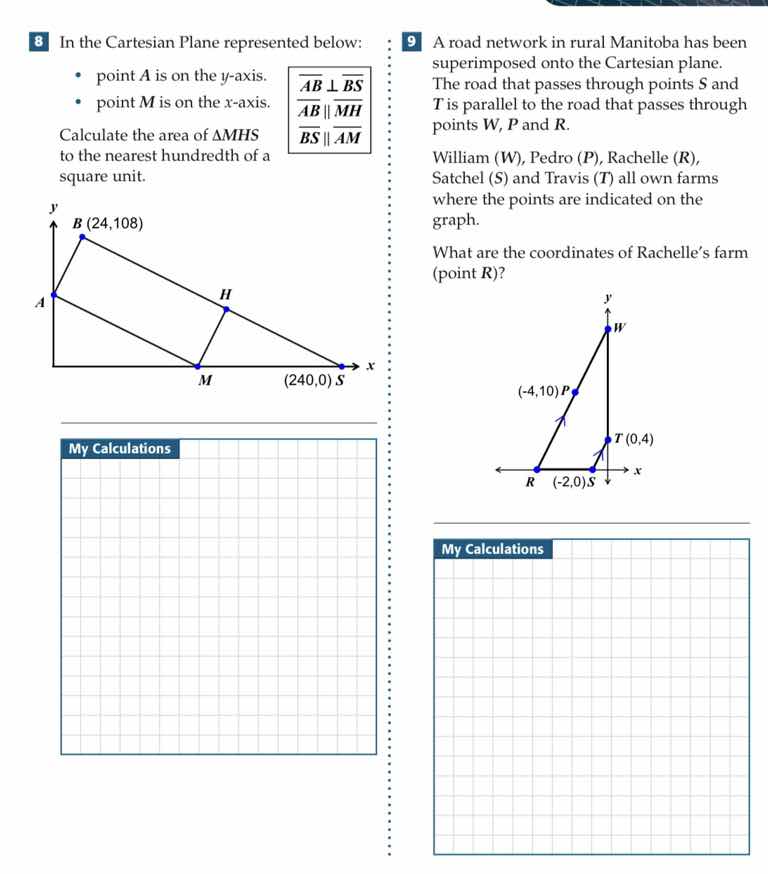
8 in the cartesian plane represented below:
- point a is on the y - axis.
- point m is on the x - axis.
calculate the area of $\triangle mhs$ to the nearest hundredth of a square unit.
(diagram: point b(24,108), a on y - axis, m on x - axis, s(240,0), h on segment from a to s, with $\overline{ab}\perp\overline{bs}$, $\overline{ab}\parallel\overline{mh}$, $\overline{bs}\parallel\overline{am}$)
my calculations
(grid for calculations)
9 a road network in rural manitoba has been superimposed onto the cartesian plane. the road that passes through points s and t is parallel to the road that passes through points w, p and r.
william (w), pedro (p), rachelle (r), satchel (s) and travis (t) all own farms where the points are indicated on the graph.
what are the coordinates of rachelle’s farm (point r)?
(diagram: w on y - axis, p(-4,10), t(0,4), s(-2,0), r on x - axis left of s)
my calculations
(grid for calculations)
Problem 8 (Area of \( \triangle MHS \))
Step 1: Determine coordinates of \( A \)
Since \( AB \perp BS \) and \( BS \parallel AM \), \( AB \) is vertical (as \( A \) is on \( y \)-axis, \( B(24,108) \), so \( A \) has same \( x \)-coordinate as \( A \) is on \( y \)-axis? Wait, no—\( AB \) is vertical? Wait, \( A \) is on \( y \)-axis, \( B(24,108) \). Wait, \( AB \perp BS \), and \( BS \) is a line from \( B(24,108) \) to \( S(240,0) \). Let's find slope of \( BS \): \( m_{BS} = \frac{0 - 108}{240 - 24} = \frac{-108}{216} = -0.5 \). Since \( AB \perp BS \), slope of \( AB \) is negative reciprocal: \( 2 \). But \( A \) is on \( y \)-axis (\( x=0 \)), so equation of \( AB \): \( y - 108 = 2(x - 24) \). At \( x=0 \), \( y = 108 - 48 = 60 \). So \( A(0,60) \).
Step 2: Determine coordinates of \( M \)
Since \( BS \parallel AM \), slope of \( AM \) is \( -0.5 \) (same as \( BS \)). \( A(0,60) \), so equation of \( AM \): \( y - 60 = -0.5x \). \( M \) is on \( x \)-axis (\( y=0 \)), so \( 0 - 60 = -0.5x \implies x = 120 \). Thus, \( M(120,0) \).
Step 3: Analyze \( \triangle MHS \)
Since \( AB \parallel MH \), \( MH \) has same slope as \( AB \)? Wait, no—\( AB \parallel MH \), slope of \( AB \) is \( 2 \)? Wait, earlier mistake: slope of \( BS \) is \( -0.5 \), so \( AB \perp BS \), so slope of \( AB \) is \( 2 \) (negative reciprocal of \( -0.5 \) is \( 2 \)). Then \( AB \parallel MH \), so slope of \( MH \) is \( 2 \). But \( M(120,0) \), so equation of \( MH \): \( y - 0 = 2(x - 120) \). \( H \) is on \( BS \)? Wait, \( BS \) has equation: from \( B(24,108) \) to \( S(240,0) \), \( y = -0.5x + 120 \) (since at \( x=24 \), \( y= -12 + 120 = 108 \); at \( x=240 \), \( y= -120 + 120 = 0 \)). Find intersection of \( MH \) and \( BS \): \( 2(x - 120) = -0.5x + 120 \implies 2x - 240 = -0.5x + 120 \implies 2.5x = 360 \implies x = 144 \), \( y = 2(144 - 120) = 48 \). So \( H(144,48) \).
Step 4: Calculate base and height of \( \triangle MHS \)
Base \( MS = 240 - 120 = 120 \) (since \( M(120,0) \), \( S(240,0) \)). Height is \( y \)-coordinate of \( H \), since \( MHS \) is on \( x \)-axis (base \( MS \) is horizontal). So height \( = 48 \).
Step 5: Area of \( \triangle MHS \)
Area \( = \frac{1}{2} \times \text{base} \times \text{height} = \frac{1}{2} \times 120 \times 48 = 2880 \)? Wait, no—wait, \( M(120,0) \), \( S(240,0) \), so base \( MS = 240 - 120 = 120 \). \( H \) has \( y=48 \), so height is \( 48 \). Thus, area \( = \frac{1}{2} \times 120 \times 48 = 2880 \)? Wait, that seems large. Wait, maybe my coordinate of \( A \) is wrong. Let's recheck: \( AB \perp BS \). Vector \( BS = (240 - 24, 0 - 108) = (216, -108) \). Vector \( AB = (0 - 24, y - 108) = (-24, y - 108) \). Dot product should be zero: \( 216 \times (-24) + (-108) \times (y - 108) = 0 \implies -5184 - 108y + 11664 = 0 \implies -108y + 6480 = 0 \implies y = 60 \). So \( A(0,60) \) is correct. Then \( BS \) slope: \( (0 - 108)/(240 - 24) = -108/216 = -0.5 \), correct. \( AM \) is parallel to \( BS \), so slope of \( AM \) is \( -0.5 \), so equation: \( y = -0.5x + 60 \) (since \( A(0,60) \)). Then \( M \) is on \( x \)-axis: \( 0 = -0.5x + 60 \implies x = 120 \), so \( M(120,0) \), correct. Now, \( AB \parallel MH \): slope of \( AB \): \( (60 - 108)/(0 - 24) = (-48)/(-24) = 2 \), so slope of \( MH \) is \( 2 \). Equation of \( MH \): \( y - 0 = 2(x - 120) \implies y = 2x - 240 \). Equation of \( BS \): \( y = -0.5x + 120 \) (from \( B(24,108) \): \( y = -0.5(24) + 120 = -12 + 120 = 108 \), correct). Intersection \( H \): solve \( 2x - 240 = -0.5x + 120 \implies 2.5x = 360 \implies x = 144 \), \( y =…
Step 1: Find slope of \( WT \)
Points \( W \) (on \( y \)-axis, let's find its coordinates) and \( T(0,4) \). Wait, road through \( W \) and \( P(-4,10) \) is parallel to road through \( S(-2,0) \) and \( R \). Wait, no: "The road that passes through points \( S \) and \( T \) is parallel to the road that passes through points \( W, P \) and \( R \)." Wait, \( T(0,4) \), \( S(-2,0) \)? Wait, no: \( S(-2,0) \), \( T(0,4) \). Let's find slope of \( ST \): \( m_{ST} = \frac{4 - 0}{0 - (-2)} = \frac{4}{2} = 2 \). So the road through \( W, P, R \) has slope \( 2 \).
Step 2: Find equation of \( WPR \)
Point \( P(-4,10) \), slope \( 2 \), so equation: \( y - 10 = 2(x + 4) \implies y = 2x + 8 + 10 \implies y = 2x + 18 \). \( W \) is on \( y \)-axis (\( x=0 \)), so \( y = 18 \), so \( W(0,18) \). Now, \( R \) is on \( x \)-axis (\( y=0 \)), so plug \( y=0 \) into \( y = 2x + 18 \): \( 0 = 2x + 18 \implies x = -9 \)? Wait, no—wait, the graph shows \( S(-2,0) \), \( T(0,4) \), \( P(-4,10) \), \( W \) on \( y \)-axis, \( R \) on \( x \)-axis. Wait, maybe I misread: "road that passes through points \( S \) and \( T \)"—\( S(-2,0) \), \( T(0,4) \), slope \( (4 - 0)/(0 - (-2)) = 2 \). Road through \( W, P, R \): \( P(-4,10) \), slope \( 2 \), so equation \( y - 10 = 2(x + 4) \implies y = 2x + 18 \). \( R \) is on \( x \)-axis (\( y=0 \)): \( 0 = 2x + 18 \implies x = -9 \)? But the graph shows \( R \) near \( S(-2,0) \). Wait, maybe the road through \( S \) and \( T \) is \( S(-2,0) \) and \( T(0,4) \), slope \( 2 \). Road through \( W, P, R \): \( P(-4,10) \), let's check \( P \) on \( y = 2x + 18 \): \( 2(-4) + 18 = -8 + 18 = 10 \), correct. \( W \) is \( (0,18) \), correct. Now, \( R \) is on \( x \)-axis, so \( y=0 \): \( 0 = 2x + 18 \implies x = -9 \)? But the graph in the problem has \( S(-2,0) \), so maybe I misread the points. Wait, the graph: \( R \) is on \( x \)-axis, \( S(-2,0) \), \( T(0,4) \), \( P(-4,10) \), \( W \) on \( y \)-axis. Wait, maybe the road through \( S \) and \( T \) is \( S(-2,0) \) to \( T(0,4) \), slope \( 2 \). Road through \( P(-4,10) \) and \( R \) (on \( x \)-axis) must have same slope. So slope between \( P(-4,10) \) and \( R(x,0) \) is \( (0 - 10)/(x - (-4)) = (-10)/(x + 4) = 2 \) (since parallel to \( ST \) with slope \( 2 \)). So \( -10 = 2(x + 4) \implies -10 = 2x + 8 \implies 2x = -18 \implies x = -9 \). Wait, but the initial thought was wrong. Wait, the graph in the problem: \( S(-2,0) \), \( T(0,4) \), \( P(-4,10) \), \( W \) on \( y \)-axis, \( R \) on \( x \)-axis. So using slope of \( ST \) is \( 2 \), so road \( WPR \) has slope \( 2 \). \( P(-4,10) \), so equation \( y = 2x + 18 \) (as \( 2(-4) + 18 = 10 \), correct). \( R \) is where \( y=0 \), so \( x = -9 \). Wait, but the user's graph might have \( S(-2,0) \), so maybe I made a mistake. Wait, let's recalculate slope of \( ST \): \( T(0,4) \), \( S(-2,0) \): \( (4 - 0)/(0 - (-2)) = 4/2 = 2 \), correct. Slope of \( PR \): \( P(-4,10) \), \( R(x,0) \): \( (0 - 10)/(x - (-4)) = -10/(x + 4) \). Set equal to \( 2 \): \( -10/(x + 4) = 2 \implies -10 = 2x + 8 \implies 2x = -18 \implies x = -9 \). So \( R(-9, 0) \).

Snap & solve any problem in the app
Get step-by-step solutions on Sovi AI
Photo-based solutions with guided steps
Explore more problems and detailed explanations
\( 2880.00 \)