QUESTION IMAGE
Question
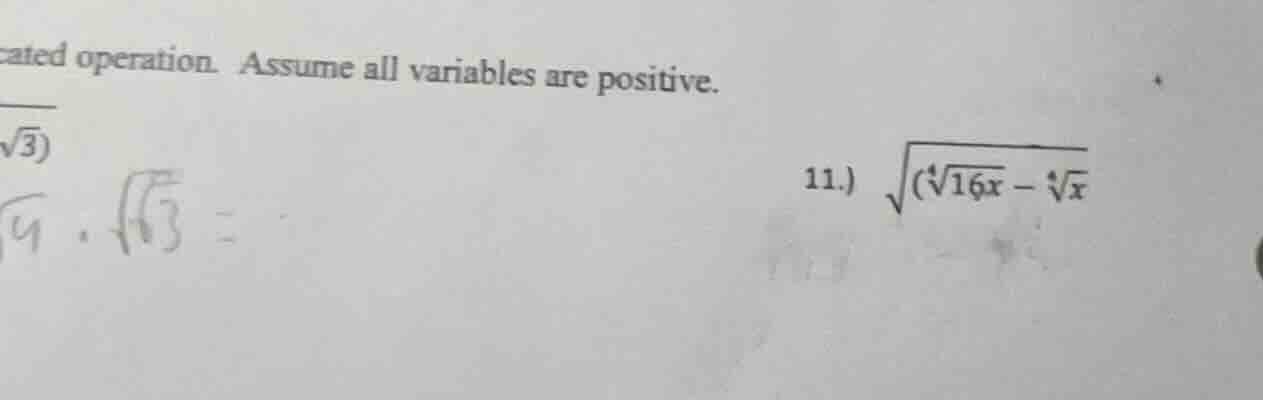
cated operation. assume all variables are positive. \\(\sqrt{3}\\) \\(\sqrt{9} \cdot \sqrt{3} = \\) 11.) \\(\sqrt{(\sqrt4{16x} - \sqrt4{x}\\)
Step1: Simplify the 4th root term
First, rewrite $\sqrt[4]{16x}$:
$\sqrt[4]{16x} = \sqrt[4]{16} \cdot \sqrt[4]{x} = 2\sqrt[4]{x}$
Step2: Subtract the like radical terms
Substitute back into the expression inside the square root:
$\sqrt{(2\sqrt[4]{x} - \sqrt[4]{x})} = \sqrt{(\sqrt[4]{x})}$
Step3: Rewrite roots as exponents
Convert the nested roots to fractional exponents to simplify:
$\sqrt{\sqrt[4]{x}} = (x^{\frac{1}{4}})^{\frac{1}{2}}$
Step4: Apply exponent power rule
Use the rule $(a^m)^n = a^{m \cdot n}$:
$(x^{\frac{1}{4}})^{\frac{1}{2}} = x^{\frac{1}{4} \cdot \frac{1}{2}} = x^{\frac{1}{8}}$
Step5: Convert back to radical form (optional)
$x^{\frac{1}{8}} = \sqrt[8]{x}$

Snap & solve any problem in the app
Get step-by-step solutions on Sovi AI
Photo-based solutions with guided steps
Explore more problems and detailed explanations
$\sqrt[8]{x}$ (or $x^{\frac{1}{8}}$)