QUESTION IMAGE
Question
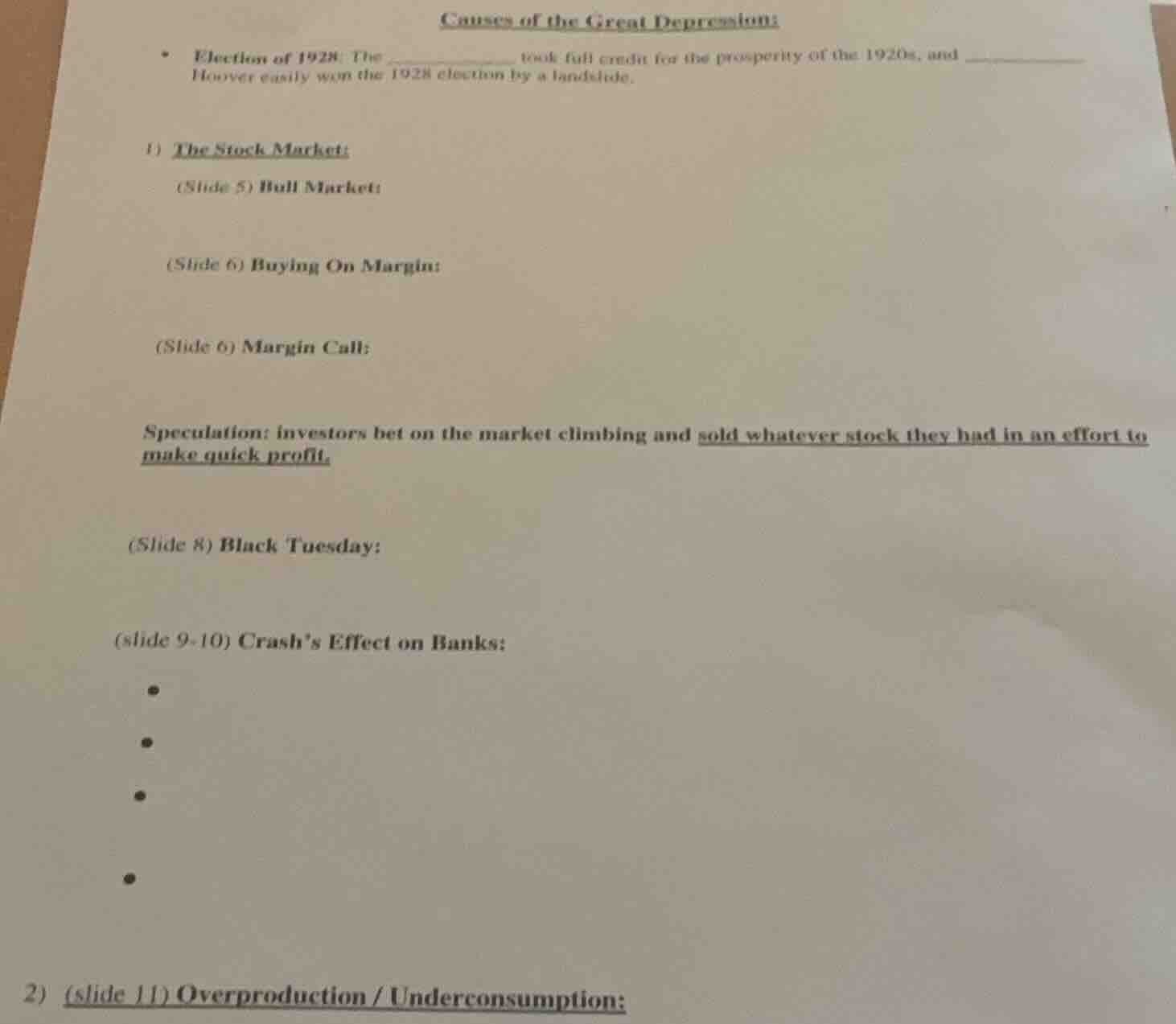
causes of the great depression:• election of 1928: the ________ took full credit for the prosperity of the 1920s, and ________hoover easily won the 1928 election by a landslide.1) the stock market:(slide 5) bull market:(slide 6) buying on margin:(slide 6) margin call:speculation: investors bet on the market climbing and sold whatever stock they had in an effort to make quick profit.(slide 8) black tuesday:(slide 9-10) crashs effect on banks:••••2) (slide 11) overproduction / underconsumption:
Brief Explanations
- For the 1928 election blank: The Republican Party took credit for the 1920s prosperity, and Herbert Hoover (their candidate) won easily.
- For the stock market sections:
- Bull Market: A period of rising stock prices, widespread investor optimism, and increased buying, which characterized the late 1920s market.
- Buying On Margin: Investors borrowed money from brokers to purchase stocks, only putting down a small percentage (e.g., 10-20%) of the stock's value upfront.
- Margin Call: When stock prices dropped, brokers demanded investors repay their borrowed funds immediately; if investors couldn't, brokers sold their stocks to recoup money.
- Black Tuesday: October 29, 1929, the day the U.S. stock market crashed, with massive panic selling and plummeting stock prices.
- Crash's Effect on Banks:
- Banks had invested depositors' money in the stock market, losing those funds when the market crashed.
- Panicked depositors rushed to withdraw all their savings, causing bank runs.
- Thousands of banks failed because they couldn't meet withdrawal demands.
- Failed banks meant many people lost their life savings with no federal insurance at the time.
- Overproduction/Underconsumption: Factories and farms produced more goods than consumers could afford to buy, due to stagnant wages, uneven wealth distribution, and high consumer debt, leading to surplus goods, falling prices, and business failures.

Snap & solve any problem in the app
Get step-by-step solutions on Sovi AI
Photo-based solutions with guided steps
Explore more problems and detailed explanations
- Election of 1928: The Republican Party took full credit for the prosperity of the 1920s, and Herbert Hoover easily won the 1928 election by a landslide.
- (Slide 5) Bull Market: A period of sustained rising stock prices, driven by investor optimism and high demand for stocks in the 1920s.
- (Slide 6) Buying On Margin: A practice where investors paid only a fraction (e.g., 10-20%) of a stock's cost upfront, borrowing the rest from brokers to purchase more stocks.
- (Slide 6) Margin Call: A demand from brokers for investors to repay the borrowed funds used to buy stocks, triggered by falling stock prices that reduced the value of the collateral.
- (Slide 8) Black Tuesday: October 29, 1929, the peak of the stock market crash, marked by record-breaking panic selling and a collapse of stock values.
- (Slide 9-10) Crash's Effect on Banks:
- Banks lost funds invested in the stock market.
- Widespread bank runs as depositors rushed to withdraw savings.
- Thousands of banks collapsed without enough cash to cover withdrawals.
- Uninsured savings meant millions lost their life savings.
- (Slide 11) Overproduction / Underconsumption: Industrial and agricultural output outpaced consumer purchasing power (due to low wages, unequal wealth, and high debt), leading to unsold goods, falling prices, and business closures that worsened economic decline.