QUESTION IMAGE
Question
cc.2.2.hs.c.6
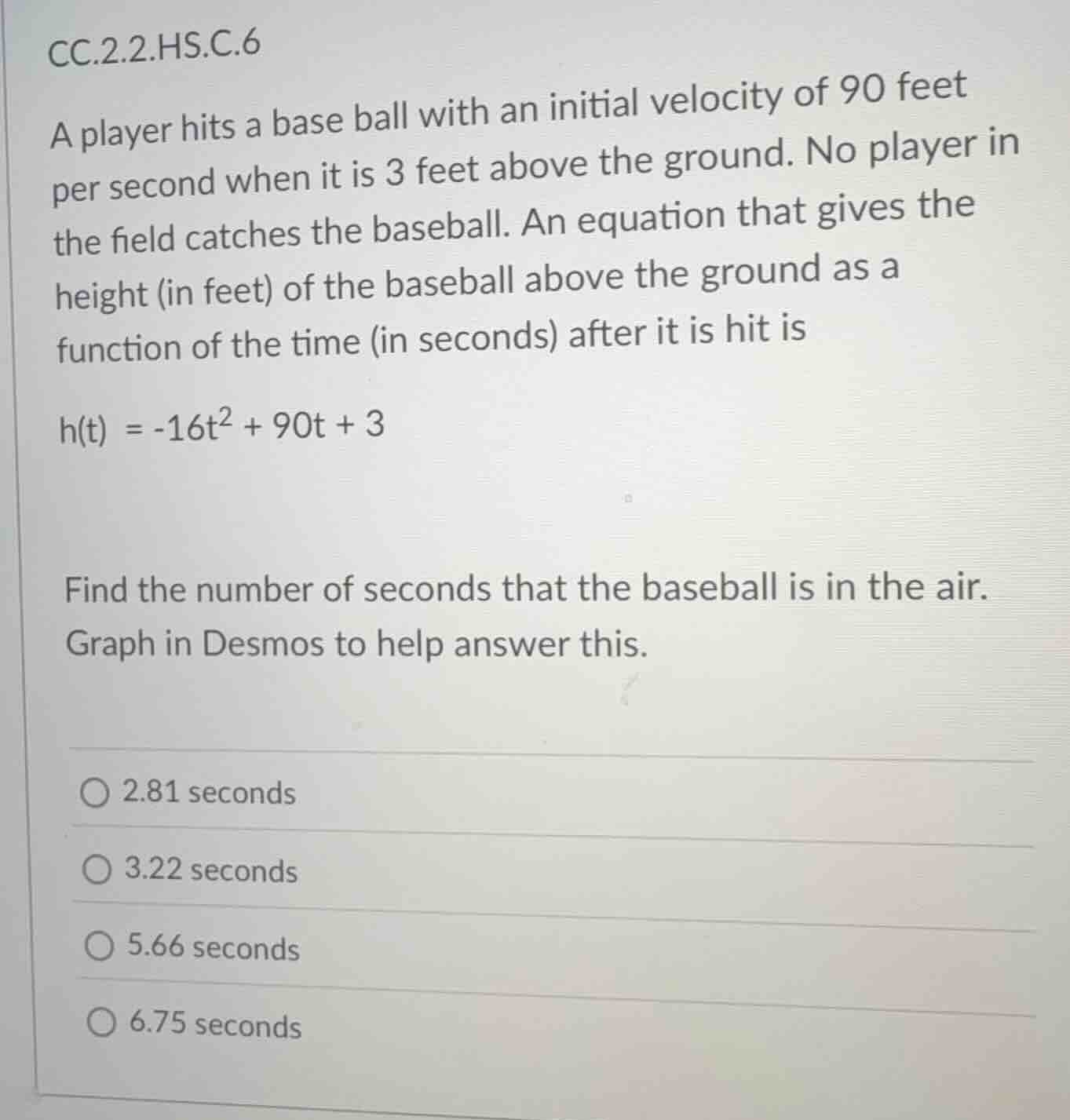
a player hits a base ball with an initial velocity of 90 feet per second when it is 3 feet above the ground. no player in the field catches the baseball. an equation that gives the height (in feet) of the baseball above the ground as a function of the time (in seconds) after it is hit is
$h(t) = -16t^2 + 90t + 3$
find the number of seconds that the baseball is in the air. graph in desmos to help answer this.
○ 2.81 seconds
○ 3.22 seconds
○ 5.66 seconds
○ 6.75 seconds
Step1: Set height to 0
To find when the baseball hits the ground, set \( h(t) = 0 \), so we have the equation \( -16t^{2}+90t + 3=0 \).
Step2: Use quadratic formula
For a quadratic equation \( ax^{2}+bx + c = 0 \), the solutions are given by \( t=\frac{-b\pm\sqrt{b^{2}-4ac}}{2a} \). Here, \( a=- 16 \), \( b = 90 \), \( c = 3 \).
First, calculate the discriminant \( \Delta=b^{2}-4ac=(90)^{2}-4\times(-16)\times3=8100 + 192=8292 \).
Then, \( t=\frac{-90\pm\sqrt{8292}}{2\times(-16)}=\frac{-90\pm\sqrt{8292}}{-32} \).
We have two solutions:
\( t_1=\frac{-90+\sqrt{8292}}{-32}\) and \( t_2=\frac{-90 - \sqrt{8292}}{-32}\)
Since time cannot be negative, we consider \( t_2=\frac{-90-\sqrt{8292}}{-32}=\frac{90 + \sqrt{8292}}{32} \)
Calculate \( \sqrt{8292}\approx91.06 \)
Then \( t=\frac{90 + 91.06}{32}=\frac{181.06}{32}\approx5.66 \)

Snap & solve any problem in the app
Get step-by-step solutions on Sovi AI
Photo-based solutions with guided steps
Explore more problems and detailed explanations
5.66 seconds