QUESTION IMAGE
Question
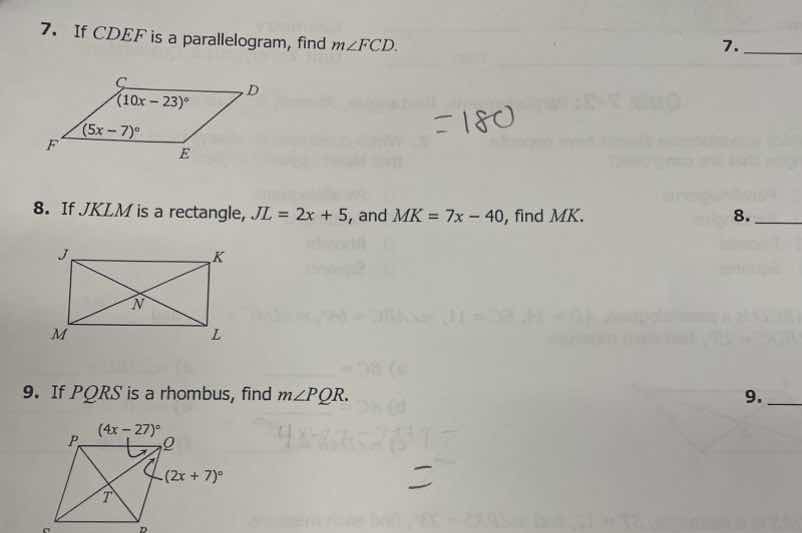
- if cdef is a parallelogram, find ( mangle fcd ).
- if jklm is a rectangle, ( jl = 2x + 5 ), and ( mk = 7x - 40 ), find ( mk ).
- if pqrs is a rhombus, find ( mangle pqr ).
Problem 7
Step1: Consecutive angles are supplementary
In a parallelogram, consecutive interior angles are supplementary, so their sum is $180^\circ$.
$$(5x-7)^\circ + (10x-23)^\circ = 180^\circ$$
Step2: Simplify and solve for $x$
Combine like terms and isolate $x$.
$$15x - 30 = 180$$
$$15x = 210$$
$$x = 14$$
Step3: Find $\angle FCD$
$\angle FCD$ is equal to $\angle FEC$ (opposite angles of parallelogram are equal), so substitute $x=14$ into $(5x-7)^\circ$.
$$m\angle FCD = 5(14) - 7 = 63$$
Step1: Diagonals of rectangle are equal
In a rectangle, the diagonals are congruent, so $JL = MK$.
$$2x + 5 = 7x - 40$$
Step2: Solve for $x$
Isolate $x$ by rearranging terms.
$$5 + 40 = 7x - 2x$$
$$45 = 5x$$
$$x = 9$$
Step3: Calculate length of $MK$
Substitute $x=9$ into the expression for $MK$.
$$MK = 7(9) - 40 = 63 - 40 = 23$$
Step1: Diagonals bisect angles in rhombus
In a rhombus, diagonals bisect the angles, so the two given angles are equal.
$$4x - 27 = 2x + 7$$
Step2: Solve for $x$
Isolate $x$ by rearranging terms.
$$4x - 2x = 7 + 27$$
$$2x = 34$$
$$x = 17$$
Step3: Find $\angle PQR$
$\angle PQR$ is twice the measure of $(2x+7)^\circ$.
$$m\angle PQR = 2(2(17)+7) = 2(34+7) = 2(41) = 82$$

Snap & solve any problem in the app
Get step-by-step solutions on Sovi AI
Photo-based solutions with guided steps
Explore more problems and detailed explanations
$63^\circ$
---