QUESTION IMAGE
Question
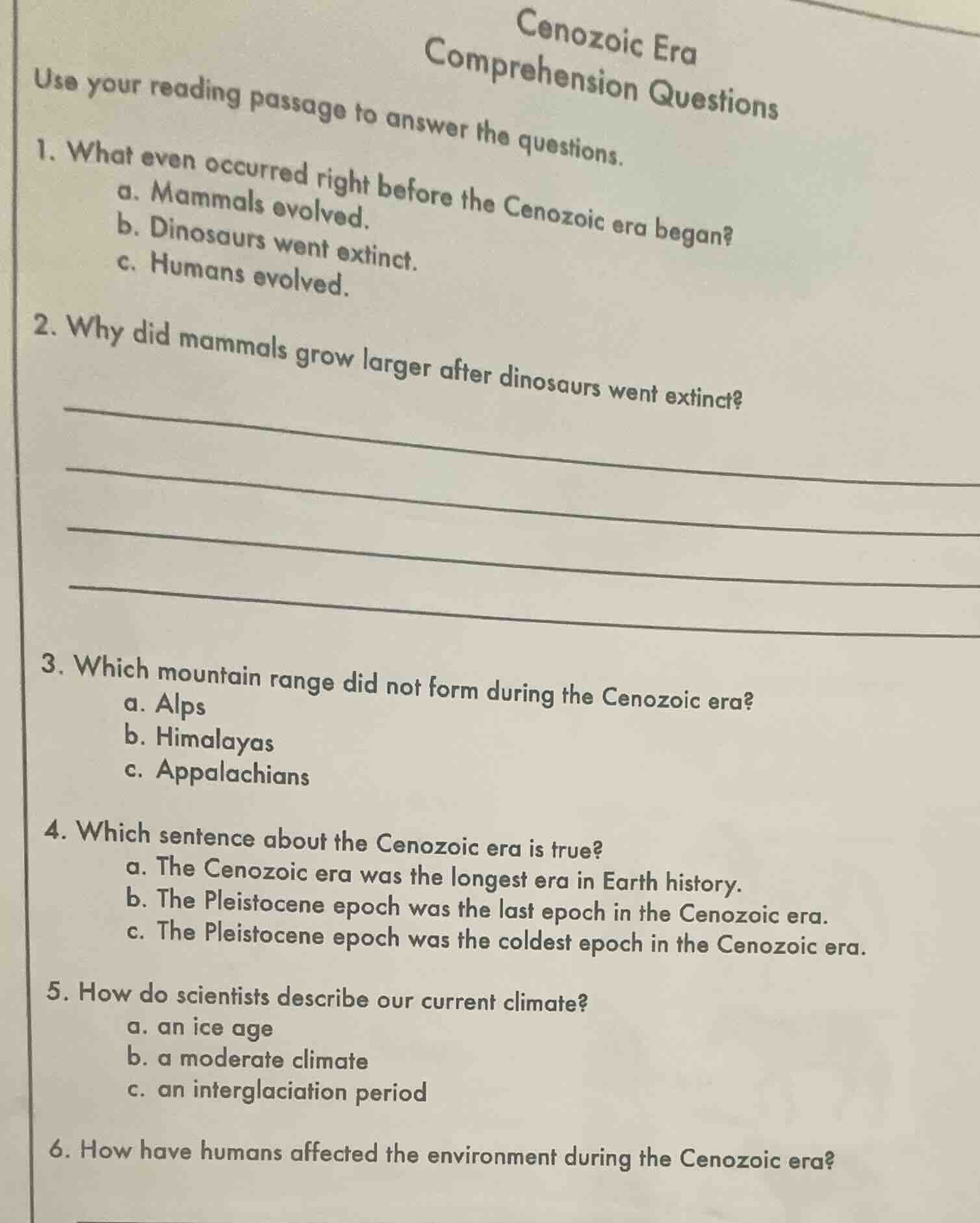
cenozoic eracomprehension questionsuse your reading passage to answer the questions.1. what event occurred right before the cenozoic era began?a. mammals evolved.b. dinosaurs went extinct.c. humans evolved.2. why did mammals grow larger after dinosaurs went extinct?3. which mountain range did not form during the cenozoic era?a. alpsb. himalayasc. appalachians4. which sentence about the cenozoic era is true?a. the cenozoic era was the longest era in earth history.b. the pleistocene epoch was the last epoch in the cenozoic era.c. the pleistocene epoch was the coldest epoch in the cenozoic era.5. how do scientists describe our current climate?a. an ice ageb. a moderate climatec. an interglaciation period6. how have humans affected the environment during the cenozoic era?
- The Cenozoic era follows the Cretaceous-Paleogene extinction event that killed non-avian dinosaurs.
- After dinosaurs went extinct, mammals no longer faced competition for resources like food and habitat from large dominant reptiles, allowing them to evolve larger body sizes to fill empty ecological niches.
- The Appalachian Mountains formed during the Paleozoic era, while the Alps and Himalayas formed in the Cenozoic.
- The Precambrian is the longest era, the Holocene is the current (last) epoch of the Cenozoic, and the Pleistocene included major ice ages making it the coldest epoch in the era.
- Earth is currently in an interglacial period within the ongoing Quaternary ice age, meaning it's a warmer interval between glacial periods.
- Humans have altered habitats via deforestation/urbanization, caused pollution, driven species to extinction, and induced climate change through greenhouse gas emissions.

Snap & solve any problem in the app
Get step-by-step solutions on Sovi AI
Photo-based solutions with guided steps
Explore more problems and detailed explanations
- b. Dinosaurs went extinct.
- Mammals no longer faced competition from large dinosaurs for resources like food and living space, so they evolved larger body sizes to occupy the empty ecological niches left by the extinct dinosaurs.
- c. Appalachians
- c. The Pleistocene epoch was the coldest epoch in the Cenozoic era.
- c. an interglaciation period
- Humans have caused widespread habitat destruction (such as deforestation and urban development), polluted air, water, and soil, driven numerous species to extinction or near-extinction, and triggered anthropogenic climate change through the release of greenhouse gases from fossil fuel use and industrial activity.