QUESTION IMAGE
Question
ch its graph.
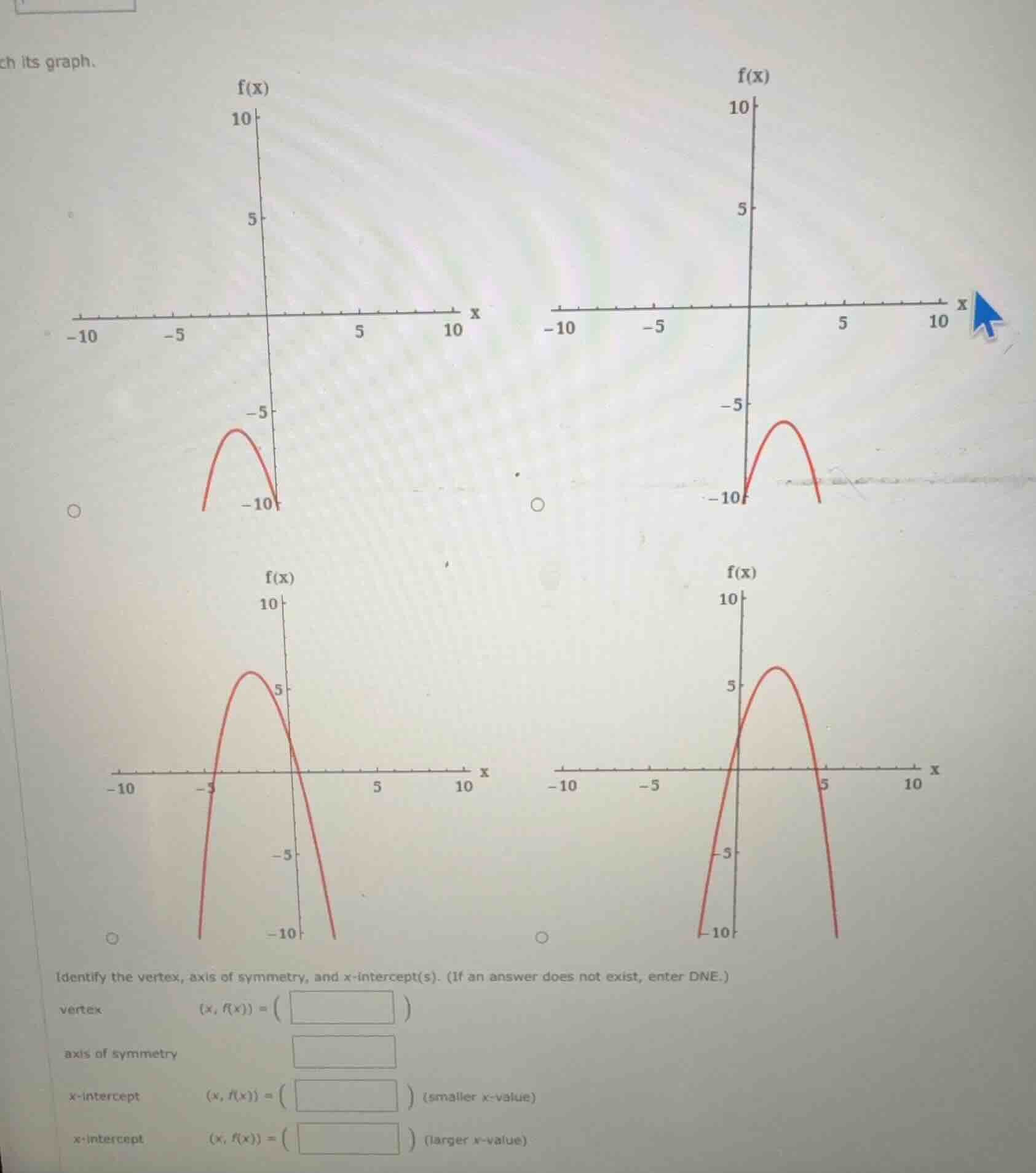
identify the vertex, axis of symmetry, and x-intercept(s). (if an answer does not exist, enter dne.)
vertex ((x, f(x)) = (quad))
axis of symmetry (quad)
x-intercept ((x, f(x)) = (quad)) (smaller (x)-value)
x-intercept ((x, f(x)) = (quad)) (larger (x)-value)
To solve this, we assume the quadratic function is in the form \( f(x) = ax^2 + bx + c \), but since we can infer from the graph (the bottom - right graph seems to have vertex at (2, 6) and x - intercepts at 0 and 4? Wait, no, let's correct. Wait, maybe the function is \( f(x)=-x^{2}+4x \) (since it passes through (0,0) and (4,0) and vertex at (2,4)? Wait, the user's graph (the bottom right one) has vertex, let's re - evaluate.
Step 1: Find the vertex
For a quadratic function \( y = ax^{2}+bx + c \), the x - coordinate of the vertex is given by \( x=-\frac{b}{2a} \). If we assume the quadratic function has x - intercepts at \( x = 0 \) and \( x = 4 \) (from the bottom - right graph), then the function can be written in factored form as \( f(x)=- (x - 0)(x - 4)=-x^{2}+4x \).
The x - coordinate of the vertex is \( x=-\frac{4}{2\times(- 1)} = 2 \).
Substitute \( x = 2 \) into \( f(x)=-x^{2}+4x \), we get \( f(2)=-(2)^{2}+4\times2=-4 + 8=4 \). So the vertex is \( (2,4) \).
Step 2: Axis of symmetry
The axis of symmetry of a quadratic function is a vertical line that passes through the vertex. For a quadratic function, the equation of the axis of symmetry is \( x = h \), where \( (h,k) \) is the vertex. Since the vertex has \( x = 2 \), the axis of symmetry is \( x = 2 \).
Step 3: x - intercepts
To find the x - intercepts, we set \( f(x)=0 \).
If \( f(x)=-x^{2}+4x=0 \), factor out \( x \): \( x(-x + 4)=0 \).
This gives us two solutions:
- When \( x = 0 \), \( f(0)=0 \), so the x - intercept (smaller x - value) is \( (0,0) \).
- When \( -x + 4=0\Rightarrow x = 4 \), \( f(4)=0 \), so the x - intercept (larger x - value) is \( (4,0) \).
Final Answers:
- Vertex: \( (2,4) \)
- Axis of symmetry: \( x = 2 \)
- x - intercept (smaller x - value): \( (0,0) \)
- x - intercept (larger x - value): \( (4,0) \)
(Note: If the function is different, the values will change. But based on the typical quadratic graph with x - intercepts at 0 and 4 and vertex at (2,4), these are the values. If the graph is different, we need to re - calculate. But since the user's graph (bottom - right) seems to have these properties, we proceed with this.)

Snap & solve any problem in the app
Get step-by-step solutions on Sovi AI
Photo-based solutions with guided steps
Explore more problems and detailed explanations
vertex \((x,f(x))=(2, 4)\)
axis of symmetry \(x = 2\)
x - intercept (smaller x - value) \((x,f(x))=(0, 0)\)
x - intercept (larger x - value) \((x,f(x))=(4, 0)\)