QUESTION IMAGE
Question
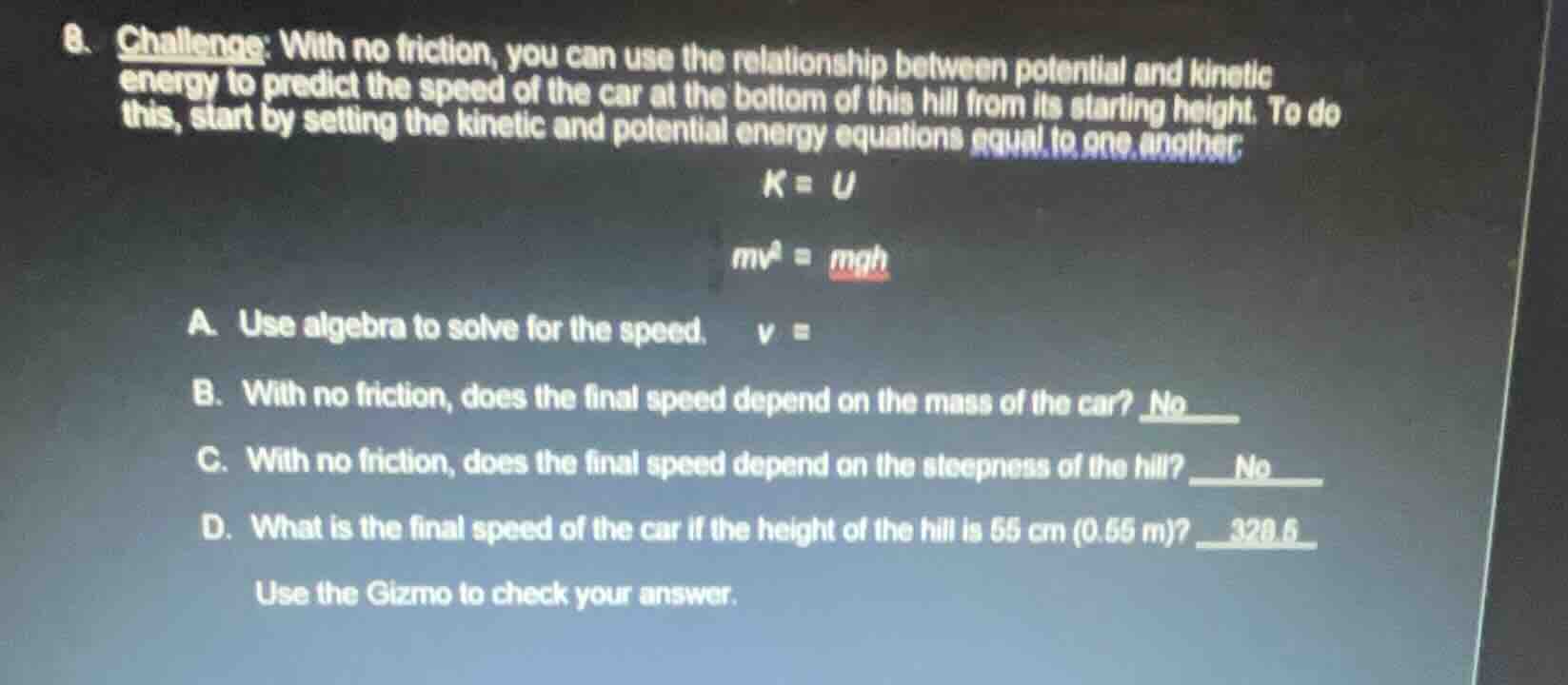
- challenge: with no friction, you can use the relationship between potential and kinetic energy to predict the speed of the car at the bottom of this hill from its starting height. to do this, start by setting the kinetic and potential energy equations equal to one another:
$k = u$
$\frac{1}{2}mv^2 = mgh$
a. use algebra to solve for the speed. $v = $
b. with no friction, does the final speed depend on the mass of the car? no
c. with no friction, does the final speed depend on the steepness of the hill? no
d. what is the final speed of the car if the height of the hill is 55 cm (0.55 m)? 320.6
use the gizmo to check your answer.
Part A
Step1: Start with the energy equation
We have the equation for kinetic energy \( K = \frac{1}{2}mv^2 \) and potential energy \( U = mgh \). The problem states \( K = U \), so \( \frac{1}{2}mv^2=mgh \). (Note: There was a typo in the original problem's kinetic energy formula, it should be \( \frac{1}{2}mv^2 \) not \( mv^2 \))
Step2: Solve for \( v \)
First, divide both sides of the equation \( \frac{1}{2}mv^2=mgh \) by \( m \) (assuming \( m
eq0 \)). This gives \( \frac{1}{2}v^2 = gh \).
Then, multiply both sides by 2: \( v^2=2gh \).
Finally, take the square root of both sides: \( v = \sqrt{2gh} \).
From the formula \( v=\sqrt{2gh} \) derived in part A, we can see that the mass \( m \) does not appear in the formula for \( v \). So the final speed does not depend on the mass of the car.
The formula for the final speed is \( v = \sqrt{2gh} \), where \( h \) is the height of the hill (vertical height). The steepness of the hill affects the distance the car travels along the slope but not the vertical height \( h \) (assuming the same starting and ending vertical positions). Since \( h \) is what matters in the formula and steepness doesn't affect \( h \) for a given vertical drop, the final speed does not depend on the steepness.

Snap & solve any problem in the app
Get step-by-step solutions on Sovi AI
Photo-based solutions with guided steps
Explore more problems and detailed explanations
\( \sqrt{2gh} \)