QUESTION IMAGE
Question
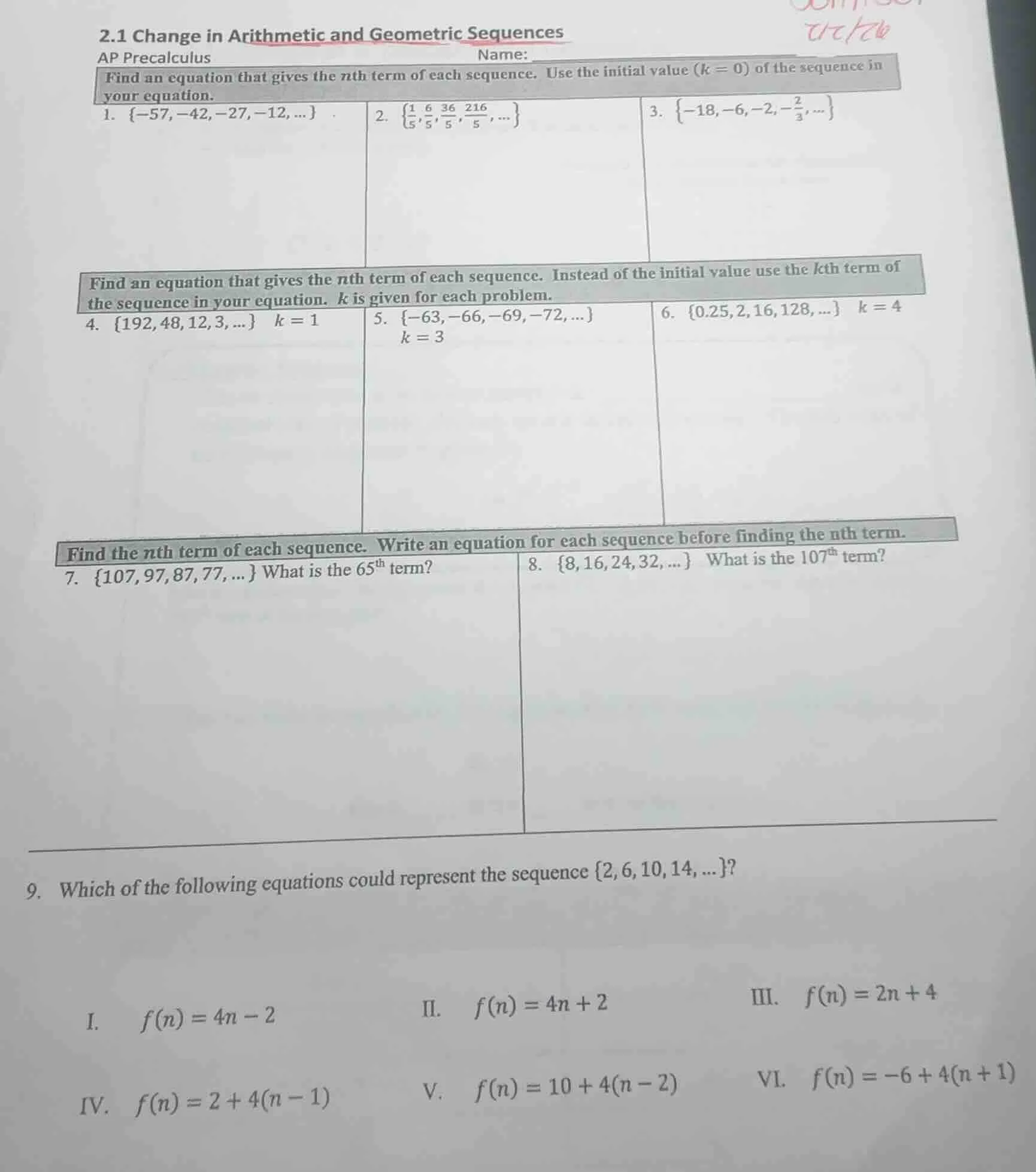
2.1 change in arithmetic and geometric sequences
ap precalculus
name:
find an equation that gives the nth term of each sequence. use the initial value (k = 0) of the sequence in your equation.
- {-57, -42, -27, -12, ...}
- {\frac{1}{5}, \frac{6}{5}, \frac{36}{5}, \frac{216}{5}, ...}
- {-18, -6, -2, -\frac{2}{3}, ...}
find an equation that gives the nth term of each sequence. instead of the initial value use the kth term of the sequence in your equation. k is given for each problem.
- {192, 48, 12, 3, ...} k = 1
- {-63, -66, -69, -72, ...} k = 3
- {0.25, 2, 16, 128, ...} k = 4
find the nth term of each sequence. write an equation for each sequence before finding the nth term.
- {107, 97, 87, 77, ...} what is the 65th term?
- {8, 16, 24, 32, ...} what is the 107th term?
- which of the following equations could represent the sequence {2, 6, 10, 14, ...}?
i. f(n) = 4n - 2
ii. f(n) = 4n + 2
iii. f(n) = 2n + 4
iv. f(n) = 2 + 4(n - 1)
v. f(n) = 10 + 4(n - 2)
vi. f(n) = -6 + 4(n + 1)
Let's solve problem 7: \(\{107, 97, 87, 77, \dots\}\) to find the \(65^{\text{th}}\) term.
Step 1: Identify the sequence type (Arithmetic)
This is an arithmetic sequence because the common difference \(d\) is constant. Let's find \(d\):
\(d = 97 - 107 = -10\), \(d = 87 - 97 = -10\), \(d = 77 - 87 = -10\). So, \(d = -10\).
Step 2: Recall the arithmetic sequence formula
The formula for the \(n^{\text{th}}\) term of an arithmetic sequence is \(a_n = a_1 + (n - 1)d\), where \(a_1\) is the first term, \(d\) is the common difference, and \(n\) is the term number.
Here, \(a_1 = 107\), \(d = -10\), and we need to find \(a_{65}\) (so \(n = 65\)).
Step 3: Substitute the values into the formula
\(a_{65} = 107 + (65 - 1)(-10)\)
First, calculate \((65 - 1)\):
\(65 - 1 = 64\)
Then, multiply by \(d\) (\(-10\)):
\(64 \times (-10) = -640\)
Now, add to \(a_1\):
\(a_{65} = 107 + (-640) = 107 - 640 = -533\)

Snap & solve any problem in the app
Get step-by-step solutions on Sovi AI
Photo-based solutions with guided steps
Explore more problems and detailed explanations
The \(65^{\text{th}}\) term of the sequence \(\{107, 97, 87, 77, \dots\}\) is \(\boxed{-533}\).