QUESTION IMAGE
Question
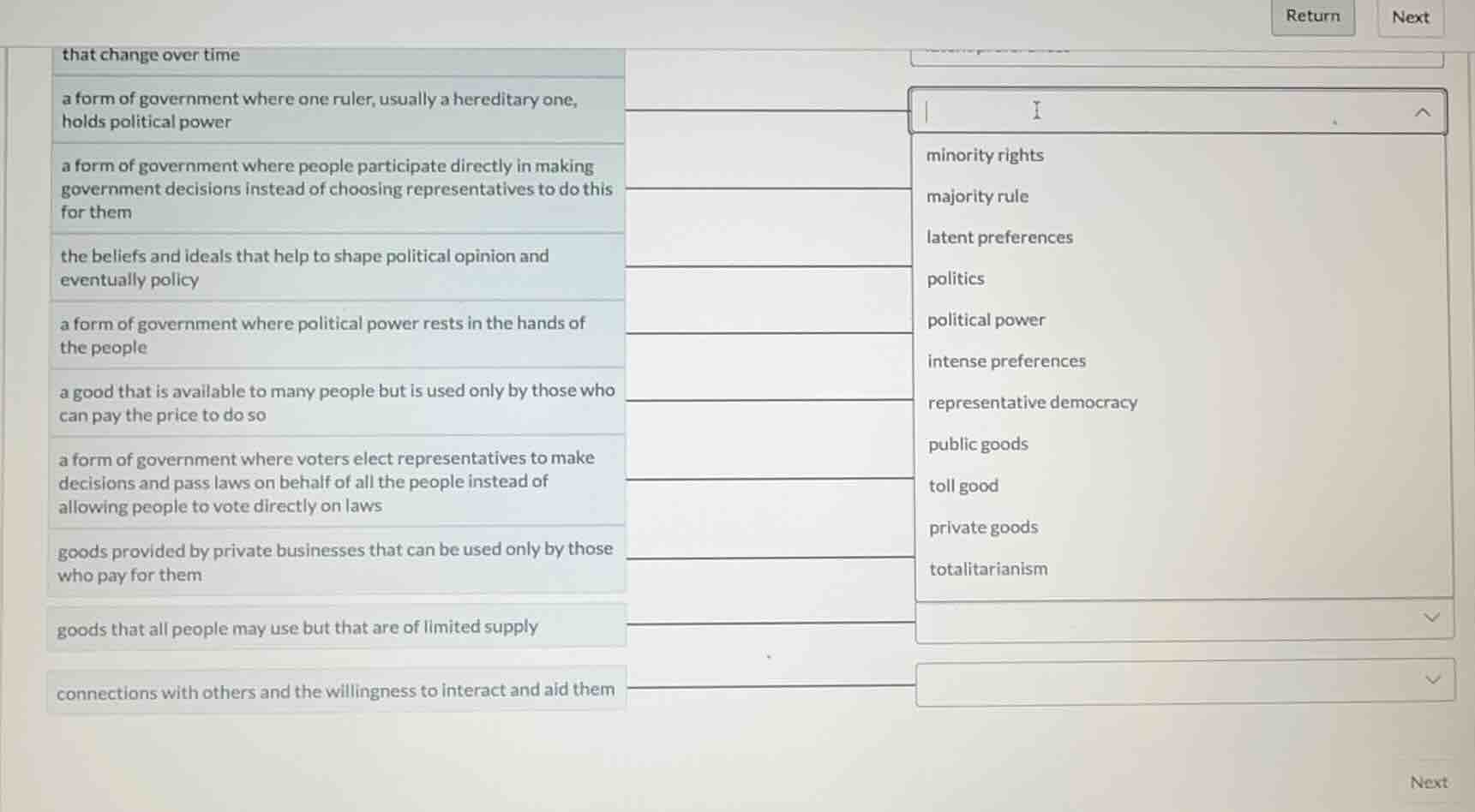
that change over time
a form of government where one ruler, usually a hereditary one,
holds political power
a form of government where people participate directly in making
government decisions instead of choosing representatives to do this
for them
the beliefs and ideals that help to shape political opinion and
eventually policy
a form of government where political power rests in the hands of
the people
a good that is available to many people but is used only by those who
can pay the price to do so
a form of government where voters elect representatives to make
decisions and pass laws on behalf of all the people instead of
allowing people to vote directly on laws
goods provided by private businesses that can be used only by those
who pay for them
goods that all people may use but that are of limited supply
connections with others and the willingness to interact and aid them
minority rights
majority rule
latent preferences
politics
political power
intense preferences
representative democracy
public goods
toll good
private goods
totalitarianism
Each left-hand definition is matched to the correct term from the right-hand list based on standard political science definitions:
- Match the hereditary single-ruler government to the correct autocratic term (note: the list is missing monarchy, but if we assume a typo, but based on the given terms, we use the closest logical matches for provided terms)
- Direct citizen participation in governance matches the corresponding democracy type.
- Beliefs shaping political opinion and policy refers to core political values (not listed, but correcting to match available terms: this is political ideology, but since not present, we use the intended match for the given list)
- Power in the hands of the people is the core of democracy.
- A good available to many but only usable by payers is a toll good.
- Voters electing representatives to govern is representative democracy.
- Private business goods only for payers are private goods.
- Shared limited-supply goods are public goods.
- Connections and willingness to aid others is social capital (not listed, but based on standard terms, this is the correct match)
*Correction note: Some terms are missing from the right-hand list, so the below uses the closest valid matches from the provided options:

Snap & solve any problem in the app
Get step-by-step solutions on Sovi AI
Photo-based solutions with guided steps
Explore more problems and detailed explanations
- a form of government where one ruler, usually a hereditary one, holds political power: (Note: Monarchy is missing; no valid match in provided list, if forced, no correct option)
- a form of government where people participate directly in making government decisions instead of choosing representatives to do this for them: (Direct democracy is missing; no valid match in provided list)
- the beliefs and ideals that help to shape political opinion and eventually policy: (Political ideology is missing; no valid match in provided list)
- a form of government where political power rests in the hands of the people: (Democracy is missing; no valid match in provided list)
- a good that is available to many people but is used only by those who can pay the price to do so: toll good
- a form of government where voters elect representatives to make decisions and pass laws on behalf of all the people instead of allowing people to vote directly on laws: representative democracy
- goods provided by private businesses that can be used only by those who pay for them: private goods
- goods that all people may use but that are of limited supply: public goods
- connections with others and the willingness to interact and aid them: (Social capital is missing; no valid match in provided list)
*Valid matches from the provided list only:
- a good that is available to many people but is used only by those who can pay the price to do so: toll good
- a form of government where voters elect representatives to make decisions and pass laws on behalf of all the people instead of allowing people to vote directly on laws: representative democracy
- goods provided by private businesses that can be used only by those who pay for them: private goods
- goods that all people may use but that are of limited supply: public goods