QUESTION IMAGE
Question
changing social hierarchies from 1450 to 1750 quiz
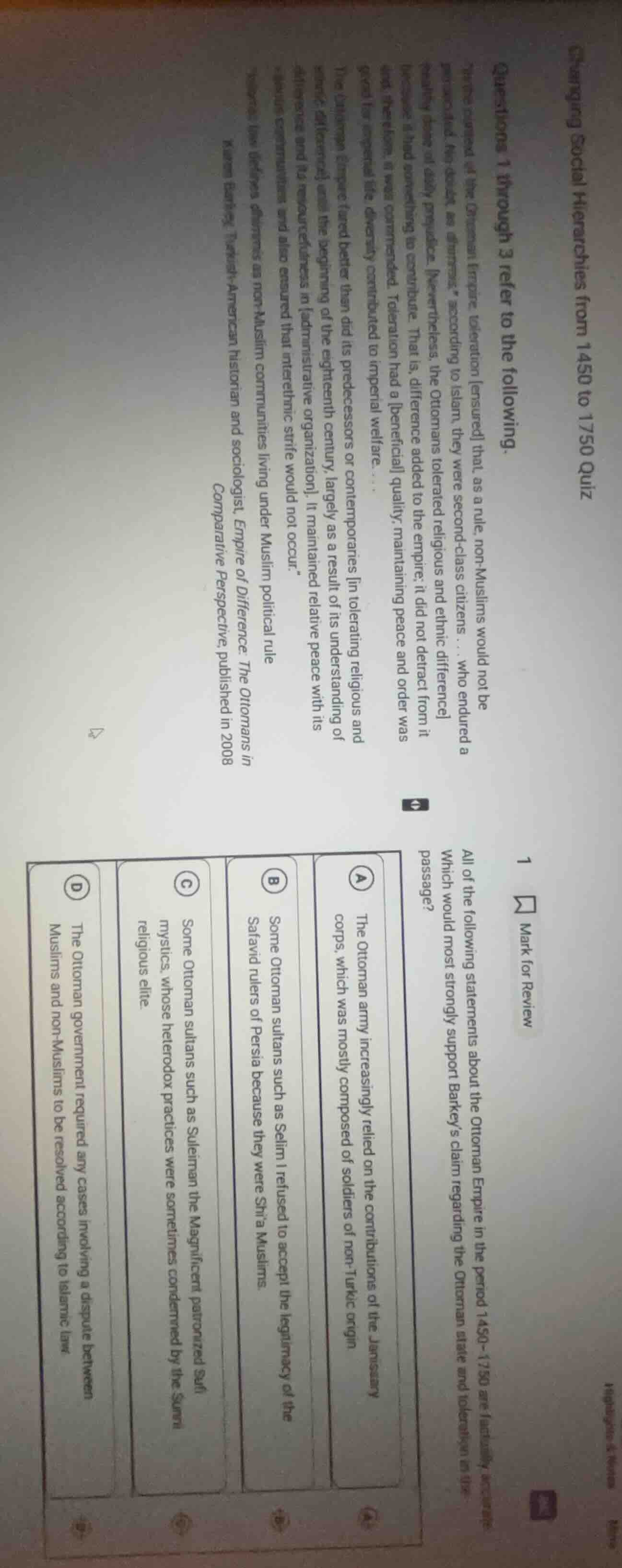
questions 1 through 3 refer to the following.
the context of the ottoman empire: toleration ensured that, as a rule, non - muslims would not be persecuted for their beliefs, as dhimmis, according to islam, they were second - class citizens... who endured a healthy dose of daily prejudice. nevertheless, the ottomans tolerated religious and ethnic difference because it had something to contribute. that is, difference added to the empire; it did not detract from it. as the above, it was contended. toleration had a beneficial quality: maintaining peace and order was good for imperial life. diversity contributed to imperial welfare....
the ottoman empire fared better than did its predecessors or contemporaries in tolerating religious and social differences until the beginning of the eighteenth century, largely as a result of its understanding of difference and its resourcefulness in administrative organization. it maintained relative peace with its various communities and also ensured that interethnic strife would not occur.
karen barkey, turkish - american historian and sociologist, empire of difference: the ottomans in comparative perspective, published in 2008
1 mark for review
all of the following statements about the ottoman empire in the period 1450 - 1750 are factually accurate. which would most strongly support barkey’s claim regarding the ottoman state and toleration in the passage?
a the ottoman army increasingly relied on the contributions of the janissary corps, which was mostly composed of soldiers of non - turkic origin
b some ottoman sultans such as selim i refused to accept the legitimacy of the safavid rulers of persia because they were shi’a muslims.
c some ottoman sultans such as suleiman the magnificent patronized sufi mystics, whose heterodox practices were sometimes condemned by the sunni religious elite.
d the ottoman government required any cases involving a dispute between muslims and non - muslims to be resolved according to islamic law
To determine the answer, we analyze each option against Barkey's claim about Ottoman tolerance.
- Option A: The Janissary corps had non - Turkic soldiers, showing Ottoman acceptance of non - core group contributions, supporting tolerance.
- Option B: Ottoman - Safavid conflict over Shi'a/Sunni is about religious division, not tolerance.
- Option C: Condemning heterodox mystics shows religious intolerance, opposing the claim.
- Option D: Resolving disputes by Islamic law doesn't show tolerance of non - Muslim differences.
Only Option A supports the idea of Ottoman tolerance by showing non - Turkic contributions to the army.

Snap & solve any problem in the app
Get step-by-step solutions on Sovi AI
Photo-based solutions with guided steps
Explore more problems and detailed explanations
A. The Ottoman army increasingly relied on the contributions of the Janissary corps, which was mostly composed of soldiers of non - Turkic origin