QUESTION IMAGE
Question
chapter 12 | building a successful career in the industry
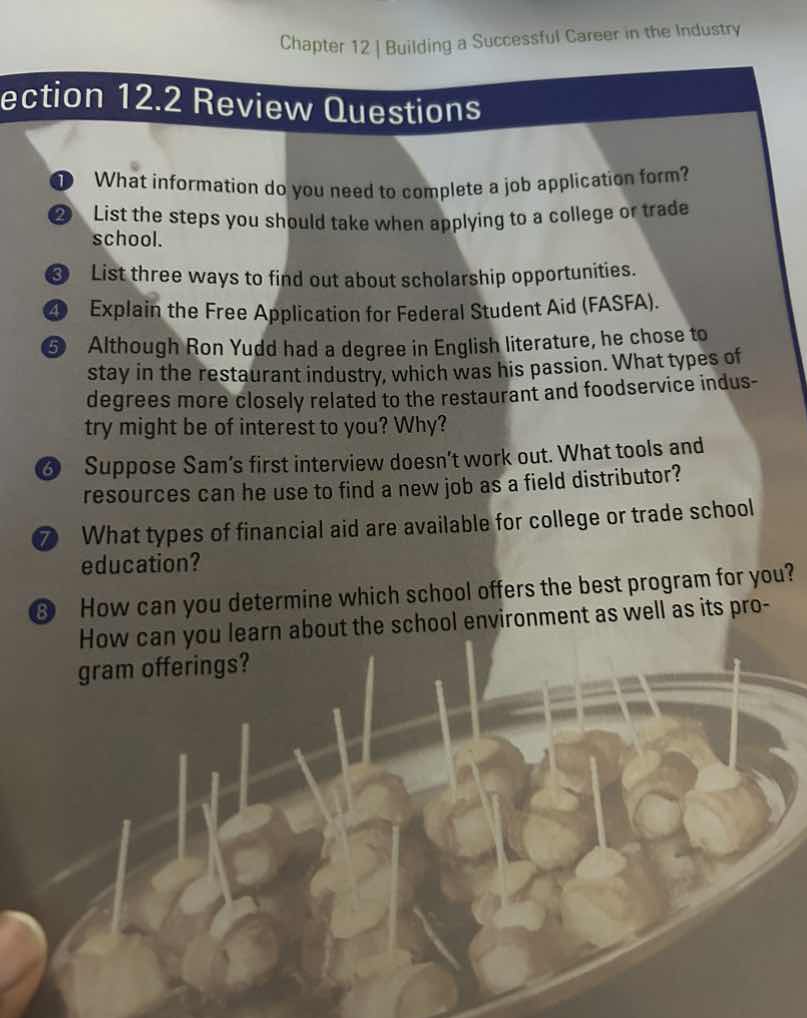
section 12.2 review questions
1 what information do you need to complete a job application form?
2 list the steps you should take when applying to a college or trade school.
3 list three ways to find out about scholarship opportunities.
4 explain the free application for federal student aid (fasfa).
5 although ron yudd had a degree in english literature, he chose to stay in the restaurant industry, which was his passion. what types of degrees more closely related to the restaurant and foodservice industry might be of interest to you? why?
6 suppose sam’s first interview doesn’t work out. what tools and resources can he use to find a new job as a field distributor?
7 what types of financial aid are available for college or trade school education?
8 how can you determine which school offers the best program for you? how can you learn about the school environment as well as its program offerings?
- Covers standard personal, background, and employment details needed for job apps.
- Outlines the sequential process for college/trade school applications.
- Lists common channels for scholarship searches.
- Defines FAFSA, its purpose, and key functions.
- Identifies relevant hospitality degrees and links them to career goals.
- Names job search resources for a field distributor role post-interview.
- Enumerates main categories of financial aid for post-secondary education.
- Details methods to evaluate school programs and environments.

Snap & solve any problem in the app
Get step-by-step solutions on Sovi AI
Photo-based solutions with guided steps
Explore more problems and detailed explanations
- To complete a job application form, you typically need: personal contact information (name, phone, email, address), employment history (previous employers, dates of employment, job duties, reasons for leaving), educational background (schools attended, degrees/diplomas earned, graduation dates), professional references (names, contact info, relationship to you), and sometimes additional details like a resume, cover letter, or responses to role-specific questions.
- Steps to apply to a college or trade school:
- Research schools to match your goals and eligibility
- Gather required materials (transcripts, test scores, essays)
- Complete and submit the school's application (and FAFSA if seeking aid)
- Submit supporting documents (letters of recommendation, portfolio if needed)
- Follow up on application status and accept an offer if admitted
- Three ways to find scholarship opportunities:
- Use free online scholarship search engines (e.g., Fastweb, Scholarships.com)
- Check with your high school guidance counselor or college financial aid office
- Apply for scholarships from community organizations, employers, or professional associations related to your field
- The Free Application for Federal Student Aid (FAFSA) is a U.S. government form that students submit to apply for federal, state, and school-based financial aid for college or trade school. It collects financial information about the student and their family to calculate the Expected Family Contribution (EFC), which determines eligibility for grants, work-study, and student loans.
- Degrees related to the restaurant and foodservice industry that may be of interest include:
- Culinary Arts: Focuses on cooking techniques, food safety, and kitchen management, ideal for roles like chef or kitchen manager.
- Hospitality Management: Covers restaurant operations, customer service, event planning, and business administration, suited for restaurant general managers or hospitality directors.
- Food Science: Combines biology and chemistry to develop food products, ensure safety, and improve quality, useful for roles in food production or quality control for foodservice brands.
These degrees provide targeted skills to advance in the industry, build expertise, and qualify for higher-level leadership roles.
- Sam can use these tools and resources:
- Specialized job boards for distribution/logistics (e.g., Indeed, ZipRecruiter with targeted filters for field distributor roles)
- Professional logistics or foodservice industry associations (networking events, job boards)
- Temporary staffing agencies focused on warehouse/distribution roles to gain experience
- Networking with current field distributors or industry contacts for referrals
- Types of financial aid available for college or trade school:
- Grants: Need-based free money (e.g., Pell Grant) that does not need to be repaid
- Scholarships: Merit-based, need-based, or interest-based free money that does not need to be repaid
- Federal Work-Study: Part-time jobs for students to earn money for school expenses
- Student Loans: Borrowed money (federal or private) that must be repaid with interest
- To determine the best program and learn about the school:
- To find the best program: Review program curricula to match your career goals, check graduation and job placement rates for the program, and compare tuition and financial aid packages.
- To learn about the school environment and offerings: Attend open houses or virtual tours, speak with current students and faculty, read online student reviews, and review the school's website for details on student organizations, support services, and facilities.