QUESTION IMAGE
Question
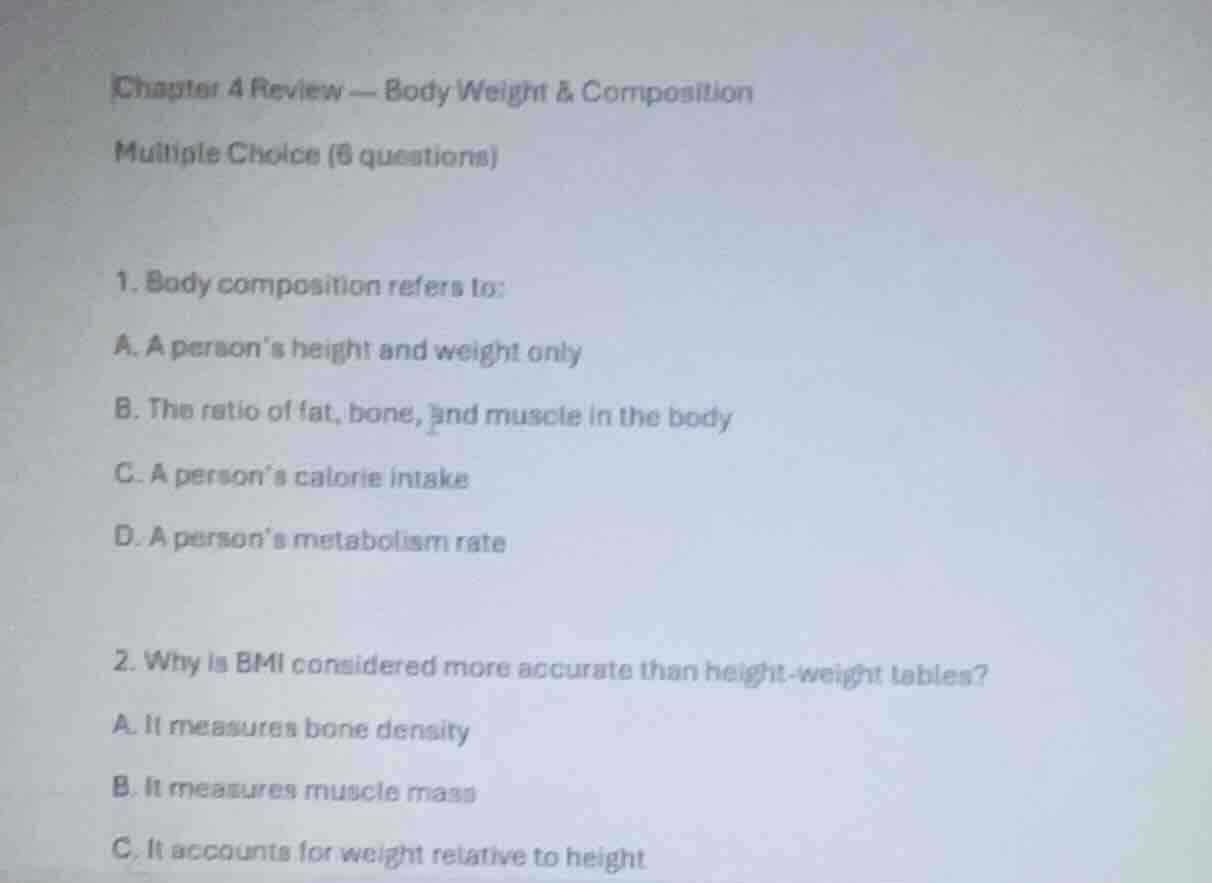
chapter 4 review — body weight & composition
multiple choice (6 questions)
- body composition refers to:
a. a person’s height and weight only
b. the ratio of fat, bone, and muscle in the body
c. a person’s calorie intake
d. a person’s metabolism rate
- why is bmi considered more accurate than height - weight tables?
a. it measures bone density
b. it measures muscle mass
c. it accounts for weight relative to height
Response
Question 1
Brief Explanations
- Option A: Height and weight alone don't define body composition; they relate to BMI or general measurements, not the composition of fat, bone, muscle, etc.
- Option B: Body composition is the proportion of fat, bone, muscle, and other tissues in the body, so this matches the definition.
- Option C: Calorie intake is about energy consumption, not body composition.
- Option D: Metabolism rate is about energy use by the body, not body composition.
Brief Explanations
- Option A: BMI does not measure bone density (bone density is measured by other methods like DEXA scans).
- Option B: BMI does not measure muscle mass (it's a simple weight - height ratio and can misclassify muscular individuals as overweight).
- Option C: BMI is calculated as weight (in kg) divided by height (in meters) squared ($BMI=\frac{weight(kg)}{height(m)^2}$), so it accounts for weight relative to height, which is more accurate than height - weight tables that may not properly account for the relationship between the two.

Snap & solve any problem in the app
Get step-by-step solutions on Sovi AI
Photo-based solutions with guided steps
Explore more problems and detailed explanations
B. The ratio of fat, bone, and muscle in the body