QUESTION IMAGE
Question
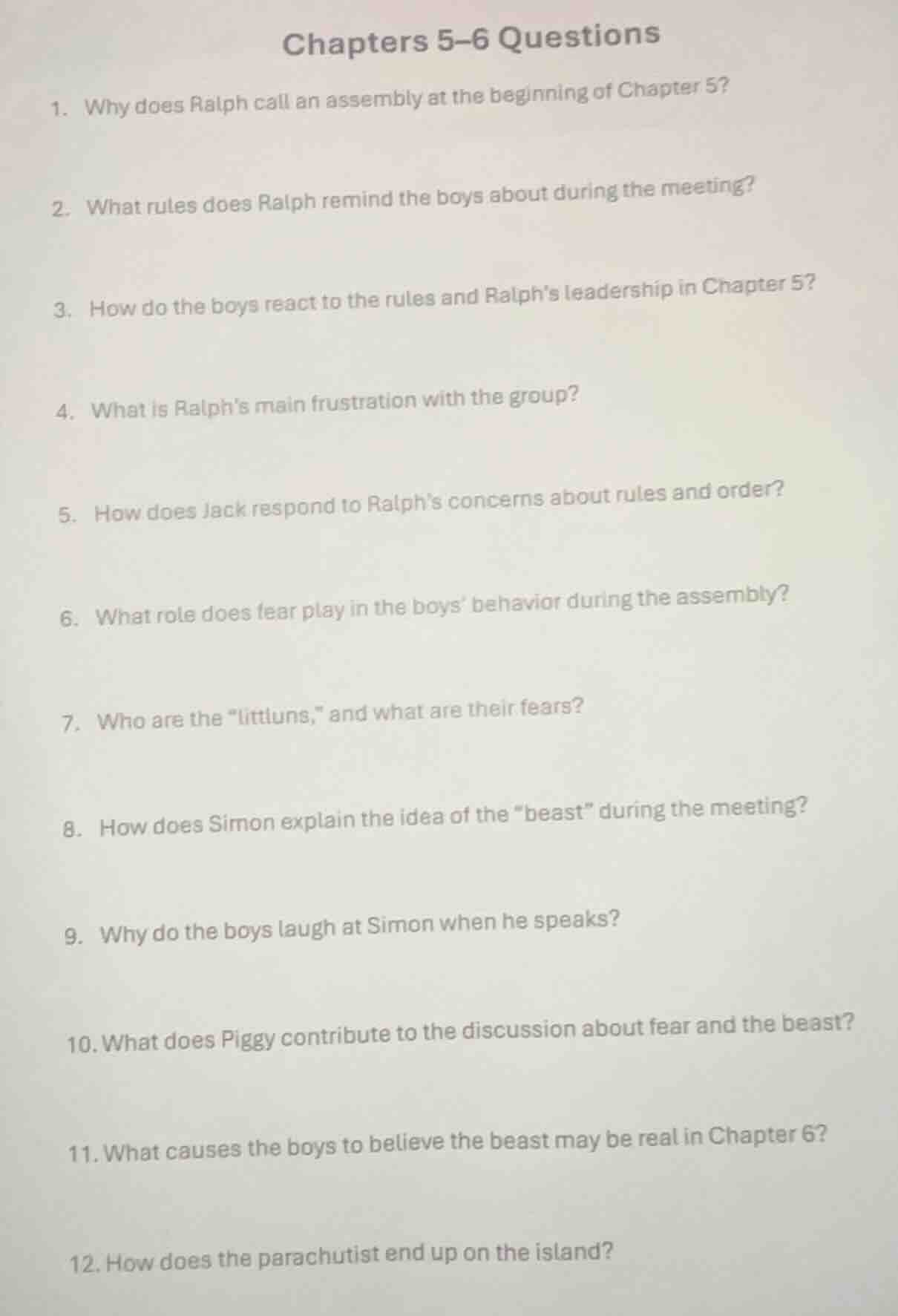
chapters 5-6 questions
- why does ralph call an assembly at the beginning of chapter 5?
- what rules does ralph remind the boys about during the meeting?
- how do the boys react to the rules and ralphs leadership in chapter 5?
- what is ralphs main frustration with the group?
- how does jack respond to ralphs concerns about rules and order?
- what role does fear play in the boys behavior during the assembly?
- who are the \littluns,\ and what are their fears?
- how does simon explain the idea of the \beast\ during the meeting?
- why do the boys laugh at simon when he speaks?
- what does piggy contribute to the discussion about fear and the beast?
- what causes the boys to believe the beast may be real in chapter 6?
- how does the parachutist end up on the island?
Brief Explanations
- Ralph calls the assembly to address the boys' growing disregard for rules, uncompleted tasks (like maintaining the signal fire), and rising fears, hoping to reestablish order.
- Ralph reminds them that only the holder of the conch may speak, the signal fire must be kept burning at all times, they must use the designated area for the bathroom, and they need to help build shelters.
- Most boys lose interest, ignore the rules, and are distracted by fear of the beast; many side with Jack's focus on hunting over Ralph's focus on rescue and order, undermining Ralph's leadership.
- Ralph is frustrated that the boys refuse to do the essential, practical work (like tending the fire, building shelters) needed for survival and rescue, choosing to hunt, play, or give in to fear instead.
- Jack dismisses Ralph's focus on rules, arguing that rules are unnecessary, that hunting and his ability to protect the boys from the beast are more important, and he openly challenges Ralph's authority.
- Fear of the "beast" makes the boys irrational, distracts them from practical tasks, erodes their respect for Ralph's ordered leadership, and pushes many to align with Jack's more aggressive, fear-driven approach.
- The "littluns" are the youngest boys on the island. They fear a "beastie" or monster on the island, as well as the dark, storms, and the unknown parts of the jungle.
- Simon suggests that the "beast" is not an external creature, but something that exists within the boys themselves—their own savagery, fear, and violent instincts.
- The boys laugh at Simon because his abstract, introspective idea about the beast being within them is too complex and uncomfortable for them to grasp; they prefer to blame an external monster rather than confront their own flaws.
- Piggy, relying on logic, argues that the beast cannot be real (since there is no evidence of it, and it would have to eat, which would leave signs) and tries to calm the group by dismissing their irrational fears.
- The boys see the dead parachutist, whose body is tangled in his parachute and moves with the wind, and mistake him for the beast, convincing themselves it is a real, threatening creature.
- The parachutist is a dead soldier from the ongoing war; his plane was shot down, and his parachute carried his body to the island.

Snap & solve any problem in the app
Get step-by-step solutions on Sovi AI
Photo-based solutions with guided steps
Explore more problems and detailed explanations
- To reestablish order, address uncompleted tasks, and confront growing fears among the boys.
- - Only the conch holder may speak.
- The signal fire must stay lit.
- Use the designated bathroom area.
- Help build and maintain shelters.
- Most boys ignore rules, lose focus, side with Jack, and undermine Ralph's leadership.
- The boys refuse to do essential survival/rescue tasks.
- Jack dismisses rules, prioritizes hunting, and challenges Ralph's authority.
- Fear makes boys irrational, erodes order, and pushes them to Jack.
- The littluns are the youngest boys; they fear a "beastie," the dark, and the unknown jungle.
- He says the beast is the boys' own inner savagery.
- They find his complex, uncomfortable idea ungraspable.
- He uses logic to argue the beast is not real and tries to calm irrational fears.
- They mistake the dead parachutist for the beast.
- He is a dead soldier whose plane was shot down, and his parachute carried him to the island.