QUESTION IMAGE
Question
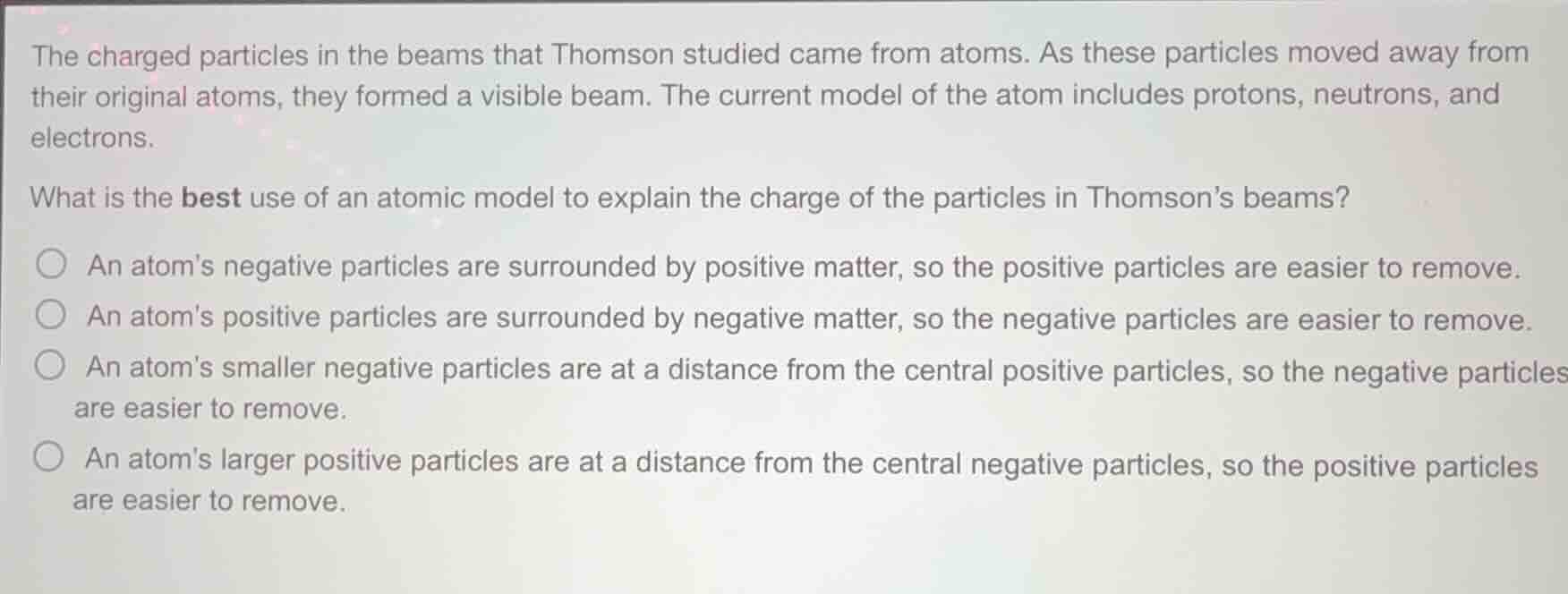
the charged particles in the beams that thomson studied came from atoms. as these particles moved away from their original atoms, they formed a visible beam. the current model of the atom includes protons, neutrons, and electrons. what is the best use of an atomic model to explain the charge of the particles in thomson’s beams? an atom’s negative particles are surrounded by positive matter, so the positive particles are easier to remove. an atom’s positive particles are surrounded by negative matter, so the negative particles are easier to remove. an atom’s smaller negative particles are at a distance from the central positive particles, so the negative particles are easier to remove. an atom’s larger positive particles are at a distance from the central negative particles, so the positive particles are easier to remove.
Thomson's cathode ray experiments identified negatively charged particles (electrons) that could be easily removed from atoms. The modern atomic model has a dense, positively charged nucleus (protons/neutrons) with smaller, negatively charged electrons orbiting at a distance. These outer electrons are weakly held and easy to remove, which matches the particles in Thomson's beams. The correct option aligns with this structure and behavior.

Snap & solve any problem in the app
Get step-by-step solutions on Sovi AI
Photo-based solutions with guided steps
Explore more problems and detailed explanations
An atom's smaller negative particles are at a distance from the central positive particles, so the negative particles are easier to remove.