QUESTION IMAGE
Question
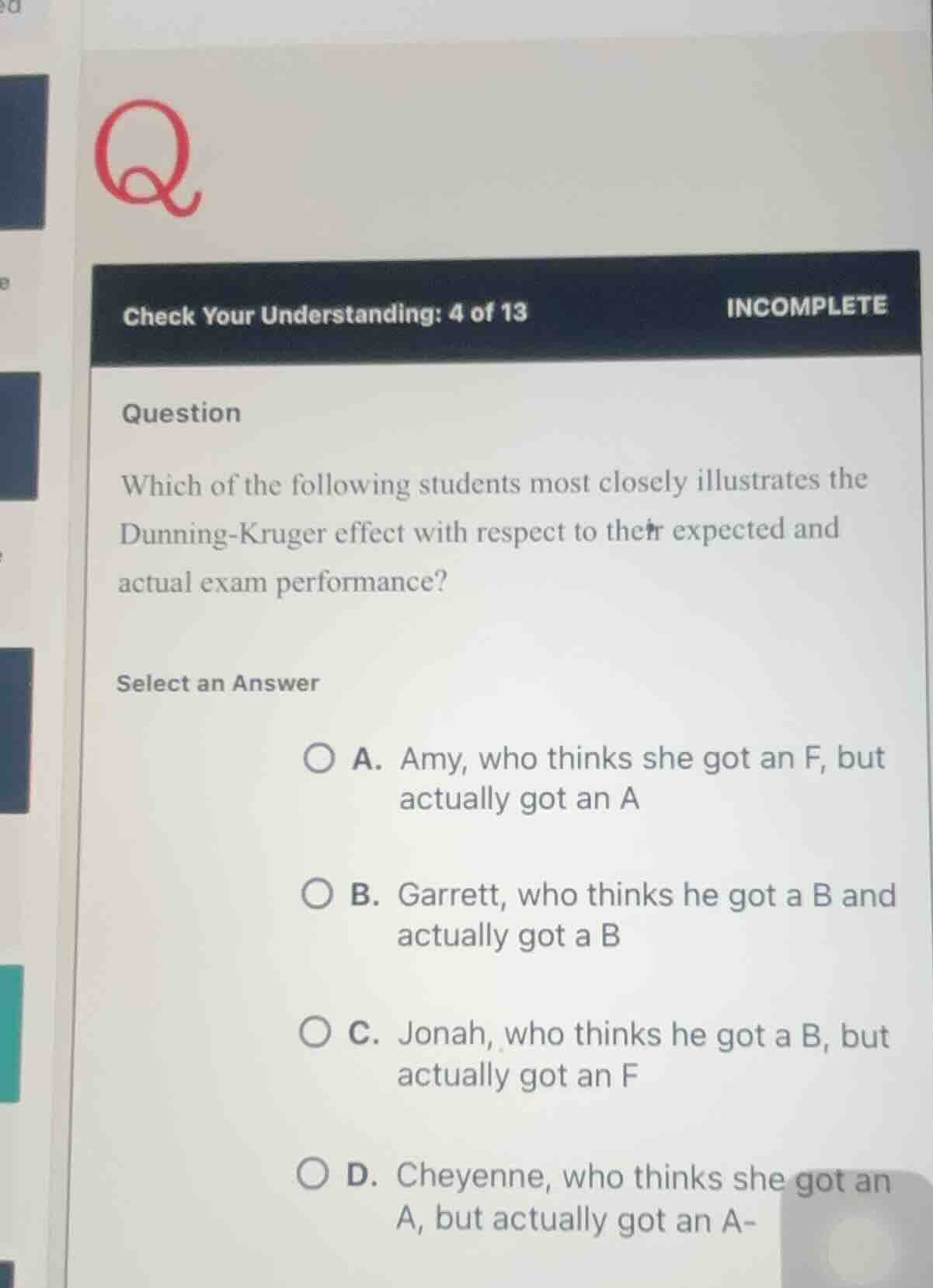
check your understanding: 4 of 13 incomplete question which of the following students most closely illustrates the dunning - kruger effect with respect to their expected and actual exam performance? select an answer a. amy, who thinks she got an f, but actually got an a b. garrett, who thinks he got a b and actually got a b c. jonah, who thinks he got a b, but actually got an f d. cheyenne, who thinks she got an a, but actually got an a -
The Dunning-Kruger effect describes a cognitive bias where people with low ability at a task overestimate their own ability, failing to recognize their lack of skill. This means they expect better performance than they actually achieve.
- Option A shows the opposite (imposter syndrome, underestimating ability).
- Option B shows accurate self-assessment, no bias.
- Option C matches the Dunning-Kruger effect: the student overestimates their performance, expecting a B but earning an F.
- Option D shows a minor overestimation of a strong performance, not the core low-ability overestimation of the effect.

Snap & solve any problem in the app
Get step-by-step solutions on Sovi AI
Photo-based solutions with guided steps
Explore more problems and detailed explanations
C. Jonah, who thinks he got a B, but actually got an F