QUESTION IMAGE
Question
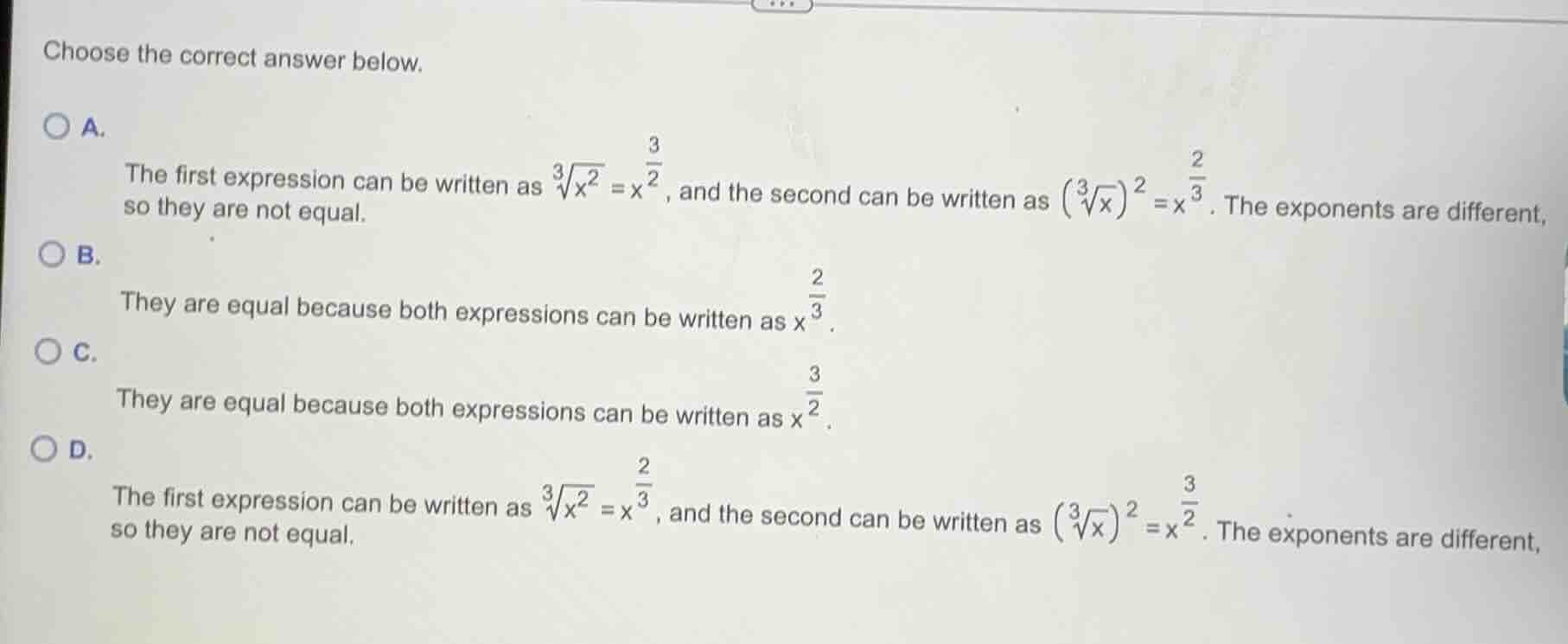
choose the correct answer below.
a.
the first expression can be written as $sqrt3{x^2}=x^{\frac{3}{2}}$, and the second can be written as $left(sqrt3{x}
ight)^2 = x^{\frac{2}{3}}$. the exponents are different, so they are not equal.
b.
they are equal because both expressions can be written as $x^{\frac{2}{3}}$.
c.
they are equal because both expressions can be written as $x^{\frac{3}{2}}$.
d.
the first expression can be written as $sqrt3{x^2}=x^{\frac{2}{3}}$, and the second can be written as $left(sqrt3{x}
ight)^2 = x^{\frac{3}{2}}$. the exponents are different, so they are not equal.
To determine if \(\sqrt[3]{x^2}\) and \((\sqrt[3]{x})^2\) are equal, we use the property of radicals and exponents: \(\sqrt[n]{a^m}=a^{\frac{m}{n}}\) and \((\sqrt[n]{a})^m = a^{\frac{m}{n}}\).
For \(\sqrt[3]{x^2}\), applying the rule \(\sqrt[n]{a^m}=a^{\frac{m}{n}}\) with \(n = 3\) and \(m=2\), we get \(x^{\frac{2}{3}}\).
For \((\sqrt[3]{x})^2\), first, \(\sqrt[3]{x}=x^{\frac{1}{3}}\), then squaring it gives \((x^{\frac{1}{3}})^2\). Using the exponent rule \((a^m)^n=a^{m\times n}\), we have \(x^{\frac{1\times2}{3}}=x^{\frac{2}{3}}\).
Both expressions simplify to \(x^{\frac{2}{3}}\), so they are equal.
Now let's analyze the options:
- Option A: Incorrectly states the exponents. The first expression is \(x^{\frac{2}{3}}\) (not \(x^{\frac{3}{2}}\)) and the second is also \(x^{\frac{2}{3}}\) (not \(x^{\frac{2}{3}}\) is misrepresented here? Wait, no, the option A says first is \(x^{\frac{3}{2}}\) which is wrong, and second is \(x^{\frac{2}{3}}\) but claims exponents are different, which is incorrect.
- Option B: Correctly states that both can be written as \(x^{\frac{2}{3}}\), so they are equal.
- Option C: Incorrectly states the exponent as \(x^{\frac{3}{2}}\) which does not match the simplification.
- Option D: Incorrectly states the exponents (first as \(x^{\frac{2}{3}}\) is correct, but second as \(x^{\frac{3}{2}}\) is wrong, and claims they are not equal which is incorrect).

Snap & solve any problem in the app
Get step-by-step solutions on Sovi AI
Photo-based solutions with guided steps
Explore more problems and detailed explanations
B. They are equal because both expressions can be written as \(x^{\frac{2}{3}}\).