QUESTION IMAGE
Question
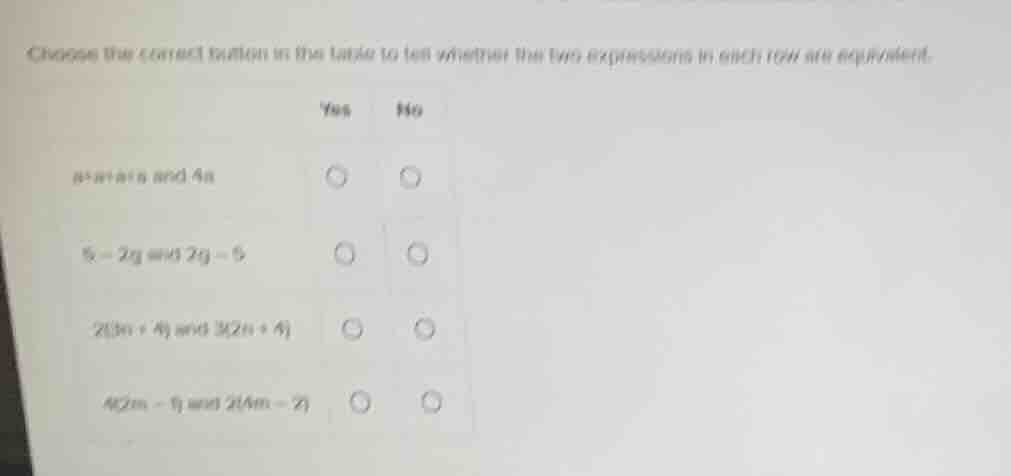
choose the correct option in the table to tell whether the two expressions in each row are equivalent.
yes no
a + a + a + a and 4a
5 - 2g and 2g - 5
2(3n + 4) and 3(2n + 4)
4(2m - 1) and 2(4m - 2)
Response
To determine if the two expressions in each row are equivalent, we analyze each row:
Row 1: \( a + a + a + a \) and \( 4a \)
- Step 1: Simplify \( a + a + a + a \). Combining like terms, we have \( 4a \) (since there are 4 \( a \) terms added together).
- Step 2: Compare with \( 4a \). Both expressions simplify to \( 4a \), so they are equivalent. Thus, we choose "Yes".
Row 2: \( 5 - 2g \) and \( 2g - 5 \)
- Step 1: Analyze the structure. \( 5 - 2g = - (2g - 5) \) (by factoring out a negative sign).
- Step 2: Compare with \( 2g - 5 \). These are not the same (one is the negative of the other). For example, if \( g = 1 \), \( 5 - 2(1) = 3 \) and \( 2(1) - 5 = -3 \), which are not equal. Thus, we choose "No".
Row 3: \( 2(3n + 4) \) and \( 3(2n + 4) \)
- Step 1: Expand both expressions.
- Expand \( 2(3n + 4) \): Using the distributive property, \( 2 \times 3n + 2 \times 4 = 6n + 8 \).
- Expand \( 3(2n + 4) \): Using the distributive property, \( 3 \times 2n + 3 \times 4 = 6n + 12 \).
- Step 2: Compare the results. \( 6n + 8
eq 6n + 12 \) (the constant terms are different). Thus, we choose "No".
Row 4: \( 4(2m - n) \) and \( 2(4m - 2n) \)
- Step 1: Expand both expressions.
- Expand \( 4(2m - n) \): Using the distributive property, \( 4 \times 2m - 4 \times n = 8m - 4n \).
- Expand \( 2(4m - 2n) \): Using the distributive property, \( 2 \times 4m - 2 \times 2n = 8m - 4n \).
- Step 2: Compare the results. Both expressions simplify to \( 8m - 4n \), so they are equivalent. Thus, we choose "Yes".
Final Answers (for each row):
- \( a + a + a + a \) and \( 4a \): \(\boldsymbol{\text{Yes}}\)
- \( 5 - 2g \) and \( 2g - 5 \): \(\boldsymbol{\text{No}}\)
- \( 2(3n + 4) \) and \( 3(2n + 4) \): \(\boldsymbol{\text{No}}\)
- \( 4(2m - n) \) and \( 2(4m - 2n) \): \(\boldsymbol{\text{Yes}}\)
To mark the table:
- For the first row, select the "Yes" radio button.
- For the second row, select the "No" radio button.
- For the third row, select the "No" radio button.
- For the fourth row, select the "Yes" radio button.

Snap & solve any problem in the app
Get step-by-step solutions on Sovi AI
Photo-based solutions with guided steps
Explore more problems and detailed explanations
To determine if the two expressions in each row are equivalent, we analyze each row:
Row 1: \( a + a + a + a \) and \( 4a \)
- Step 1: Simplify \( a + a + a + a \). Combining like terms, we have \( 4a \) (since there are 4 \( a \) terms added together).
- Step 2: Compare with \( 4a \). Both expressions simplify to \( 4a \), so they are equivalent. Thus, we choose "Yes".
Row 2: \( 5 - 2g \) and \( 2g - 5 \)
- Step 1: Analyze the structure. \( 5 - 2g = - (2g - 5) \) (by factoring out a negative sign).
- Step 2: Compare with \( 2g - 5 \). These are not the same (one is the negative of the other). For example, if \( g = 1 \), \( 5 - 2(1) = 3 \) and \( 2(1) - 5 = -3 \), which are not equal. Thus, we choose "No".
Row 3: \( 2(3n + 4) \) and \( 3(2n + 4) \)
- Step 1: Expand both expressions.
- Expand \( 2(3n + 4) \): Using the distributive property, \( 2 \times 3n + 2 \times 4 = 6n + 8 \).
- Expand \( 3(2n + 4) \): Using the distributive property, \( 3 \times 2n + 3 \times 4 = 6n + 12 \).
- Step 2: Compare the results. \( 6n + 8
eq 6n + 12 \) (the constant terms are different). Thus, we choose "No".
Row 4: \( 4(2m - n) \) and \( 2(4m - 2n) \)
- Step 1: Expand both expressions.
- Expand \( 4(2m - n) \): Using the distributive property, \( 4 \times 2m - 4 \times n = 8m - 4n \).
- Expand \( 2(4m - 2n) \): Using the distributive property, \( 2 \times 4m - 2 \times 2n = 8m - 4n \).
- Step 2: Compare the results. Both expressions simplify to \( 8m - 4n \), so they are equivalent. Thus, we choose "Yes".
Final Answers (for each row):
- \( a + a + a + a \) and \( 4a \): \(\boldsymbol{\text{Yes}}\)
- \( 5 - 2g \) and \( 2g - 5 \): \(\boldsymbol{\text{No}}\)
- \( 2(3n + 4) \) and \( 3(2n + 4) \): \(\boldsymbol{\text{No}}\)
- \( 4(2m - n) \) and \( 2(4m - 2n) \): \(\boldsymbol{\text{Yes}}\)
To mark the table:
- For the first row, select the "Yes" radio button.
- For the second row, select the "No" radio button.
- For the third row, select the "No" radio button.
- For the fourth row, select the "Yes" radio button.