QUESTION IMAGE
Question
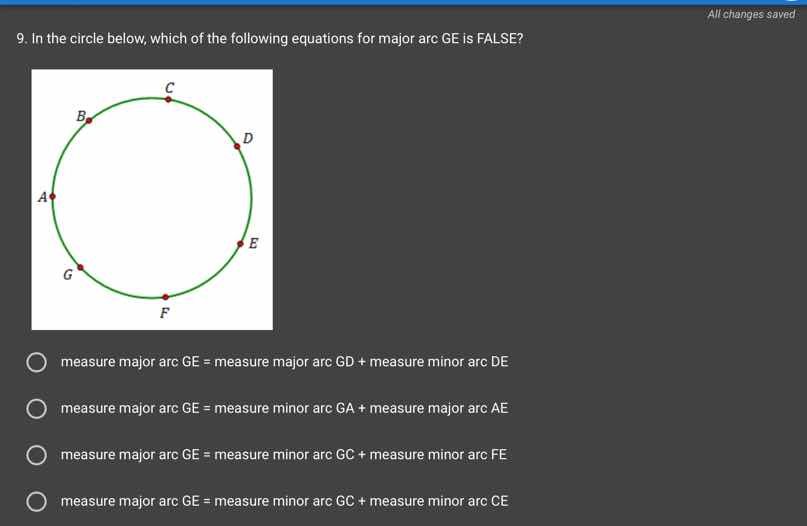
- in the circle below, which of the following equations for major arc ge is false?
options:
measure major arc ge = measure major arc gd + measure minor arc de
measure major arc ge = measure minor arc ga + measure major arc ae
measure major arc ge = measure minor arc gc + measure minor arc fe
measure major arc ge = measure minor arc gc + measure minor arc ce
Step1: Recall Arc Addition Postulate
The arc addition postulate states that the measure of an arc formed by two adjacent arcs is the sum of the measures of the two arcs. For a circle, the major arc and minor arc between two points can be analyzed by breaking down the arcs into adjacent parts.
Step2: Analyze Each Option
- Option 1: measure major arc \( GE \) = measure major arc \( GD \) + measure minor arc \( DE \)
Major arc \( GD \) and minor arc \( DE \) are adjacent (share point \( D \)), so their sum should be major arc \( GE \). This is likely true.
- Option 2: measure major arc \( GE \) = measure minor arc \( GA \) + measure major arc \( AE \)
Minor arc \( GA \) and major arc \( AE \) are adjacent (share point \( A \)), so their sum should be major arc \( GE \). This is likely true.
- Option 3: measure major arc \( GE \) = measure minor arc \( GC \) + measure minor arc \( FE \)
Minor arc \( GC \) and minor arc \( FE \): Let's check the positions. Points \( G, C, F, E \) – minor arc \( GC \) and minor arc \( FE \) are not adjacent in a way that their sum would be major arc \( GE \). Wait, maybe miscalculation. Wait, let's check Option 4 first.
- Option 4: measure major arc \( GE \) = measure minor arc \( GC \) + measure minor arc \( CE \)
Minor arc \( GC \) and minor arc \( CE \): These two arcs are adjacent (share point \( C \)), so their sum should be major arc \( GE \) (since \( GC + CE \) would cover from \( G \) to \( E \) through \( C \), which is the major arc if the minor arc \( GE \) is the other way). Wait, no – actually, the major arc \( GE \) is the longer path, so if minor arc \( GE \) is the shorter path, then major arc \( GE \) is the rest of the circle. But let's re-express:
Wait, the key is to find which equation is FALSE. Let's re-express each:
- For major arc \( GE \), the correct decompositions should use adjacent arcs that add up to it.
Option 4: minor arc \( GC \) + minor arc \( CE \). Since \( GC \) and \( CE \) are adjacent (share \( C \)), their sum is arc \( GE \) (but wait, is it major or minor? If \( GC \) and \( CE \) are minor arcs, their sum could be major arc \( GE \) if the total is more than 180 degrees.
Option 3: minor arc \( GC \) + minor arc \( FE \). Are these adjacent? Minor arc \( GC \) is from \( G \) to \( C \), minor arc \( FE \) is from \( F \) to \( E \). These two arcs are not adjacent (they are separated by arc \( CF \) or something). So their sum would not be major arc \( GE \). Wait, maybe I got Option 3 and 4 mixed. Wait, let's list the points in order: \( G, A, B, C, D, E, F, G \) (assuming the circle is labeled clockwise: \( G \) to \( A \) to \( B \) to \( C \) to \( D \) to \( E \) to \( F \) to \( G \)). So the order is \( G, A, B, C, D, E, F \) around the circle.
So major arc \( GE \) is the arc from \( G \) to \( E \) through \( C, D \) (the longer path). Let's check each option:
- Major arc \( GD \) (from \( G \) to \( D \) through \( C \)) + minor arc \( DE \) (from \( D \) to \( E \)): Yes, \( GD \) (major) + \( DE \) (minor) = \( GE \) (major). Correct.
- Minor arc \( GA \) (from \( G \) to \( A \)) + major arc \( AE \) (from \( A \) to \( E \) through \( B, C, D \)): Yes, \( GA \) (minor) + \( AE \) (major) = \( GE \) (major). Correct.
- Minor arc \( GC \) (from \( G \) to \( C \)) + minor arc \( FE \) (from \( F \) to \( E \)): These two arcs are not adjacent. \( GC \) is \( G \) to \( C \), \( FE \) is \( F \) to \( E \). The arc from \( G \) to \( C \) and \( F \) to \( E \) – there's a gap between \( C \) and \( F \) (ar…

Snap & solve any problem in the app
Get step-by-step solutions on Sovi AI
Photo-based solutions with guided steps
Explore more problems and detailed explanations
The false equation is: measure major arc \( GE \) = measure minor arc \( GC \) + measure minor arc \( FE \) (the third option in the list).