QUESTION IMAGE
Question
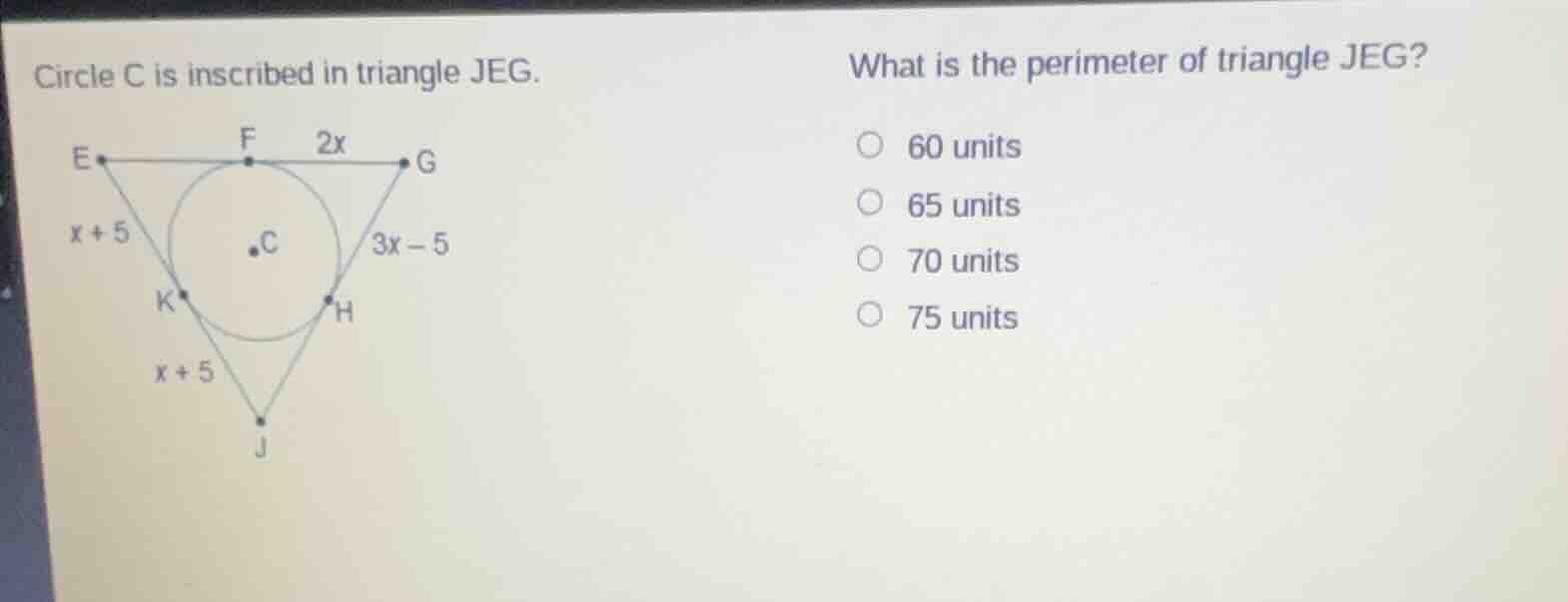
circle c is inscribed in triangle jeg.
what is the perimeter of triangle jeg?
60 units
65 units
70 units
75 units
Step1: Use tangent segment theorem
Tangent segments from a point to a circle are equal. So, \(EG\) and \(JG\) related segments: \(2x = 3x - 5\) (wait, no, actually, from point \(G\), the two tangents to the circle are \(GF\) (length \(2x\)) and \(GH\) (length \(3x - 5\))? Wait, no, looking at the triangle: from \(E\), the tangents are \(EK\) and \(EF\), both \(x + 5\). From \(J\), the tangents are \(JK\) and \(JH\), both \(x + 5\)? Wait, no, \(JK\) is \(x + 5\), \(JH\) should be equal? Wait, no, from \(G\), the two tangents: \(GF = 2x\) and \(GH = 3x - 5\). Wait, no, correct: in a triangle with an incircle, the lengths of the two tangent segments from a vertex to the points of tangency are equal. So, from \(G\): \(GF = GH\)? Wait, \(GF\) is \(2x\), \(GH\) is \(3x - 5\)? No, wait, \(G\) to \(F\) is \(2x\), \(G\) to \(H\) is \(3x - 5\)? Wait, no, \(E\) to \(F\) and \(E\) to \(K\) are equal (both from \(E\) to the circle). \(J\) to \(K\) and \(J\) to \(H\) are equal. \(G\) to \(F\) and \(G\) to \(H\) are equal. So, \(GF = GH\)? Wait, \(GF = 2x\), \(GH = 3x - 5\)? No, that can't be. Wait, maybe from \(G\), the two tangents are \(GF\) (length \(2x\)) and \(GH\) (length \(3x - 5\))? Wait, no, let's re-examine the diagram. The triangle is \(JEG\), with incircle touching \(EG\) at \(F\), \(EJ\) at \(K\), and \(JG\) at \(H\). So:
- From \(E\): \(EK = EF = x + 5\)
- From \(J\): \(JK = JH = x + 5\) (wait, \(JK\) is \(x + 5\), \(JH\) should be equal? Wait, \(JK\) is \(x + 5\), \(JH\) is... Wait, \(J\) to \(K\) is \(x + 5\), \(J\) to \(H\) is \(3x - 5\)? No, that's not. Wait, no, \(J\) to \(K\) is \(x + 5\), \(J\) to \(H\) should be equal to \(JK\)? Wait, no, \(J\) to \(K\) is \(x + 5\), \(J\) to \(H\) is \(3x - 5\)? No, that's a mistake. Wait, no, from \(G\): \(GF = GH\). \(GF\) is \(2x\), \(GH\) is \(3x - 5\)? Wait, no, \(G\) to \(F\) is \(2x\), \(G\) to \(H\) is \(3x - 5\). So set them equal: \(2x = 3x - 5\). Solve for \(x\): \(3x - 2x = 5\) → \(x = 5\)? Wait, no, that can't be. Wait, maybe from \(J\): \(JK = JH\). \(JK\) is \(x + 5\), \(JH\) is \(3x - 5\)? Wait, that makes sense. So \(x + 5 = 3x - 5\). Let's solve that: \(3x - x = 5 + 5\) → \(2x = 10\) → \(x = 5\). Wait, no, if \(x = 5\), then \(JK = 5 + 5 = 10\), \(JH = 3*5 - 5 = 10\), that works. Then from \(E\): \(EK = EF = x + 5 = 10\). Then \(EG\) is \(EF + FG = (x + 5) + 2x = 10 + 10 = 20\)? Wait, no, \(EF\) is \(x + 5 = 10\), \(FG\) is \(2x = 10\), so \(EG = 10 + 10 = 20\). \(EJ\) is \(EK + JK = (x + 5) + (x + 5) = 10 + 10 = 20\). \(JG\) is \(JH + GH = (3x - 5) + (2x) = 10 + 10 = 20\)? No, that would make an equilateral triangle, but the options are 60, 65, 70, 75. Wait, I must have misidentified the segments. Let's re-express:
Wait, the triangle is \(JEG\). The incircle touches \(EG\) at \(F\), \(EJ\) at \(K\), \(JG\) at \(H\). So:
- \(EK = EF = a\) (let's say)
- \(JK = JH = b\)
- \(GF = GH = c\)
So, \(EK = EF = x + 5\) (so \(a = x + 5\))
\(JK = JH = x + 5\) (so \(b = x + 5\))? No, \(JK\) is \(x + 5\), \(JH\) is \(3x - 5\), so \(b = x + 5\) and \(b = 3x - 5\), so \(x + 5 = 3x - 5\) → \(x = 5\). Then \(a = 10\), \(b = 10\), \(c = 2x = 10\). Then sides:
\(EJ = EK + JK = a + b = 10 + 10 = 20\)
\(JG = JH + GH = b + c = 10 + 10 = 20\)
\(EG = EF + FG = a + c = 10 + 10 = 20\)
Perimeter would be 20 + 20 + 20 = 60, but 60 is an option. Wait, but let's check again. Wait, maybe \(EG\) is \(EF + FG = (x + 5) + 2x\), \(EJ\) is \(EK + JK = (x + 5) + (x + 5)\), \(JG\) is \(JH + GH = (3x - 5) + (2x)\). Wait, no, \(GH\) is \(GF\), which is \(2x\), and \(JH\) is \(3x - 5\), and \(JK\) is \(…

Snap & solve any problem in the app
Get step-by-step solutions on Sovi AI
Photo-based solutions with guided steps
Explore more problems and detailed explanations
60 units