QUESTION IMAGE
Question
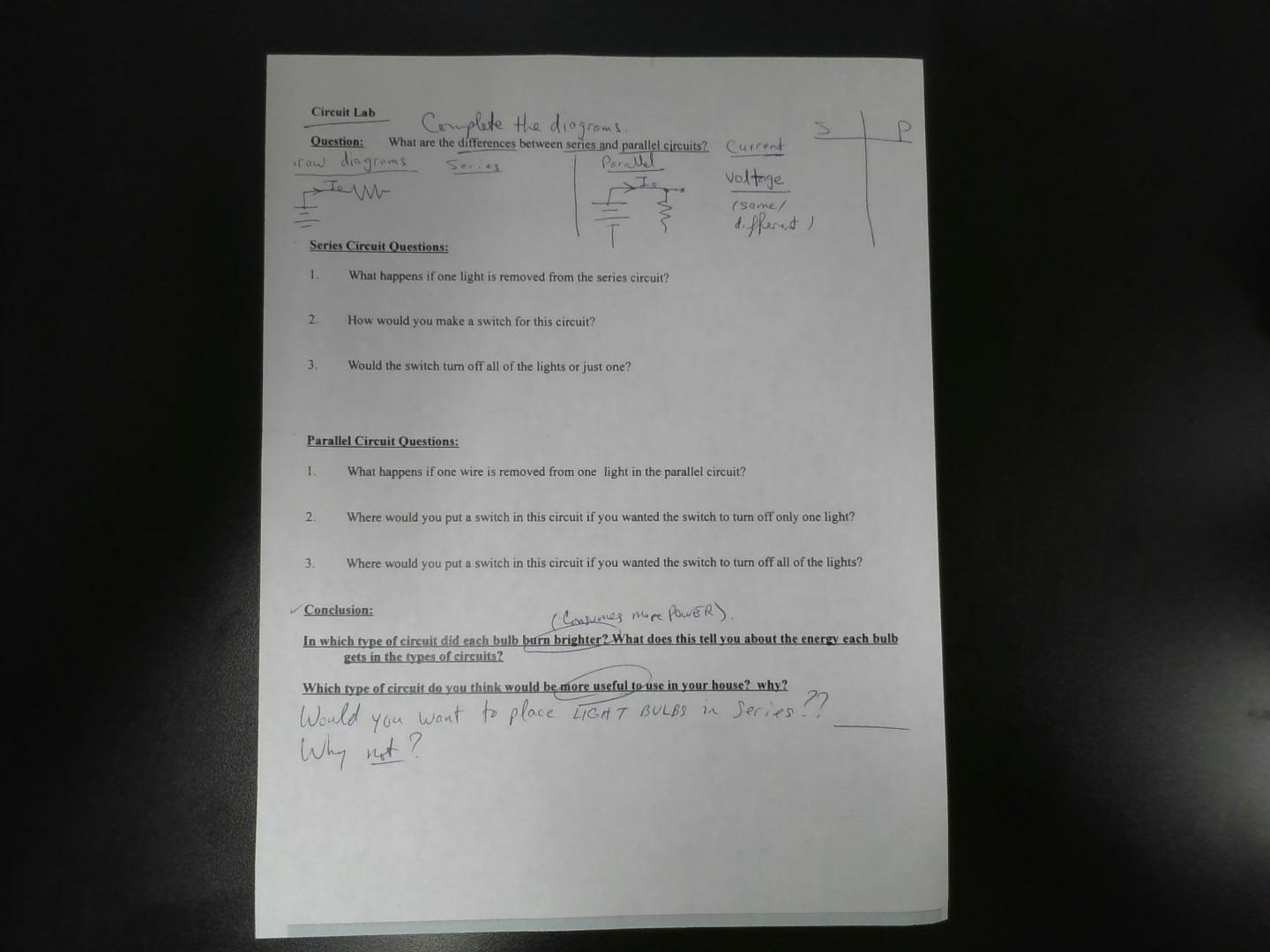
circuit labcomplete the diagrams.question: what are the differences between series and parallel circuits?raw diagrams series parallel currentvoltage(same/different)series circuit questions:1. what happens if one light is removed from the series circuit?2. how would you make a switch for this circuit?3. would the switch turn off all of the lights or just one?parallel circuit questions:1. what happens if one wire is removed from one light in the parallel circuit?2. where would you put a switch in this circuit if you wanted the switch to turn off only one light?3. where would you put a switch in this circuit if you wanted the switch to turn off all of the lights?conclusion:(contains more power)in which type of circuit did each bulb burn brighter? what does this tell you about the energy each bulbgets in the types of circuits?which type of circuit do you think would be more useful to use in your house? why?would you want to place light bulbs in series??why not?
Series Circuit Answers:
- A series circuit has one continuous path for current. Removing one light breaks the circuit, so no current flows.
- A switch is inserted into the single current path of the series circuit.
- The switch controls the only current path, so it affects all components.
Parallel Circuit Answers:
- Parallel circuits have separate branches for each component. Removing a wire from one light only breaks that single branch; other branches remain intact.
- To control only one light, the switch must be placed on the individual branch of that specific light.
- To control all lights, the switch must be placed on the main (common) path that supplies current to all parallel branches.
Conclusion Answers:
- In a parallel circuit, each bulb receives the full source voltage, while in a series circuit, voltage is divided between bulbs. Higher voltage means more power ($P=\frac{V^2}{R}$) for identical bulbs, so parallel bulbs burn brighter. This means bulbs in parallel receive more electrical energy per unit time.
- Parallel circuits are more useful for houses. If one light fails, others stay on, and each device can operate at full voltage. Series circuits are not ideal because one failed device shuts off all others, and devices don't get full voltage.

Snap & solve any problem in the app
Get step-by-step solutions on Sovi AI
Photo-based solutions with guided steps
Explore more problems and detailed explanations
Series Circuit Questions:
- All other lights will turn off, as the circuit is broken.
- Insert the switch into the single continuous path of the circuit.
- The switch will turn off all of the lights.
Parallel Circuit Questions:
- Only that one light will turn off; all other lights in the circuit will remain on.
- Place the switch on the individual branch that connects to the specific light you want to control.
- Place the switch on the main circuit path before the parallel branches split.
Conclusion:
- Bulbs in a parallel circuit burn brighter. This tells us each bulb in a parallel circuit receives more electrical energy (since they get the full source voltage, unlike series bulbs which split the voltage).
- Parallel circuits are more useful for houses. This is because if one electrical device (like a light) stops working, all other devices will continue to function, and each device can operate at the full household voltage. You would not want to place light bulbs in series because if one bulb burns out, all the other bulbs in the circuit will also turn off, and each bulb would receive only a fraction of the total voltage, making them dimmer.