QUESTION IMAGE
Question
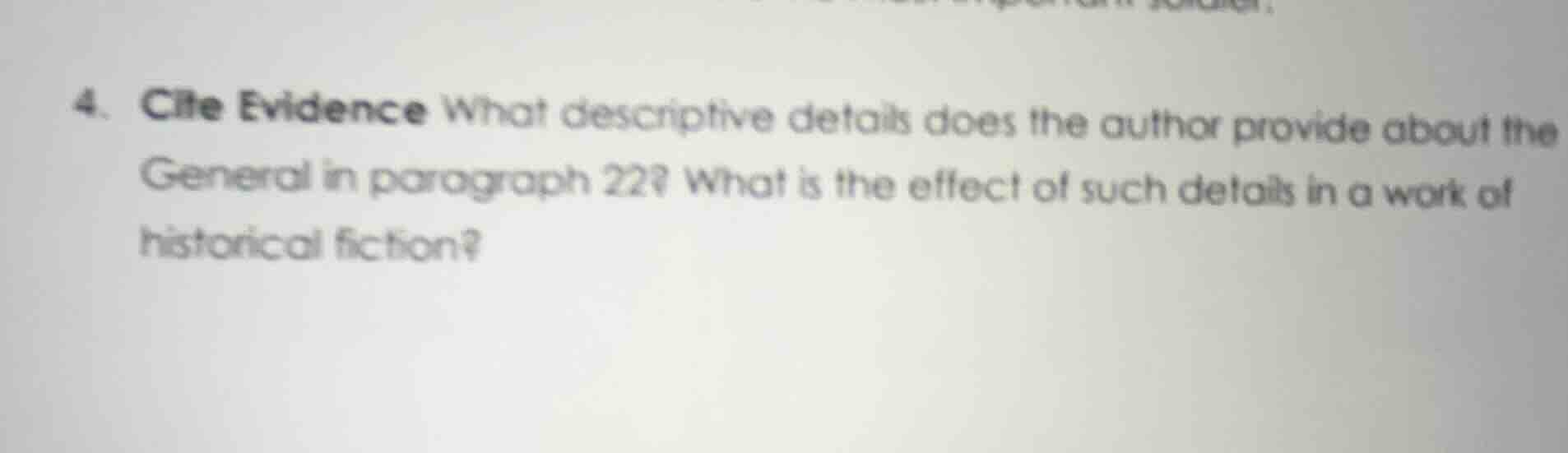
- cite evidence what descriptive details does the author provide about the general in paragraph 22? what is the effect of such details in a work of historical fiction?
To answer this question, we would first need the text of paragraph 22 (the paragraph about the General) from the work of historical fiction in question. Since that text is not provided here, we can't directly identify the descriptive details. However, in general, for the first part, we would:
- Locate paragraph 22 and identify details like the General’s physical appearance (e.g., “a tall, gaunt man with a stern jaw”), actions (e.g., “he paced the tent, fingers drumming on a map”), speech (e.g., “his voice, sharp as a saber, barked orders”), or personality traits (e.g., “brooding, yet fiercely loyal to his troops”) that the author uses to describe the General.
- For the effect of such details in historical fiction: Descriptive details humanize historical figures, making them feel real and relatable (not just names in history). They add depth to the story, blend historical accuracy with creative storytelling, and help readers visualize the past, enhancing immersion. They also can emphasize the time period’s culture, social norms, or military practices, balancing fact and fiction to make the historical setting feel authentic.
If we had the specific text of paragraph 22, we could extract the exact details (e.g., if it says, “The General stood, his uniform crisp with gold braid, eyes like flint as he surveyed the camp,” we’d cite that). Then, explain the effect: those details (uniform, eye description) make the General a vivid, three - dimensional character, root the story in its historical context (showing military attire of the era), and bridge the gap between historical record and fictional narrative, engaging readers emotionally while teaching them about the time.

Snap & solve any problem in the app
Get step-by-step solutions on Sovi AI
Photo-based solutions with guided steps
Explore more problems and detailed explanations
To answer this question, we would first need the text of paragraph 22 (the paragraph about the General) from the work of historical fiction in question. Since that text is not provided here, we can't directly identify the descriptive details. However, in general, for the first part, we would:
- Locate paragraph 22 and identify details like the General’s physical appearance (e.g., “a tall, gaunt man with a stern jaw”), actions (e.g., “he paced the tent, fingers drumming on a map”), speech (e.g., “his voice, sharp as a saber, barked orders”), or personality traits (e.g., “brooding, yet fiercely loyal to his troops”) that the author uses to describe the General.
- For the effect of such details in historical fiction: Descriptive details humanize historical figures, making them feel real and relatable (not just names in history). They add depth to the story, blend historical accuracy with creative storytelling, and help readers visualize the past, enhancing immersion. They also can emphasize the time period’s culture, social norms, or military practices, balancing fact and fiction to make the historical setting feel authentic.
If we had the specific text of paragraph 22, we could extract the exact details (e.g., if it says, “The General stood, his uniform crisp with gold braid, eyes like flint as he surveyed the camp,” we’d cite that). Then, explain the effect: those details (uniform, eye description) make the General a vivid, three - dimensional character, root the story in its historical context (showing military attire of the era), and bridge the gap between historical record and fictional narrative, engaging readers emotionally while teaching them about the time.