QUESTION IMAGE
Question
college graduation year:
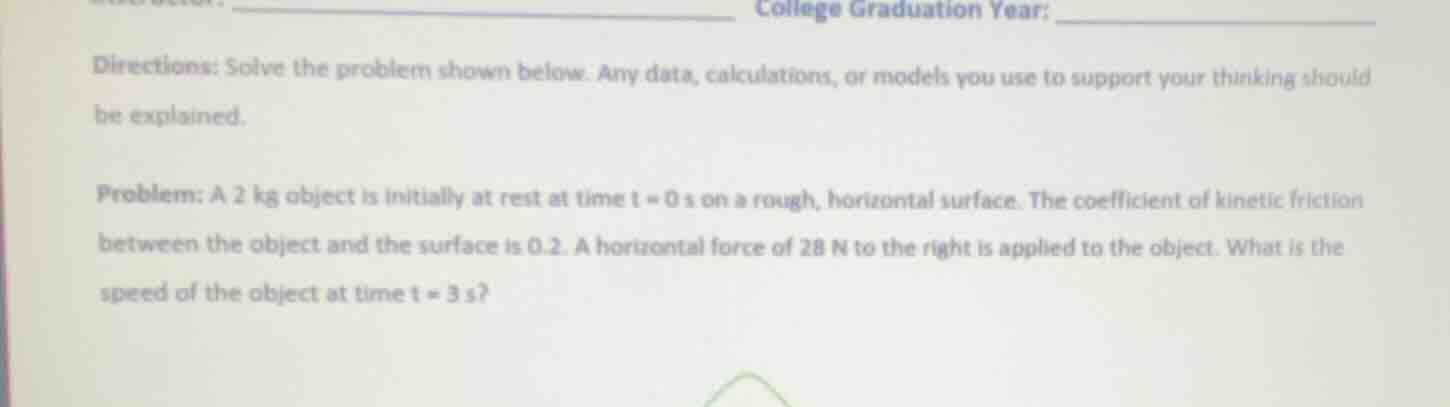
directions: solve the problem shown below. any data, calculations, or models you use to support your thinking should be explained.
problem: a 2 kg object is initially at rest at time t = 0 s on a rough, horizontal surface. the coefficient of kinetic friction between the object and the surface is 0.2. a horizontal force of 28 n to the right is applied to the object. what is the speed of the object at time t = 3 s?
Step1: Calculate the frictional force
The formula for kinetic frictional force is \( F_f = \mu_k F_N \), where \( F_N \) (normal force) on a horizontal surface is equal to the weight of the object, \( F_N = mg \). Here, \( m = 2\space kg \), \( g = 9.8\space m/s^2 \), and \( \mu_k = 0.2 \). So \( F_N = 2\times9.8 = 19.6\space N \), and \( F_f = 0.2\times19.6 = 3.92\space N \).
Step2: Calculate the net force
The applied force \( F_{app} = 28\space N \) to the right, and frictional force \( F_f \) is to the left. So net force \( F_{net} = F_{app}-F_f = 28 - 3.92 = 24.08\space N \).
Step3: Calculate the acceleration
Using Newton's second law \( F_{net}=ma \), we can find acceleration \( a=\frac{F_{net}}{m}=\frac{24.08}{2}=12.04\space m/s^2 \).
Step4: Calculate the speed at \( t = 3\space s \)
Using the kinematic equation \( v = u+at \), where initial velocity \( u = 0\space m/s \) (object is at rest initially), \( a = 12.04\space m/s^2 \), and \( t = 3\space s \). So \( v = 0+12.04\times3 = 36.12\space m/s \). (If we use \( g = 10\space m/s^2 \) for approximation, \( F_N = 2\times10 = 20\space N \), \( F_f = 0.2\times20 = 4\space N \), \( F_{net}=28 - 4 = 24\space N \), \( a=\frac{24}{2}=12\space m/s^2 \), \( v = 0 + 12\times3 = 36\space m/s \))

Snap & solve any problem in the app
Get step-by-step solutions on Sovi AI
Photo-based solutions with guided steps
Explore more problems and detailed explanations
The speed of the object at \( t = 3\space s \) is approximately \( 36\space m/s \) (or \( 36.12\space m/s \) with \( g = 9.8\space m/s^2 \)).