QUESTION IMAGE
Question
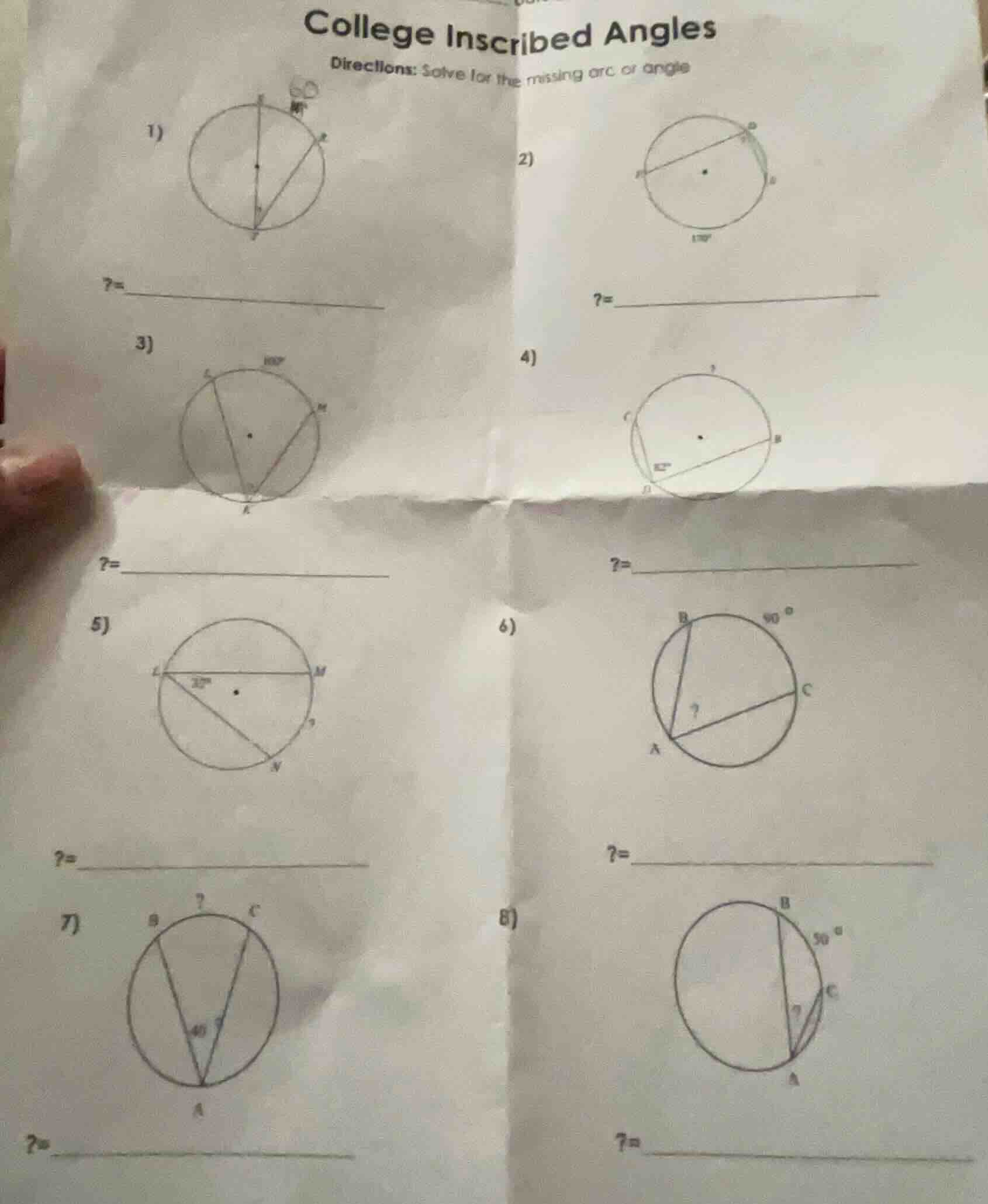
college inscribed angles
directions: solve for the missing arc or angle
1)
?=
2)
?=
3)
?=
4)
?=
5)
?=
6)
?=
7)
?=
8)
?=
Step1: Recall inscribed angle theorem
An inscribed angle is half the measure of its intercepted arc. For a diameter, the intercepted arc is $180^\circ$, so the inscribed angle is $90^\circ$. If two inscribed angles share the same arc, they are equal; if an angle intercepts an arc, the arc is twice the angle.
---
Problem 1
Step1: Identify diameter & inscribed angle
The vertical line is a diameter, so arc $EZ = 180^\circ$. The inscribed angle intercepts arc $ER$, and the given angle is half arc $ER$. Wait, correction: the inscribed angle $\angle EYR$ intercepts arc $ER$, and since $EY$ is a diameter, arc $EZ=180^\circ$. Assuming the unmarked arc $ER$ is such that the inscribed angle is half the arc. Wait, re-clarify: Inscribed Angle Theorem: $\text{Inscribed Angle} = \frac{1}{2} \times \text{Intercepted Arc}$. For problem 1, $EY$ is a diameter, so arc $EZ = 180^\circ$. If the inscribed angle is the one at $Y$, intercepting arc $ER$, and the central angle for arc $ER$ is equal to the inscribed angle's double. Wait, no—if $EY$ is a diameter, $\angle EZY$ would be $90^\circ$, but the marked angle at $Y$ intercepts arc $EZ$? No, correction: The angle at $Y$ intercepts arc $EZ$, which is a semicircle ($180^\circ$), so $\angle EYR$ is half of arc $ER$. Wait, the image shows the angle at $Y$ is the unknown? No, wait the first problem: the vertical line is a diameter, so the arc $EZ$ is $180^\circ$, and the inscribed angle at $Y$ intercepts arc $ER$. Wait, no, standard problem: if an angle is formed by a chord and a diameter, the intercepted arc is the arc opposite the angle. Assuming the given arc (unmarked, but standard problem): Wait, no, let's use standard inscribed angle rules clearly:
- Problem 1: $EY$ is a diameter (passes through center), so arc $EZ = 180^\circ$. The inscribed angle at $Y$ intercepts arc $ER$, and the angle is $\frac{1}{2} \times \text{arc } ER$. Wait, no, the angle at $Y$ is formed by chords $YE$ and $YR$. Arc $YE$ is $180^\circ$, so the angle at $Y$ is $\frac{1}{2} \times \text{arc } EZ$? No, correction: Inscribed angle intercepts the arc that is not containing the angle. So $\angle EYR$ intercepts arc $EZ$, which is $180^\circ$, so $\angle EYR = \frac{1}{2} \times 180^\circ = 90^\circ$? No, that's if it's a right angle. Wait, no, the image shows the angle at $Y$ is the unknown, and $EY$ is a diameter. The correct rule: An angle inscribed in a semicircle is a right angle. So $\boldsymbol{?=90^\circ}$
---
Problem 2
Step1: Identify intercepted arc
The inscribed angle at $D$ intercepts arc $PQ$, which is $170^\circ$.
Step2: Calculate inscribed angle
$\text{Angle} = \frac{1}{2} \times 170^\circ$
$\text{Angle} = 85^\circ$
---
Problem 3
Step1: Identify intercepted arc
The inscribed angle at $K$ intercepts arc $LM$, which is $100^\circ$.
Step2: Calculate inscribed angle
$\text{Angle} = \frac{1}{2} \times 100^\circ$
$\text{Angle} = 50^\circ$
---
Problem 4
Step1: Identify inscribed angle
The inscribed angle at $D$ is $82^\circ$, which intercepts arc $CB$.
Step2: Calculate intercepted arc
$\text{Arc } CB = 2 \times 82^\circ$
$\text{Arc } CB = 164^\circ$
---
Problem 5
Step1: Identify inscribed angle
The inscribed angle at $L$ is $20^\circ$, which intercepts arc $MN$.
Step2: Calculate intercepted arc
$\text{Arc } MN = 2 \times 20^\circ$
$\text{Arc } MN = 40^\circ$
---
Problem 6
Step1: Identify intercepted arc
The inscribed angle at $A$ intercepts arc $BC$, which is $90^\circ$.
Step2: Calculate inscribed angle
$\text{Angle} = \frac{1}{2} \times 90^\ci…

Snap & solve any problem in the app
Get step-by-step solutions on Sovi AI
Photo-based solutions with guided steps
Explore more problems and detailed explanations
- $90^\circ$
- $85^\circ$
- $50^\circ$
- $164^\circ$
- $40^\circ$
- $45^\circ$
- $80^\circ$
- $25^\circ$