QUESTION IMAGE
Question
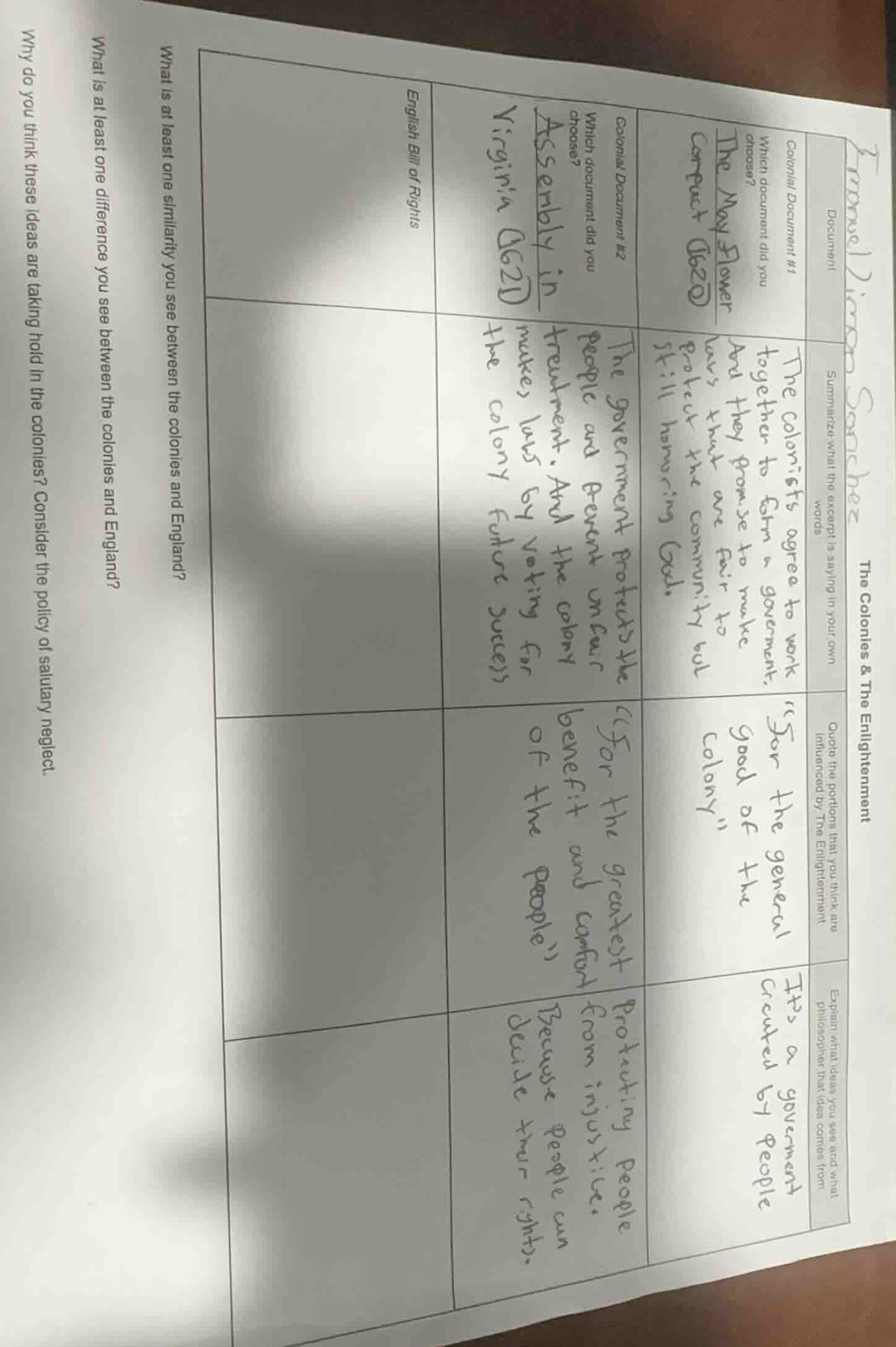
the colonies & the enlightenment
document
colonial document #1
which document did you choose?
the may flower compact (1620)
summarize what the excerpt is saying in your own words.
the colonists agree to work together to form a government. and they promise to make laws that are fair to protect the community and still honoring god.
quote the portions that you think are influenced by the enlightenment.
\for the general good of the colony\
explain what ideas you see and what philosopher that idea comes from.
its a government created by people
colonial document #2
which document did you choose?
assembly in virginia (1621)
summarize what the excerpt is saying in your own words.
the government protects the people and prevent unfair treatment. and the colony makes laws by voting for the colony future success
quote the portions that you think are influenced by the enlightenment.
\for the greatest benefit and comfort of the people\
explain what ideas you see and what philosopher that idea comes from.
protecting people from injustice. because people can decide their rights.
english bill of rights
what is at least one similarity you see between the colonies and england?
what is at least one difference you see between the colonies and england?
why do you think these ideas are taking hold in the colonies? consider the policy of salutary neglect.
- Similarity between colonies and England: Both systems recognized the idea of representative governance and protecting basic rights of citizens, as seen in the English Bill of Rights and colonial documents like the Virginia Assembly.
- Difference between colonies and England: Colonial governments had more direct, local control (e.g., colonists voting on their own laws in Virginia) and focused on community-specific needs, while England's government was more centralized and prioritized imperial interests.
- Why ideas took hold (salutary neglect): England's policy of salutary neglect meant it did not enforce strict imperial rules, allowing colonists to self-govern and develop ideas about popular sovereignty and community welfare without direct interference. This gave space for these Enlightenment-influenced ideas to grow and become embedded in colonial governance.

Snap & solve any problem in the app
Get step-by-step solutions on Sovi AI
Photo-based solutions with guided steps
Explore more problems and detailed explanations
- Similarity: Both the colonies and England embraced principles of representative rule and protecting citizen rights.
- Difference: Colonial governments had greater local self-governance for community needs, while England's rule was centralized around imperial goals.
- Why ideas took hold: England's salutary neglect policy allowed colonists to practice self-governance freely, enabling Enlightenment ideas about popular sovereignty and collective good to spread and become established in the colonies.