QUESTION IMAGE
Question
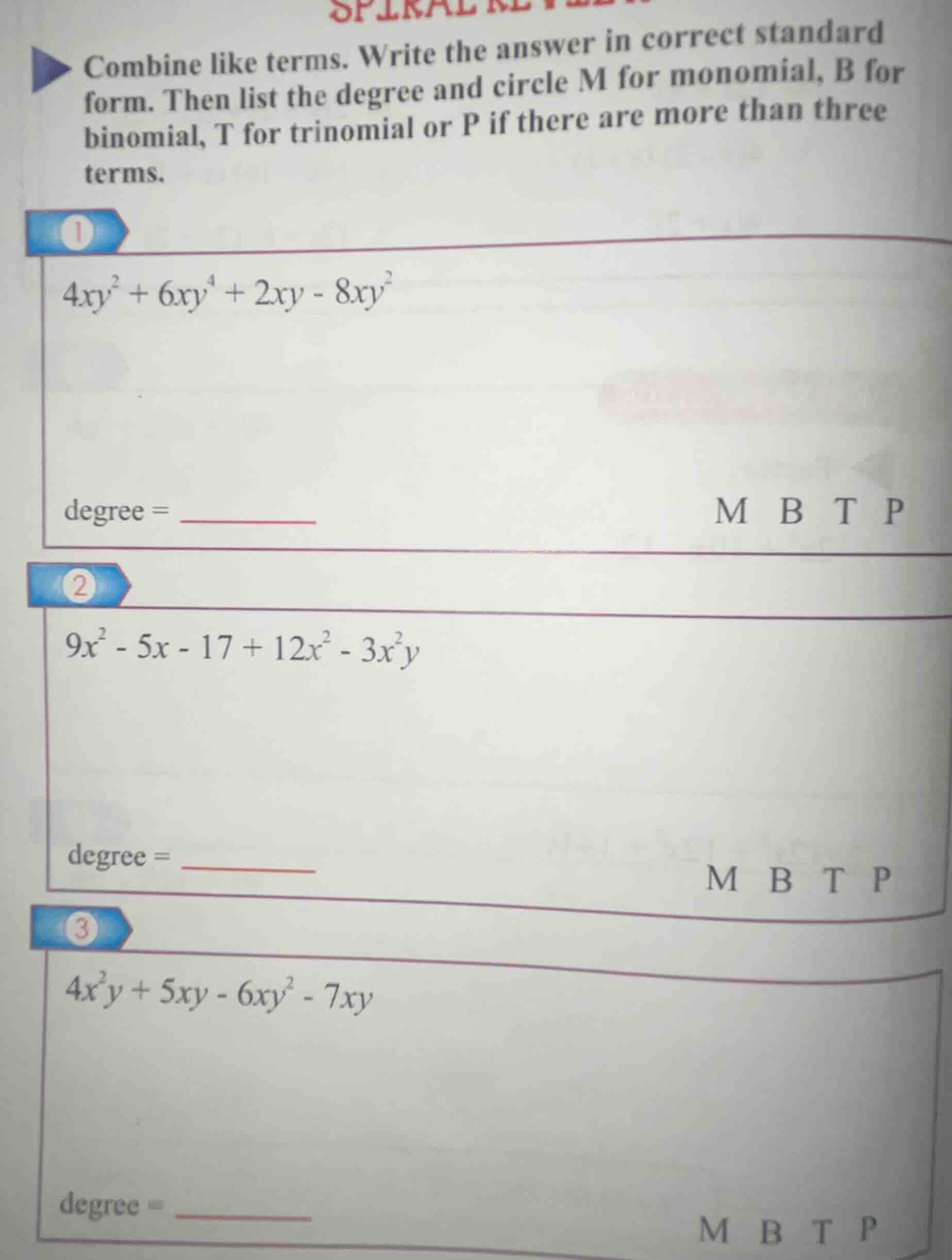
combine like terms. write the answer in correct standard form. then list the degree and circle m for monomial, b for binomial, t for trinomial or p if there are more than three terms.
1
$4xy^2 + 6xy^4 + 2xy - 8xy^2$
degree =
m b t p
2
$9x^2 - 5x - 17 + 12x^2 - 3x^2y$
degree =
m b t p
3
$4x^2y + 5xy - 6xy^2 - 7xy$
degree =
m b t p
Problem 1
Step1: Identify like terms
Like terms are \(4xy^2\) and \(-8xy^2\). The other terms \(6xy^4\) and \(2xy\) have no like terms.
Step2: Combine like terms
\(4xy^2 - 8xy^2 = -4xy^2\). So the polynomial becomes \(6xy^4 - 4xy^2 + 2xy\).
Step3: Find the degree
The degree of a term is the sum of the exponents of its variables. For \(6xy^4\), degree is \(1 + 4 = 5\); for \(-4xy^2\), degree is \(1 + 2 = 3\); for \(2xy\), degree is \(1 + 1 = 2\). The highest degree is 5.
Step4: Classify the polynomial
There are 3 terms, so it's a trinomial (T). But wait, wait, no: \(6xy^4 - 4xy^2 + 2xy\) has three terms? Wait, original terms after combining: \(6xy^4\), \(-4xy^2\), \(2xy\) – three terms? Wait, no, original expression was \(4xy^2 + 6xy^4 + 2xy - 8xy^2\), which has four terms before combining. After combining like terms, we have three terms? Wait, no: \(6xy^4\) (1 term), \(-4xy^2\) (1 term), \(2xy\) (1 term) – three terms? Wait, no, \(4xy^2 - 8xy^2\) is one term, \(6xy^4\) is another, \(2xy\) is another. So three terms? Wait, no, the original expression has four terms: \(4xy^2\), \(6xy^4\), \(2xy\), \(-8xy^2\). After combining \(4xy^2\) and \(-8xy^2\) into \(-4xy^2\), we have three terms: \(6xy^4\), \(-4xy^2\), \(2xy\). Wait, but the problem says "P if there are more than three terms". So three terms would be trinomial (T). But let's check again. Wait, \(6xy^4 - 4xy^2 + 2xy\) – three terms. So degree is 5, and it's a trinomial (T). Wait, no, wait: the degree of the polynomial is the highest degree of its terms. The term \(6xy^4\) has degree \(1 + 4 = 5\), so the polynomial's degree is 5. And since there are three terms, it's a trinomial (T). But wait, the original expression had four terms, but after combining like terms, we have three terms. So the classification is based on the number of terms after combining like terms. So three terms: trinomial (T).
Step1: Identify like terms
Like terms are \(9x^2\) and \(12x^2\). The other terms \(-5x\), \(-17\), \(-3x^2y\) have no like terms.
Step2: Combine like terms
\(9x^2 + 12x^2 = 21x^2\). So the polynomial becomes \(-3x^2y + 21x^2 - 5x - 17\).
Step3: Find the degree
For \(-3x^2y\), degree is \(2 + 1 = 3\); for \(21x^2\), degree is 2; for \(-5x\), degree is 1; for \(-17\), degree is 0. The highest degree is 3.
Step4: Classify the polynomial
There are four terms, so it's a polynomial with more than three terms (P).
Step1: Identify like terms
Like terms are \(5xy\) and \(-7xy\). The other terms \(4x^2y\) and \(-6xy^2\) have no like terms.
Step2: Combine like terms
\(5xy - 7xy = -2xy\). So the polynomial becomes \(4x^2y - 6xy^2 - 2xy\).
Step3: Find the degree
For \(4x^2y\), degree is \(2 + 1 = 3\); for \(-6xy^2\), degree is \(1 + 2 = 3\); for \(-2xy\), degree is \(1 + 1 = 2\). The highest degree is 3.
Step4: Classify the polynomial
There are three terms, so it's a trinomial (T).

Snap & solve any problem in the app
Get step-by-step solutions on Sovi AI
Photo-based solutions with guided steps
Explore more problems and detailed explanations
Combined form: \(6xy^4 - 4xy^2 + 2xy\)
Degree = \(5\)
Classification: \(\boldsymbol{T}\) (circle T)