QUESTION IMAGE
Question
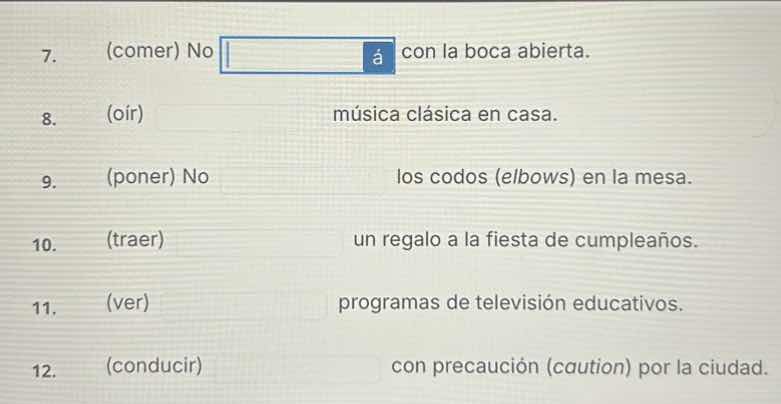
- (comer) no á con la boca abierta.
- (oír) música clásica en casa.
- (poner) no los codos (elbows) en la mesa.
- (traer) un regalo a la fiesta de cumpleaños.
- (ver) programas de televisión educativos.
- (conducir) con precaución (caution) por la ciudad.
To solve these Spanish verb conjugation problems, we need to use the correct form of the verb in the imperative mood (commands) for the "tú" (you, informal) form. Let's go through each one:
Problem 7: (comer) No ______ con la boca abierta.
The verb is "comer" (to eat). The negative imperative for "tú" is "no + verb (infinitive)? Wait, no. Wait, the negative command for "tú" is "no + verb (present subjunctive)". Wait, "comer" in the negative command for "tú" is "no comas"? Wait, no, maybe I made a mistake. Wait, actually, in the negative imperative for "tú", we use the present subjunctive. But let's check the context. The sentence is "No ______ con la boca abierta." The verb is "comer". Wait, maybe it's the positive imperative? No, it's negative. Wait, maybe the correct form is "comas"? Wait, no, maybe the exercise is using the infinitive? No, that doesn't make sense. Wait, maybe it's the "tú" command. Wait, "comer" in the imperative (positive) is "come", negative is "no comas". But the blank has "á" at the end, maybe a typo? Wait, the first blank has "á" at the end, maybe it's "com" + "á"? No, that doesn't fit. Wait, maybe it's a different form. Wait, maybe the verb is "comer" and the correct form is "comas"? No, maybe the exercise is using the "usted" form? Wait, "usted" negative command is "no coma". Ah! Maybe that's it. So "No coma con la boca abierta." (Don't eat with your mouth open.) So the correct form is "coma".
Problem 8: (oir) ______ música clásica en casa.
The verb is "oir" (to hear/listen to). The positive imperative for "tú" is "oye". But let's check. "Oír" (to hear) in the imperative (tú) is "oye". So "Oye música clásica en casa." (Listen to classical music at home.)
Problem 9: (poner) No ______ los codos en la mesa.
The verb is "poner" (to put). The negative imperative for "tú" is "no pongas". But if it's "usted", it's "no ponga". Wait, the context. "No ______ los codos en la mesa." (Don't put your elbows on the table.) If it's "tú", negative is "no pongas", if "usted", "no ponga". Let's see the other problems. Maybe "usted" form. So "No ponga los codos en la mesa."
Problem 10: (traer) ______ un regalo a la fiesta de cumpleaños.
The verb is "traer" (to bring). The positive imperative for "tú" is "trae". So "Trae un regalo a la fiesta de cumpleaños." (Bring a gift to the birthday party.)
Problem 11: (ver) ______ programas de televisión educativos.
The verb is "ver" (to watch). The positive imperative for "tú" is "ve". So "Ve programas de televisión educativos." (Watch educational TV programs.)
Problem 12: (conducir) ______ con precaución por la ciudad.
The verb is "conducir" (to drive). The positive imperative for "tú" is "conduce". So "Conduce con precaución por la ciudad." (Drive carefully in the city.)
Wait, but let's re-examine problem 7. The blank has "á" at the end, maybe it's "coma" (from "comer", usted form). So:
- No coma con la boca abierta. (usted form, negative command)
- Oye música clásica en casa. (tú form, positive command)
- No ponga los codos en la mesa. (usted form, negative command)
- Trae un regalo a la fiesta de cumpleaños. (tú form, positive command)
- Ve programas de televisión educativos. (tú form, positive command)
- Conduce con precaución por la ciudad. (tú form, positive command)
Let's verify each:
- 7. (comer): "No coma con la boca abierta." (Usted, don't eat with your mouth open.)
- 8. (oir): "Oye música clásica en casa." (Tú, listen to classical music at home.)
- 9. (poner): "No ponga los codos en la mesa." (Uste…

Snap & solve any problem in the app
Get step-by-step solutions on Sovi AI
Photo-based solutions with guided steps
Explore more problems and detailed explanations
To solve these Spanish verb conjugation problems, we need to use the correct form of the verb in the imperative mood (commands) for the "tú" (you, informal) form. Let's go through each one:
Problem 7: (comer) No ______ con la boca abierta.
The verb is "comer" (to eat). The negative imperative for "tú" is "no + verb (infinitive)? Wait, no. Wait, the negative command for "tú" is "no + verb (present subjunctive)". Wait, "comer" in the negative command for "tú" is "no comas"? Wait, no, maybe I made a mistake. Wait, actually, in the negative imperative for "tú", we use the present subjunctive. But let's check the context. The sentence is "No ______ con la boca abierta." The verb is "comer". Wait, maybe it's the positive imperative? No, it's negative. Wait, maybe the correct form is "comas"? Wait, no, maybe the exercise is using the infinitive? No, that doesn't make sense. Wait, maybe it's the "tú" command. Wait, "comer" in the imperative (positive) is "come", negative is "no comas". But the blank has "á" at the end, maybe a typo? Wait, the first blank has "á" at the end, maybe it's "com" + "á"? No, that doesn't fit. Wait, maybe it's a different form. Wait, maybe the verb is "comer" and the correct form is "comas"? No, maybe the exercise is using the "usted" form? Wait, "usted" negative command is "no coma". Ah! Maybe that's it. So "No coma con la boca abierta." (Don't eat with your mouth open.) So the correct form is "coma".
Problem 8: (oir) ______ música clásica en casa.
The verb is "oir" (to hear/listen to). The positive imperative for "tú" is "oye". But let's check. "Oír" (to hear) in the imperative (tú) is "oye". So "Oye música clásica en casa." (Listen to classical music at home.)
Problem 9: (poner) No ______ los codos en la mesa.
The verb is "poner" (to put). The negative imperative for "tú" is "no pongas". But if it's "usted", it's "no ponga". Wait, the context. "No ______ los codos en la mesa." (Don't put your elbows on the table.) If it's "tú", negative is "no pongas", if "usted", "no ponga". Let's see the other problems. Maybe "usted" form. So "No ponga los codos en la mesa."
Problem 10: (traer) ______ un regalo a la fiesta de cumpleaños.
The verb is "traer" (to bring). The positive imperative for "tú" is "trae". So "Trae un regalo a la fiesta de cumpleaños." (Bring a gift to the birthday party.)
Problem 11: (ver) ______ programas de televisión educativos.
The verb is "ver" (to watch). The positive imperative for "tú" is "ve". So "Ve programas de televisión educativos." (Watch educational TV programs.)
Problem 12: (conducir) ______ con precaución por la ciudad.
The verb is "conducir" (to drive). The positive imperative for "tú" is "conduce". So "Conduce con precaución por la ciudad." (Drive carefully in the city.)
Wait, but let's re-examine problem 7. The blank has "á" at the end, maybe it's "coma" (from "comer", usted form). So:
- No coma con la boca abierta. (usted form, negative command)
- Oye música clásica en casa. (tú form, positive command)
- No ponga los codos en la mesa. (usted form, negative command)
- Trae un regalo a la fiesta de cumpleaños. (tú form, positive command)
- Ve programas de televisión educativos. (tú form, positive command)
- Conduce con precaución por la ciudad. (tú form, positive command)
Let's verify each:
- 7. (comer): "No coma con la boca abierta." (Usted, don't eat with your mouth open.)
- 8. (oir): "Oye música clásica en casa." (Tú, listen to classical music at home.)
- 9. (poner): "No ponga los codos en la mesa." (Usted, don't put your elbows on the table.)
- 10. (traer): "Trae un regalo a la fiesta de cumpleaños." (Tú, bring a gift to the birthday party.)
- 11. (ver): "Ve programas de televisión educativos." (Tú, watch educational TV programs.)
- 12. (conducir): "Conduce con precaución por la ciudad." (Tú, drive carefully in the city.)
These forms make sense in the context of giving commands (either to "tú" or "usted").