QUESTION IMAGE
Question
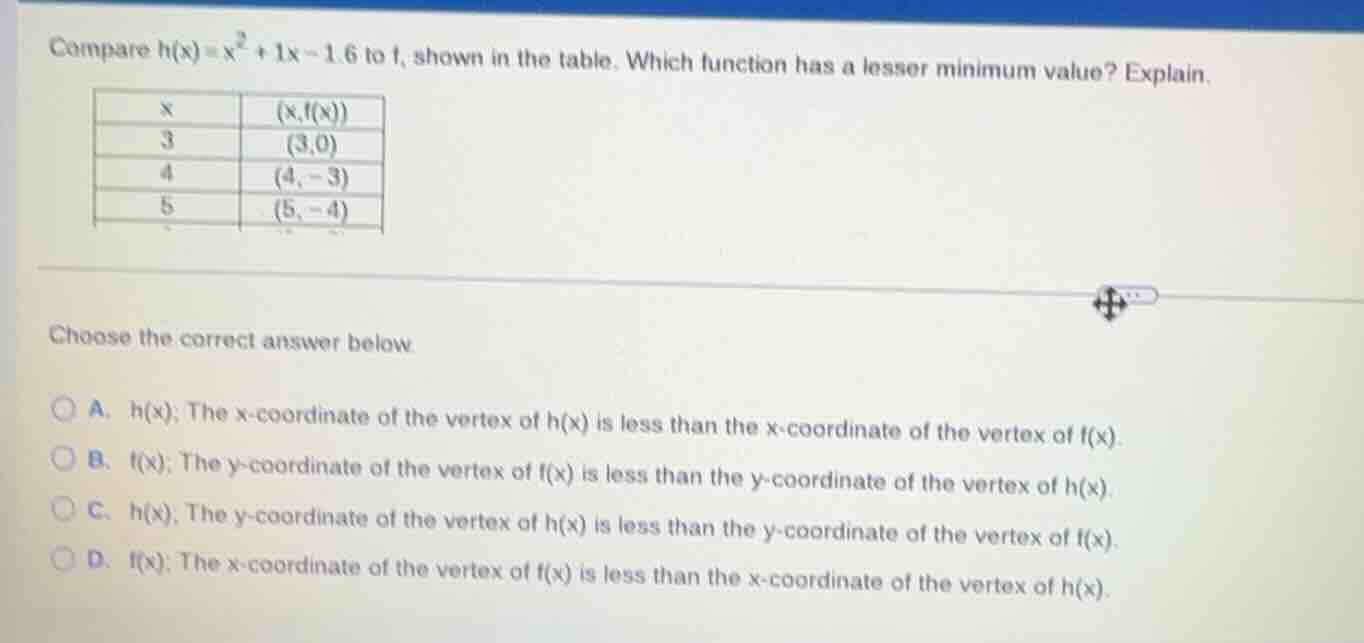
compare ( h(x) = x^2 + 1x - 1.6 ) to ( f ), shown in the table. which function has a lesser minimum value? explain.
| x | ( (x, f(x)) ) |
|---|---|
| 4 | ( (4, -3) ) |
| 5 | ( (5, -4) ) |
choose the correct answer below
a. ( h(x) ); the ( x )-coordinate of the vertex of ( h(x) ) is less than the ( x )-coordinate of the vertex of ( f(x) ).
b. ( f(x) ); the ( y )-coordinate of the vertex of ( f(x) ) is less than the ( y )-coordinate of the vertex of ( h(x) ).
c. ( h(x) ); the ( y )-coordinate of the vertex of ( h(x) ) is less than the ( y )-coordinate of the vertex of ( f(x) ).
d. ( f(x) ); the ( x )-coordinate of the vertex of ( f(x) ) is less than the ( x )-coordinate of the vertex of ( h(x) ).
Step1: Find vertex of \( h(x) \)
For quadratic \( h(x)=ax^2+bx+c \), vertex \( x \)-coordinate is \( -\frac{b}{2a} \). Here, \( a = 1 \), \( b = 1 \), so \( x = -\frac{1}{2(1)} = -0.5 \).
Substitute \( x = -0.5 \) into \( h(x) \):
\( h(-0.5)=(-0.5)^2 + 1(-0.5) - 1.6 = 0.25 - 0.5 - 1.6 = -1.85 \).
So vertex of \( h(x) \) is \( (-0.5, -1.85) \), minimum \( y \)-coordinate is \( -1.85 \).
Step2: Analyze \( f(x) \) from table
From table, \( f(3)=0 \), \( f(4)=-3 \), \( f(5)=-4 \). The function \( f(x) \) (likely quadratic, as \( h(x) \) is quadratic) has values decreasing then? Wait, no—wait, the table shows \( x=3 \) (0), \( x=4 \) (-3), \( x=5 \) (-4). Let's check the vertex of \( f(x) \). Assume \( f(x) \) is quadratic. Let's find its vertex. Let’s suppose \( f(x)=ax^2+bx+c \). Using points (3,0), (4,-3), (5,-4):
But maybe simpler: the minimum \( y \)-value from table is \( -4 \) (at \( x=5 \))? Wait, no—wait, maybe the function \( f(x) \) is a quadratic opening upwards (since \( h(x) \) opens upwards, \( a=1>0 \)). Wait, but the table values: from \( x=3 \) to \( x=4 \), \( y \) decreases by 3; \( x=4 \) to \( x=5 \), \( y \) decreases by 1. So maybe the vertex is after \( x=5 \)? Wait, no—wait, maybe I made a mistake. Wait, the key is the minimum \( y \)-coordinate (since both quadratics open upwards, as \( a=1>0 \) for \( h(x) \), and \( f(x) \)’s values are decreasing then? Wait, no—if \( f(x) \) is quadratic opening upwards, the vertex is the minimum. But the table shows \( x=3 \) (0), \( x=4 \) (-3), \( x=5 \) (-4). Let's check the differences: from \( x=3 \) to \( x=4 \): \( \Delta x=1 \), \( \Delta y=-3 \); \( x=4 \) to \( x=5 \): \( \Delta x=1 \), \( \Delta y=-1 \). So the function is decreasing at a decreasing rate (so concave up, opening upwards). So the minimum \( y \)-value of \( f(x) \) (from the table, the lowest \( y \) is \( -4 \) at \( x=5 \)), but wait, maybe the vertex is at \( x \) where the slope changes. Wait, but the minimum \( y \)-coordinate of \( f(x) \) (from the table) is \( -4 \), and \( h(x) \)’s minimum is \( -1.85 \). Wait, no—wait, \( -4 < -1.85 \)? Wait, no: \( -4 \) is less than \( -1.85 \)? Wait, no: \( -4 \) is more negative than \( -1.85 \), so \( -4 < -1.85 \). Wait, but that contradicts? Wait, no—wait, let's recalculate \( h(x) \)’s vertex. Wait, \( h(x)=x^2 + x - 1.6 \). Vertex \( x = -b/(2a) = -1/(2*1) = -0.5 \). Then \( h(-0.5) = (-0.5)^2 + (-0.5) - 1.6 = 0.25 - 0.5 - 1.6 = -1.85 \). So minimum \( y \) for \( h(x) \) is \( -1.85 \). For \( f(x) \), from the table, the \( y \)-values are 0, -3, -4. So the minimum \( y \)-value of \( f(x) \) (the lowest) is \( -4 \), which is less than \( -1.85 \)? Wait, no: \( -4 \) is less than \( -1.85 \) (since \( -4 < -1.85 \)). Wait, but the options: Option B says “\( f(x) \); The \( y \)-coordinate of the vertex of \( f(x) \) is less than the \( y \)-coordinate of the vertex of \( h(x) \).” Wait, but wait—maybe I messed up \( f(x) \)’s vertex. Wait, maybe \( f(x) \) is a quadratic with vertex at \( x \) where the minimum is. Wait, let's check the differences: from \( x=3 \) to \( x=4 \): \( \Delta y = -3 \), \( x=4 \) to \( x=5 \): \( \Delta y = -1 \). So the function is decreasing, then the rate of decrease slows (so concave up, vertex at \( x \) where the slope is zero). Let's find the vertex of \( f(x) \). Let's assume \( f(x) = ax^2 + bx + c \). Using (3,0): \( 9a + 3b + c = 0 \); (4,-3): \( 16a + 4b + c = -3 \); (5,-4): \( 25a + 5b + c = -4 \). Subtract first from second: \( 7a + b = -3 \). Subtract second from third: \( 9a + b = -1 \). Subt…

Snap & solve any problem in the app
Get step-by-step solutions on Sovi AI
Photo-based solutions with guided steps
Explore more problems and detailed explanations
B. \( f(x) \); The \( y \)-coordinate of the vertex of \( f(x) \) is less than the \( y \)-coordinate of the vertex of \( h(x) \)