QUESTION IMAGE
Question
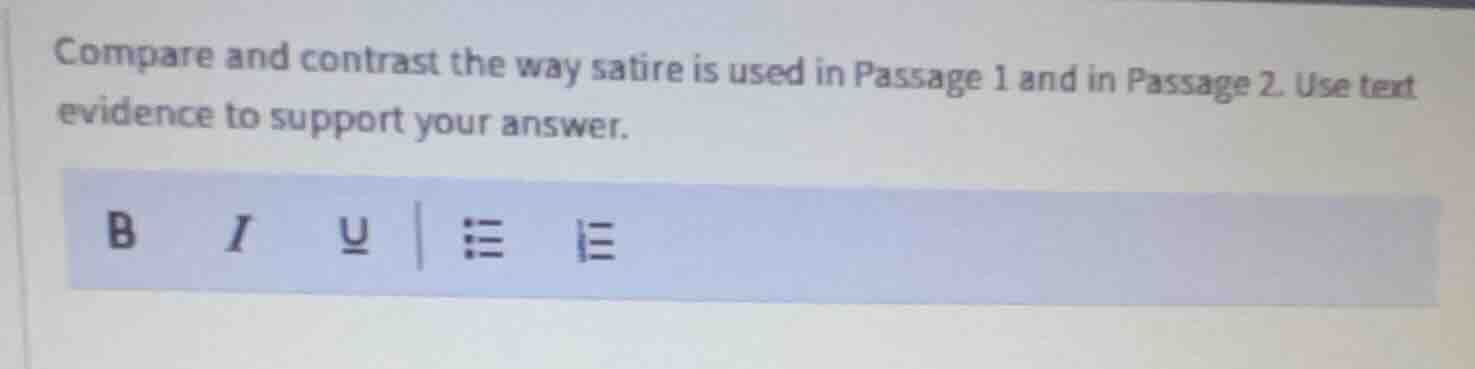
compare and contrast the way satire is used in passage 1 and in passage 2. use text evidence to support your answer.
To answer this, we would analyze the two passages (though they aren't provided here). First, identify the satirical elements in each: tone (humorous, ironic, mocking), targets (social issues, institutions, people), and techniques (exaggeration, irony, parody). Then, compare similarities (e.g., both use irony to critique society) and contrast differences (e.g., Passage 1 targets politics with exaggeration, Passage 2 targets consumerism with parody). Use direct quotes from each passage as evidence. For example, if Passage 1 has a line like "The politicians’ promises were as empty as a balloon with a pinhole," that's irony mocking politics. If Passage 2 has "People bought the ‘miracle’ soap that cured nothing, but they kept buying," that's satire of consumerism.
Since the passages aren't given, a general approach is:
- Analyze Satire in Passage 1:
- Identify the satirical technique (irony, exaggeration, etc.).
- Note the target (what is being criticized: society, government, culture).
- Find text evidence (quotes) to support.
- Analyze Satire in Passage 2:
- Repeat the above steps for the second passage.
- Compare and Contrast:
- Similarities: Do both use the same technique? Target similar themes?
- Differences: Different techniques (e.g., one uses irony, the other exaggeration) or different targets (e.g., one targets politics, the other media).
If you provide the passages, we can give a more specific analysis with text evidence!

Snap & solve any problem in the app
Get step-by-step solutions on Sovi AI
Photo-based solutions with guided steps
Explore more problems and detailed explanations
To answer this, we would analyze the two passages (though they aren't provided here). First, identify the satirical elements in each: tone (humorous, ironic, mocking), targets (social issues, institutions, people), and techniques (exaggeration, irony, parody). Then, compare similarities (e.g., both use irony to critique society) and contrast differences (e.g., Passage 1 targets politics with exaggeration, Passage 2 targets consumerism with parody). Use direct quotes from each passage as evidence. For example, if Passage 1 has a line like "The politicians’ promises were as empty as a balloon with a pinhole," that's irony mocking politics. If Passage 2 has "People bought the ‘miracle’ soap that cured nothing, but they kept buying," that's satire of consumerism.
Since the passages aren't given, a general approach is:
- Analyze Satire in Passage 1:
- Identify the satirical technique (irony, exaggeration, etc.).
- Note the target (what is being criticized: society, government, culture).
- Find text evidence (quotes) to support.
- Analyze Satire in Passage 2:
- Repeat the above steps for the second passage.
- Compare and Contrast:
- Similarities: Do both use the same technique? Target similar themes?
- Differences: Different techniques (e.g., one uses irony, the other exaggeration) or different targets (e.g., one targets politics, the other media).
If you provide the passages, we can give a more specific analysis with text evidence!