QUESTION IMAGE
Question
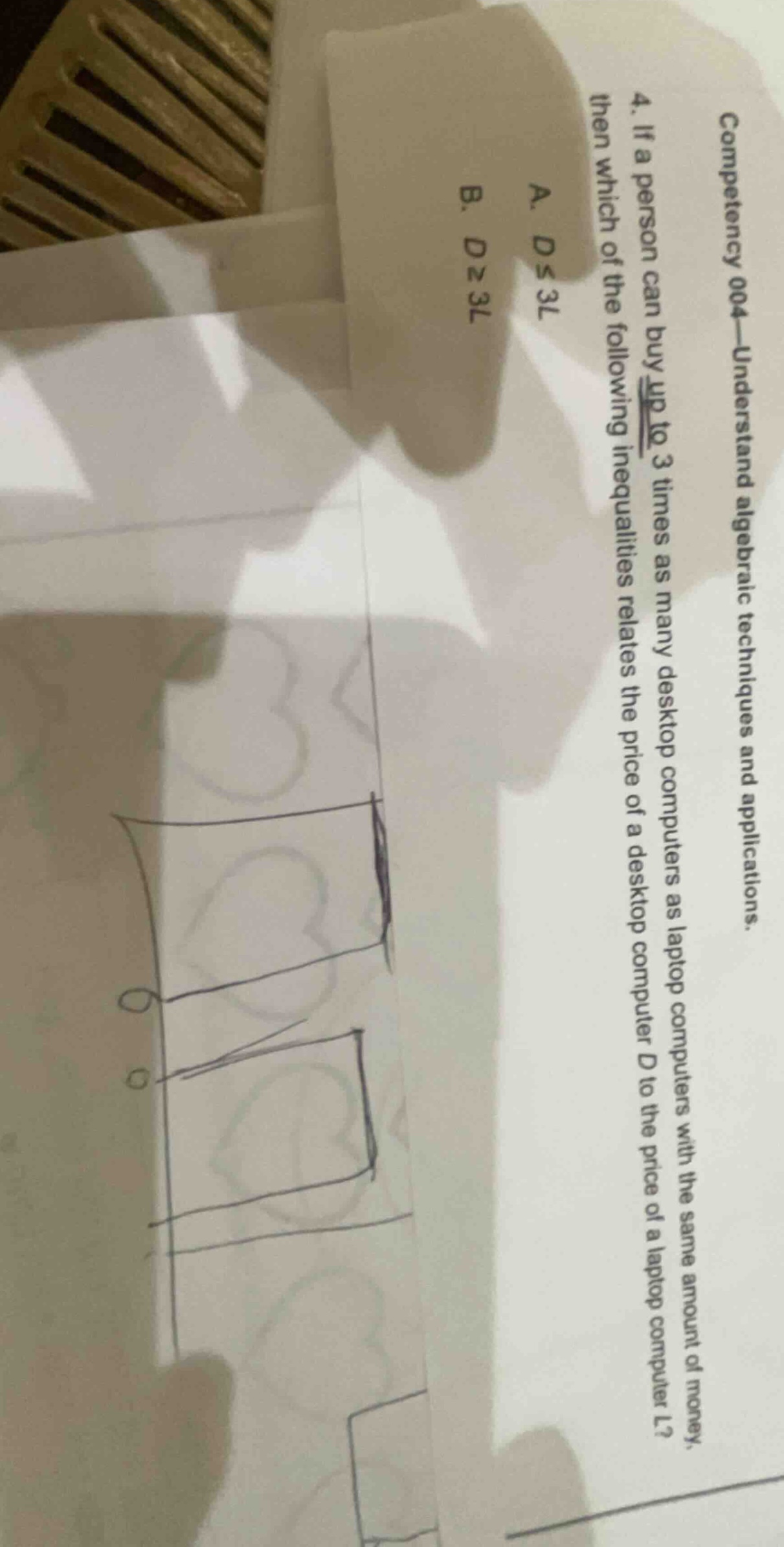
competency 004—understand algebraic techniques and applications. 4. if a person can buy up to 3 times as many desktop computers as laptop computers with the same amount of money, then which of the following inequalities relates the price of a desktop computer d to the price of a laptop computer l? a. d ≤ 3l b. d ≥ 3l
Step1: Analyze the relationship
Let the number of desktop computers be \( n_D \) and laptop computers be \( n_L \). With the same money, \( n_D \leq 3n_L \). Since price is inversely related to quantity (same money), if \( D \) is desktop price and \( L \) is laptop price, then \( D\times n_D = L\times n_L \). From \( n_D \leq 3n_L \), substitute \( n_D=\frac{L\times n_L}{D} \) (from \( D\times n_D = L\times n_L \)) into \( n_D \leq 3n_L \), we get \( \frac{L\times n_L}{D} \leq 3n_L \). Cancel \( n_L \) (positive quantity), we have \( \frac{L}{D} \leq 3 \), then \( L \leq 3D \) is wrong. Wait, re - express: From \( n_D \leq 3n_L \) and \( D\times n_D=L\times n_L \), so \( n_D=\frac{L n_L}{D} \). Then \( \frac{L n_L}{D}\leq3n_L \), divide both sides by \( n_L \) ( \( n_L>0 \) ), we get \( \frac{L}{D}\leq3 \), multiply both sides by \( D \) (assuming \( D > 0 \), which it is as price), we get \( L\leq3D \), or \( D\geq\frac{L}{3} \)? Wait, no. Wait, the number of desktops is up to 3 times the number of laptops. So \( n_D\leq3n_L \). Since total money \( M = D\times n_D=L\times n_L \), so \( n_D=\frac{M}{D} \), \( n_L=\frac{M}{L} \). Then \( \frac{M}{D}\leq3\times\frac{M}{L} \). Since \( M>0 \), divide both sides by \( M \), we get \( \frac{1}{D}\leq\frac{3}{L} \), cross - multiply ( \( D,L>0 \) ), we get \( L\leq3D \), or \( D\geq\frac{L}{3} \)? Wait, no, let's do it again. If you can buy up to 3 desktops for the price of 1 laptop? No, the problem says "a person can buy up to 3 times as many desktop computers as laptop computers with the same amount of money". So same money \( M \), number of desktops \( D_{num}=\frac{M}{D} \), number of laptops \( L_{num}=\frac{M}{L} \). So \( D_{num}\leq3\times L_{num} \), so \( \frac{M}{D}\leq3\times\frac{M}{L} \). Divide both sides by \( M \) ( \( M > 0 \) ), \( \frac{1}{D}\leq\frac{3}{L} \). Cross - multiply ( \( D>0,L > 0 \) ), \( L\leq3D \), which is \( D\geq\frac{L}{3} \)? Wait, no, the inequality we need is about \( D \) and \( L \). Wait, the options are \( D\leq3L \) or \( D\geq3L \). Wait, let's take an example. Suppose laptop price \( L = 3000 \), desktop price \( D = 1000 \). Then with \( M = 3000 \), number of laptops \( n_L = 1 \), number of desktops \( n_D=3 \), which is 3 times. So \( D = 1000 \), \( L = 3000 \), \( D=1000\leq3\times3000 = 9000 \), so \( D\leq3L \) holds. If \( D = 2000 \), \( L = 3000 \), with \( M = 6000 \), \( n_D = 3 \), \( n_L = 2 \), \( 3\leq3\times2 \), which holds, and \( D = 2000\leq3\times3000=9000 \). If \( D = 4000 \), \( L = 3000 \), with \( M = 12000 \), \( n_D = 3 \), \( n_L = 4 \), \( 3\leq3\times4 \), but \( D = 4000>3\times3000 = 9000 \)? No, 4000 is not greater than 9000. Wait, I messed up. Wait, if \( D \) is desktop price, \( L \) is laptop price. If desktop is cheaper, you can buy more. So if you can buy up to 3 desktops for the money of 1 laptop, that means \( D\leq\frac{L}{3} \)? No, wait, let's use the inequality again. \( n_D\leq3n_L \), \( Dn_D = Ln_L \), so \( n_D=\frac{Ln_L}{D} \). Then \( \frac{Ln_L}{D}\leq3n_L \), cancel \( n_L \), \( \frac{L}{D}\leq3 \), so \( L\leq3D \), or \( D\geq\frac{L}{3} \). But the options are \( D\leq3L \) or \( D\geq3L \). Wait, maybe I got the variables reversed. Let's re - define: Let \( D \) be desktop price, \( L \) be laptop price. The number of desktops you can buy with money \( M \) is \( \frac{M}{D} \), number of laptops is \( \frac{M}{L} \). The condition is \( \frac{M}{D}\leq3\times\frac{M}{L} \). Divide both sides by \( M \) ( \( M>0 \) ), \( \frac{1}{D}\leq\frac{3}{L} \), cross - multiply ( \( D…

Snap & solve any problem in the app
Get step-by-step solutions on Sovi AI
Photo-based solutions with guided steps
Explore more problems and detailed explanations
A. \( D\leq3L \)