QUESTION IMAGE
Question
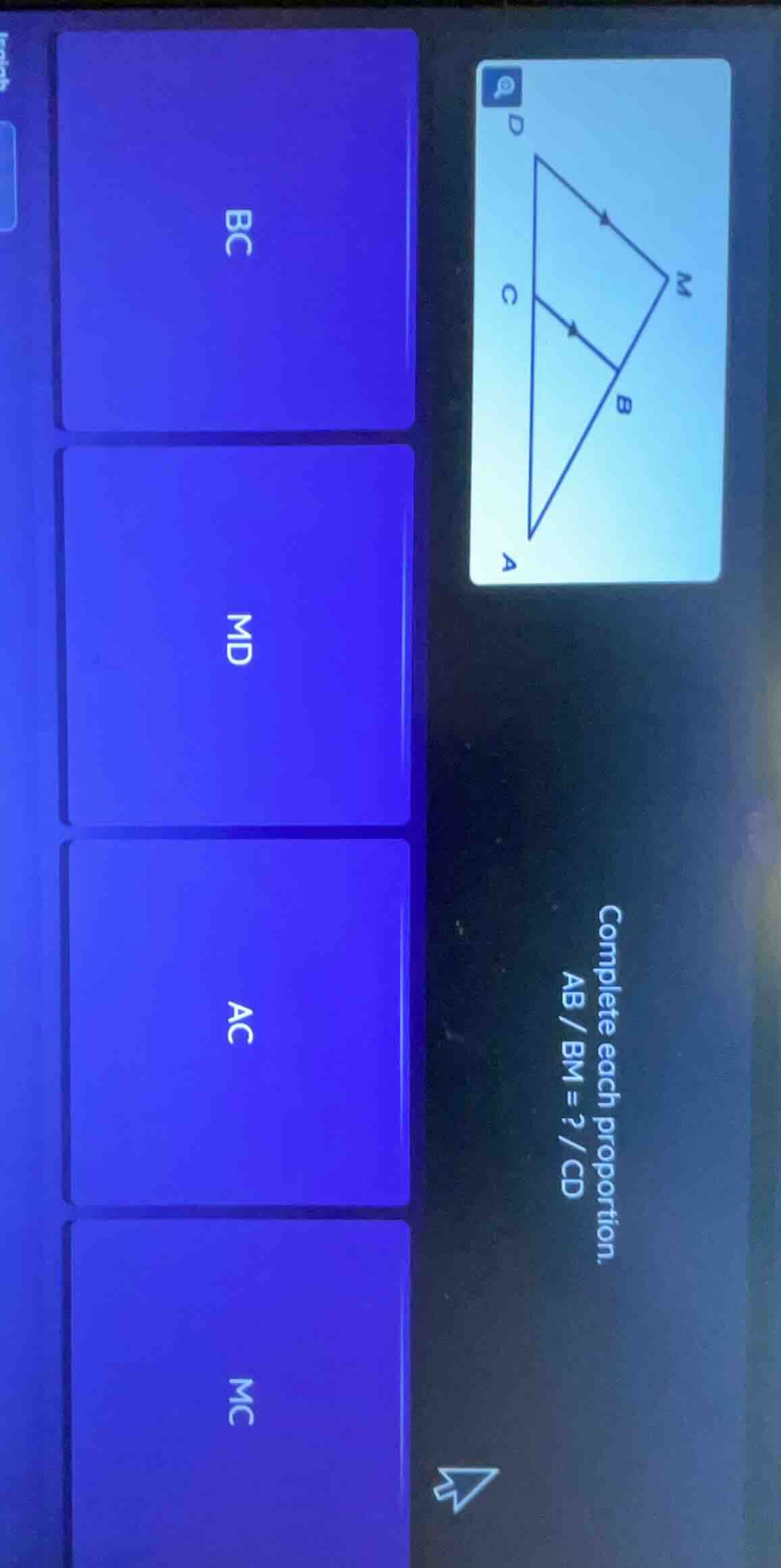
complete each proportion. ab / bm = ? / cd
Step1: Identify the Theorem
This problem involves the Basic Proportionality Theorem (Thales' theorem), which states that if a line is drawn parallel to one side of a triangle, intersecting the other two sides, then it divides those sides proportionally. Here, the lines \( MC \) and \( BM \) (assuming the parallel lines) suggest the proportionality \( \frac{AB}{BM}=\frac{AC}{CD} \)? Wait, no, looking at the diagram, the segments: Let's assume the triangle is \( \triangle AMD \), with \( BC \parallel MD \) (since there are arrows indicating parallel lines). Wait, the given proportion is \( \frac{AB}{BM}=\frac{?}{CD} \). By the Basic Proportionality Theorem (Thales' theorem), if a line is parallel to a side of the triangle, the ratio of the segments on one side is equal to the ratio of the segments on the other side. So, if \( BC \parallel MD \), then \( \frac{AB}{BM}=\frac{AC}{CD} \)? Wait, no, maybe the triangle is \( \triangle AMD \), with \( B \) on \( AM \) and \( C \) on \( AD \), and \( BC \parallel MD \). Then by Thales' theorem, \( \frac{AB}{BM}=\frac{AC}{CD} \)? Wait, no, the correct proportion from Thales' theorem is \( \frac{AB}{BM}=\frac{AC}{CD} \)? Wait, no, let's re-examine. The theorem says that if a line is drawn parallel to one side of a triangle, intersecting the other two sides, then it divides those sides proportionally. So, in \( \triangle AMD \), if \( BC \parallel MD \), then \( \frac{AB}{BM}=\frac{AC}{CD} \)? Wait, no, the sides are \( AM \) and \( AD \). So \( AB \) and \( BM \) are segments on \( AM \), and \( AC \) and \( CD \) are segments on \( AD \). So by Thales' theorem, \( \frac{AB}{BM}=\frac{AC}{CD} \)? Wait, but the options are \( BC \), \( MD \), \( AC \), \( MC \). Wait, maybe I misread. Wait, the proportion is \( \frac{AB}{BM}=\frac{?}{CD} \). Let's check the options. The options are \( BC \), \( MD \), \( AC \), \( MC \). Wait, maybe the triangle is \( \triangle MCD \) with \( AB \parallel MC \)? No, the arrows: the two lines with arrows are parallel. So the line through \( B \) and \( C \) is parallel to the line through \( M \) and... Wait, the diagram has \( M \), \( B \), \( A \) on one side, and \( D \), \( C \), \( A \) on the other? Wait, maybe the correct proportion is \( \frac{AB}{BM}=\frac{AC}{CD} \)? No, the options include \( AC \). Wait, let's think again. The Basic Proportionality Theorem: In \( \triangle AMD \), if \( BC \parallel MD \), then \( \frac{AB}{BM}=\frac{AC}{CD} \). So the missing segment is \( AC \). Wait, but the options are \( BC \), \( MD \), \( AC \), \( MC \). So the answer should be \( AC \).
Step2: Verify the Proportion
By Thales' theorem (Basic Proportionality Theorem), if a line is parallel to one side of a triangle, intersecting the other two sides, then it divides those sides proportionally. Here, the line \( BC \) is parallel to \( MD \) (as indicated by the arrows), so in \( \triangle AMD \), \( BC \parallel MD \), intersecting \( AM \) at \( B \) and \( AD \) at \( C \). Therefore, \( \frac{AB}{BM}=\frac{AC}{CD} \).

Snap & solve any problem in the app
Get step-by-step solutions on Sovi AI
Photo-based solutions with guided steps
Explore more problems and detailed explanations
\( AC \)