QUESTION IMAGE
Question
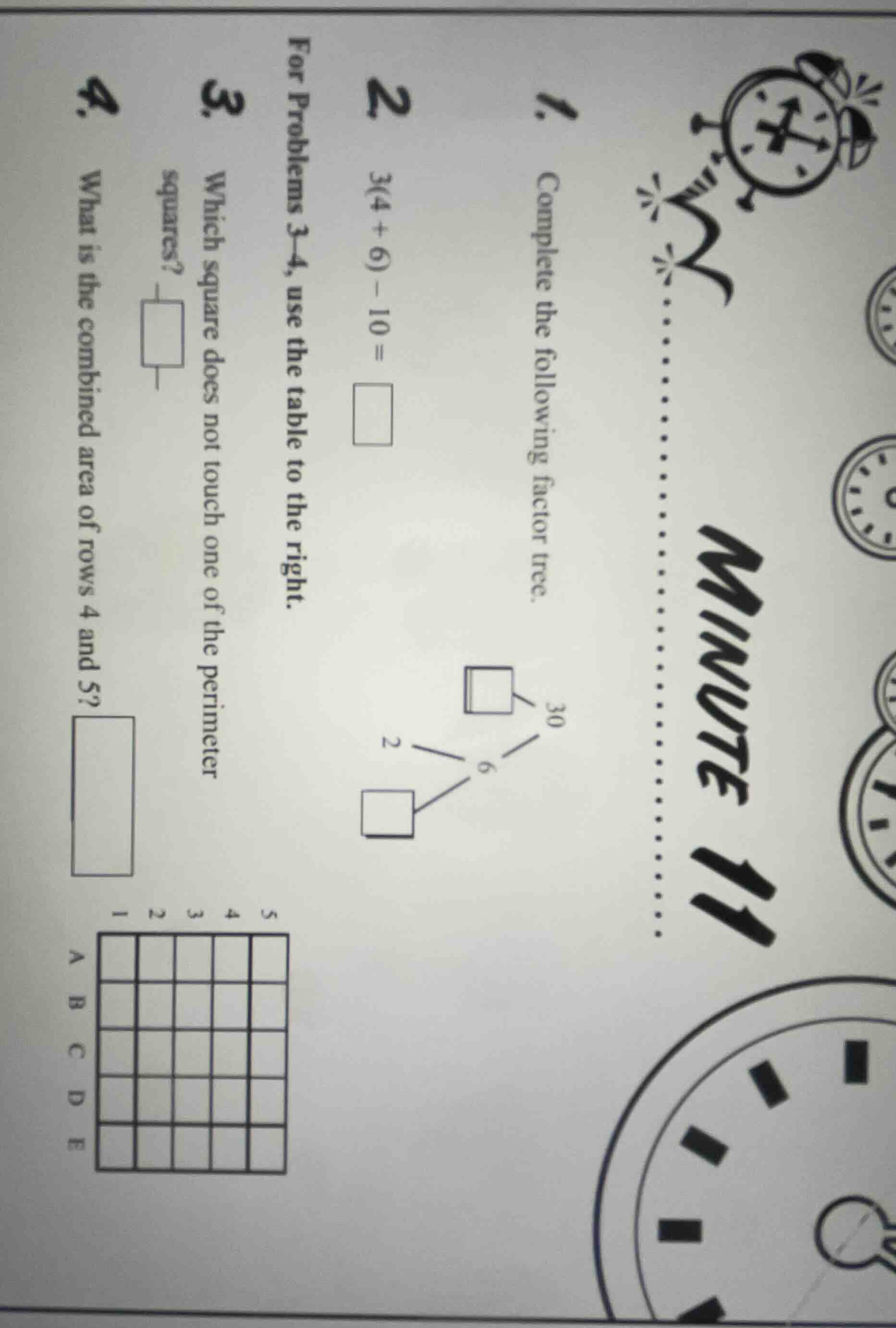
- complete the following factor tree.
30
/ \\
6 □
/ \\
2 □
- 3(4 + 6) - 10 = □
for problems 3–4, use the table to the right.
- which square does not touch one of the perimeter squares?
square box
- what is the combined area of rows 4 and 5?
rectangle box
grid table with rows a - e and columns 1 - 5
minute 11
Problem 2:
Step1: Calculate inside the parentheses
First, we solve the expression inside the parentheses: \(4 + 6 = 10\).
Step2: Multiply by 3
Then we multiply the result by 3: \(3\times10 = 30\).
Step3: Subtract 10
Finally, we subtract 10 from the product: \(30 - 10 = 20\).
To complete the factor tree, we know that in a factor tree, we break down numbers into their factors.
- For the top part, we need to find a factor of 30 such that when we divide 30 by that factor, we get 6. So we calculate \(30\div6 = 5\). So the top blank (next to 30 and 6) is 5.
- For the bottom part, we need to find a factor of 6 such that when we divide 6 by 2, we get that factor. So we calculate \(6\div2 = 3\). So the bottom blank (next to 6 and 2) is 3.
To find the combined area of rows 4 and 5, we first find the number of squares in each row. From the grid, we can see there are 5 columns (columns 1 - 5). So each row has 5 squares (assuming each square has area 1 unit²).
- Area of row 4: \(5\times1 = 5\) (since 5 squares, each area 1)
- Area of row 5: \(5\times1 = 5\)
- Combined area: \(5 + 5 = 10\)

Snap & solve any problem in the app
Get step-by-step solutions on Sovi AI
Photo-based solutions with guided steps
Explore more problems and detailed explanations
\(20\)